TheJournal.ie uses cookies. By continuing to browse this site you are agreeing to our use of cookies. Click here to find out more »
Dublin: 10 °C Saturday 18 May, 2013

Dublin water disruption: Tests show ‘improvement’ in supply

Authorities have released further information on the contamination of water in Clontarf.

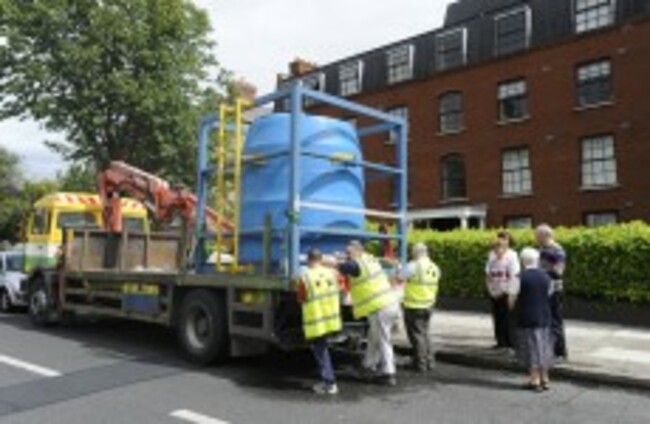
A tanker supplies water to residents in Clontarf earlier this week
Image: Sasko Lazarov/Photocall Ireland

THE QUALITY OF contaminated water supplies for around 1,400 homes in north Dublin “continues to improve”, according to the city council.

However, precautions remain in place for residents who are being advised to boil any water used for drinking or cooking.

Testing is continuing on water samples from the St Lawrence’s district meter area (DMA), which sparked alarm over the weekend when raised levels of coliform bacteria were found.

The council has reiterated that no e. coli – a bacterium which can cause serious gastrointestinal problems – has been detected in any sample tested.

Water mains are being disinfected by Dublin City Council teams until tests show bacteria in the water have returned to below regulation levels.

A council statement said:

In conjunction with the HSE, Dublin City Council confirms that the precautionary advice for people in the St Lawrence’s DMA remains in place i.e. to boil water for drinking or cookingwhile supplementary tests are undertaken and while the system is cleaned.

Water tankers are being used to supply clean drinking water to residents of the area. They were in place at the junction of Castle Avenue and Kincora Avenue, and the St Lawrence and Howth Roads, until 9pm last night and were due back at  6am this morning.

Read: Clontarf water disruption: DCC says water can be boiled for use>

Read next:

Comments (4 Comments)

  • Look at the costs of local government, pay for councillors and expenses. You’ll see how is being wasted, when it could be invested in new pipes. All we need is one Super Council, doing away with 753 councillors, reform the Seanad and elect the senators to do council business. The Seand could then be full-time and hold the newly reformed dail to account, while doing council business. Get rid of waste in Local Government!

    Reply
  • I think this is still worrying , people underestimate the long term affects of contaminated , and i have no doubt some of these underground water pipes are there way to long without proper checks done, hopefully this will change soon….

    Reply
  • Hmm….

    http://www.ehow.com/about_5081549_coliform-bacteria-symptoms.html

    “Coliform bacteria is a type of organism that inhabits the intestinal tract of animals and people. The bacteria is passed through fecal matter and can contaminate water supplies, if not treated properly.”

    Reply
  • This is what happens if we don’t pay for water, which would cover the cost of the management and the preservation of our water resources, its treatment (rendering of it safe for consumption, quality controlling and the depollution of used waters) and making it accessible to all.
    Paying for water would also provide the means for employment and communication, to inform the public on the quality of their water and to educating them on the related environmental issues.
    Most European consumers already pay for this service with Denmark and Germany top of the list for the high cost and Britain one of the lowest.
    Here in France we’re median at around 3.5€ per cubic meter, of which less than half is actually for the water itself, the rest being for the treatment of used waters & taxes.

    Reply

Add New Comment