Sign in. It’s quick, free and it’s up to you.
An account is an optional way to support the work we do. Find out more.
Sign in. It’s quick, free and it’s up to you.
An account is an optional way to support the work we do. Find out more.
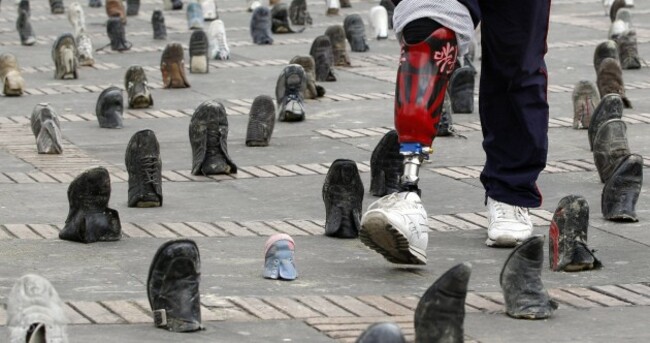
WHEN SHE WAS 15, an anti-personnel mine blast nearly killed Gloria Nancy Vasquez as she traveled in rural northwestern Colombia. Now she’s learning how to unearth the deadly explosives.
Vasquez, 23, has joined a team of local volunteers being trained by a British organisation to remove landmines from the heavily forested hillsides of El Retiro, in the coffee-producing department of Antioquia.
Leftist guerrilla groups, paramilitary fighters and government soldiers have battled in the area for decades, making Antioquia one of Colombia’s most heavily mined regions.
The mule that Vasquez was riding “stepped on the landmine, and the blast affected mainly the left side of my body,” she told AFP. “The mule died and they took me to the hospital, unconscious.”
Vasquez survived, but suffered multiple scars on her face. She received skin grafts to her left leg, her waist and left arm. “I nearly lost all vision from my left eye and the hearing from my left ear.”
“I don’t want what happened to me to happen to anyone else”
Vasquez now wants to help clear the mines. “At the beginning, I thought it was risky,” she said. “I like it a lot, because I’ve been through this and I don’t want what happened to me to happen to anyone else.”
Colombia has the world’s second highest number of landmine victims after Afghanistan, according to the International Campaign to Ban Landmines.
Over the years fighters from all sides planted landmines, which are hard to detect and can detonate decades after they were buried.
Between 1990 and December 2012 landmines killed more than 2,100 people in Colombia and wounded more than 8,000, according to government figures – and the highest number of victims by far are in Antioquia.
The Colombians being trained to clear mines “are basically farmers from the same hamlets where the mines are located. They are men and women that know their territory,” said Nathaly Ochoa with the British non-governmental group Halo Trust, which is training the farmers.
Each volunteer gets $325, room and board, transportation and medical and life insurance, said Ochoa, who hopes that by the end of 2013 some 200 Colombian farmers will have been trained to remove landmines.
“We’re all going to feel safer”
Halo Trust has been carrying out de-mining operations for the past 25 years in 15 countries, including places like Afghanistan, Angola, Laos and Somalia.
The training “allows us to make a contribution for the good of our families. We’re all going to feel safer,” said Jhoan Henao, 23, another volunteer mine remover.
In 2000, Colombia signed the Anti-Personnel Mine Ban Convention, also known as the Ottawa Treaty, aimed at eliminating all anti-personnel landmines. The treaty commits countries to destroy their landmines 10 years after ratifying the treaty, but Colombia had its deadline extended to 2021.
“It’s true that the government – the army – has their own capacity to remove mines,” said Grant Salisbury, the Colombia director of Halo Trust. “But the government realises that this does not suffice.”
Colombian soldiers stopped placing anti-personnel landmines when their country signed the treaty in 2000, and since 2005 an army battalion has been assigned the full-time duty of removing landmines.
But officials say most of the landmines are buried by the Revolutionary Armed Forces of Colombia (FARC), the country’s largest leftist rebel group.
Colombia and the FARC rebels are currently engaged in peace talks in Havana aimed at ending a conflict that began in 1964.

To embed this post, copy the code below on your site















have your say