TheJournal.ie uses cookies. By continuing to browse this site you are agreeing to our use of cookies. Click here to find out more »
Dublin: 16 °C Tuesday 21 May, 2013

EU leaders agree on bank supervision

They agreed at the EU summit to create a single supervisor for banks in countries that use the euro.

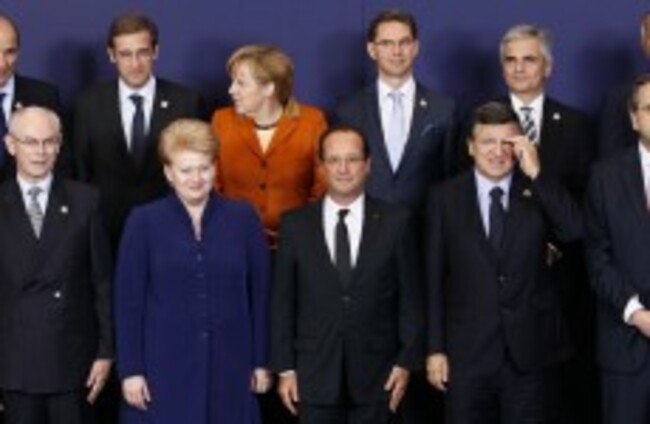
Image: Remy de la Mauviniere/AP/Press Association Images

EUROPEAN UNION LEADERS have agreed to create a single supervisor for banks in countries that use the euro — without saying when it would become fully operational.

The deal, reached at a summit of EU leaders in Brussels, represented a shaky compromise between the Germans and French, who had been tussling over how to shore up the eurozone’s stricken banking system — one of the main causes of Europe’s debt crisis.

Compromise

France has been pushing to get all 6,000 banks in the 17 euro countries under the supervision of one European body by the end of this year. Leaders agreed in June that, once a supervisor is in place, struggling financial institutions would be able to tap Europe’s emergency bailout fund, the European Stability Mechanism, directly.

At the moment, money to help out banks has to go through a country’s government — placing more strain on state finances. In Ireland’s case, the government’s attempts to rescue failing banks forced it into a bailout. Some fear Spain could face that fate, too.

But Germany’s Chancellor Angela Merkel, wary of using taxpayers’ money to prop up other countries’ banks, had tried to put the brakes on the plan, insisting that creating the supervisor should be done slowly and that “quality must come before speed.”

The compromise included something for both — all 6,000 banks will be included, as France had wanted. But there is no firm deadline for the single supervisor to be up and running — other than to say that the “objective” is to finish the legal framework by January 1, and that work on its operational implementation “will take place during the course of 2013.”

Despite the lack of a deadline, French President Francois Hollande declared victory and presented a much more ambitious timeline than his colleagues, claiming the supervisor could be up and running within weeks or months of January 1.

Hollande hailed the steps as pushing the eurozone toward a “banking union” that he said would protect “all countries touched by the virus of bank failures.”

The debate over the supervisor was especially intense because countries belong to the EU but don’t use the euro are nervous that the new system could make banks in the eurozone look so safe that investors will pour into them. They are also concerned that the eurozone countries will vote as a group on regulations that affect all EU members.

Challenges

However, many challenges remain. Unemployment in the region is at a record 10.5 percent and, growth is grinding to a halt around the continent. There are still concerns Greece might default on its loans — even after two bailouts — and be forced to leave the eurozone.

Leaders praised the progress it said Greece had made toward reforming its economy and balancing its budget, though, without a new report by international lenders, no decision could be taken on badly needed continued aid for country.

Greece’s bailout creditors — the EU, the International Monetary Fund and the European Central Bank — have been engaged in tough negotiations in recent weeks over more budget cuts.

In addition, the question of whether Spain will ask for a bailout itself looms. The government in Madrid said this week that it would decide in the coming weeks — although it is still hoping it can avoid asking for any kind of aid.

Read: Slideshow: The EU summit in Brussels>

Read: EU summit: Merkel backs EU budget control>

Read next:

Comments (39 Comments)

  • Was that the sound of a can being kicked further down the road?

    So much for strong decisive leadership. Bad news for Ireland with very little if any progress made on the question of Irish debt.

    Reply
  • This is quite dangerous. Bringing us closer to a federal state and more EU control

    Reply
    • And why is that dangerous Stephen? There’s no one currently in Irish politics capable of running the place. Maybe being governed by Brussels or Berlin is a far better option! Unless you’re part of the crowd that are largely untouched by the corruption that has the country where it is.

      Reply
    • I would prefer EU supervision of the banks, then a politically appointed yes man in Ireland!

      Reply
    • Its dangerous because we will be forced to adhere to similar rules as other european banks , between Ireland and the UK we love property ownership, If ‘rent for life’ europe is controlling the banks you can bet youll see severe restrictions on mortgages , with our VRT rate and also needing rhd models cars are quite expensive to buy new here, a car loan might become a far harder thing to get as to some eu countries 40 grand would seem like a ridiculous amount of money to spend on a family car when in reality thats not that much for here at all

      Reply
    • @ Stephen – yes, it could be dangerous. But given that a lack of regulation in banking systems and a willingness to lend freely is one of major reasons for this economic mess we’re in, stronger regulation is the less of two evils, in my opinion. It’s not a case of “If it’s not broke, don’t fix it.”

      Reply
    • In the longer term such a “rent for life” or long term rental approach may be a better option for many people. I know it would have been a better option for me. I resisted buying a place for years but finally succumbed to the national obsession with property ownership. Now I’m stuck in a place that I don’t want to be in and with no way out. If I could convert into something like that now which would give me a way out at some point I’d take it. If this current crisis weans the Irish peple off their obsession with property owning then something good may come out of this current mess. It may prevent future property bubble like the one we had.

      As for VRT and the cost of cars that has nothing to do with the EU but the ridiculous rates of duty that are placed on cars. And I have to say that €40 for a car sounds like a ridiculous amount of money to me as well.

      Reply
    • Jim Walsh

      The Greeks’ financial & political elites were to blame just as much as ours were here. If the Eurozone authorities didn’t know, or didn’t flag, that Greek authorities were hiding public debt off the books (with banks’ conivance), how were ordinary citizens to know?

      Just as very few gained in Ireland from the property bubble/casino – most people merely had to pay extortionate prices (in buying or renting) for a home – very few gained much. In both Greece & Ireland, only the top few percent ‘partied’.

      Yet, in both Ireland & Greece, who is being punished? Not the elites, they are still increasing their wealth.

      What’s more, the policies of these elites, in protecting themselves & financial elites, are creating even more hardship for ordinary citizens unneccesarily by causing mass unemployment to grow and/or persist.

      The economics of a nation or the Eurozone is profoundly +not+ like a household budget as most people in their ignorance believe. Macro economics is +not+ micro economics. A fiat monetary system is +not+ a household.

      There is no shortage of money, entirely debt-free, with which to relieve the private & houshold debt mountain holding back growth. The ECB can create money out of thin air to stimulate growth & relieve debt 9& on a fair, per capita basis) – just as it created €1,000 billion to ‘lend’ to banks earlier this year/end of 2011. (I say ‘lend’ because you can be sure this money, at a fifth of the interest cost Ireland is paying, will be simply rolled over as long as banks’ want.)

      There is no risk of inflation with such a policy in a deep recession (depression in Greece & Spain) & it can readily be dealt with as & when it arises when recovery & employment have been restored.

      The only reasons not to do this is the ignorance, ideology & callous self interest of the same ‘authorities’ that created the mess in the first place.

      Reply
    • It is dangerous because the EU has shown itself to consistently put German and French needs above all others, if that means violating treaties or agreements then so be it.

      Reply
    • Sorry Mike but I don’t agree with some of your points.

      Once more you resort to the “only the elite prospered” argument and the idea that nobody did well during the boom years. Most people did well enough during the period 1997-2007 and its foolish to pretend otherwise. I don’t subscribe to the “we all partied” line either but this idea that somehow during all this era most people were just barely scraping by is not reality. Yes property prices became crazy (and I’m a victim of that myself) but I saw most of my friends and family who were in well paid jobs having an exceedingly good lifestyle and I know I had a very comfortable life as well while I was employed.

      The problem was that at the end of that period we were fuelling our prosperity on an unsustainable model and when it crashed it crashed big time. I’m not saying there wasn’t cupability on the banks and the governments side but casting this argument in some sort of class warfare mode doesn’t reflect reality and the problem is that if we convince ourselves that we had no part to play in the problem, then we will inevitably end up in the exact same problem again because we will learn nothing from it.

      On the economic side I know that you can’t do a strict comparison between micro and macro ecomonics but there are similarities between the systems and the fact is that you can’t finance a monetary system on continuous debt. Also I think saying there is no risk of inflation if the ECB just printed their way out of the problem is completely untrue. Even in the midst of this recession/depression we are still looking at a positive inflation rate. While a certain injection of capital would be helpful, flooding the economy of Europe with vast amounts of money is not going to be a long term solution. All we’d end up doing is creating another set of problems in place of the ones we have.

      The idea that there is some hidden elite at the very top creating this problem for their own personal gain is just a little too close to a conspiracy theory for me. However I do think the ECB could operate a more European level and consider what is best for Europe as a whole as opposed to individual economies such as Germany.

      Reply
    • Jim Walsh

      You are missing the point when you imply that their was significant personal responsibility on the part of the majority just because many, including yourself & friends ‘prospered’ during the boom. Yes, many did +appear+ to prosper but whilst it was mainly debt fuelled, that debt was not by any many means spread evenly within the economy. When people with existing property sold at high prices, income & equity release from that expanded spending much more broadly in the economy. Consumer debt of many individuals did increase, but by far the biggest aggregate was from debt originally taken on to buy property as it rippled thru’ from the cash received by sellers. And even when people traded up with a mortgage, they often took the opportunity to release equity to spend.

      But the bigger point here is that individuals do not have either the time or ability to make a thorough going assessment of the macro economics prospects for the country & wider global economy, going forward, before making financial decisions. Recall, the financial crisis was effectively global in nature & on a massive scale, making all countries’ prospects of weathering the shock much worse. Most individuals were not speculators. A home is not a discretionary purchase – we all need somewhere to live. The decision then, amidst a barrage of supposedly professional advice & media output, that buying was a better deal than renting.

      Contrast, then, how we could reasonably expect individuals to behave versus the economy wide decisions of the various economics professionals who, effectively, we all collectively paid (& still do) very substantial salaries to give decisions or opinions on the resonsible management of the economy & banking systems?

      Tell me Jim, do you expect the manufacturer you paid for your car to have done the neccesary engineering calculations for the safety of its braking system, or do you think we should all be doing that ourselves before we buy? This is the real issue.

      Jim, you say:

      “On the economic side I know that you can’t do a strict comparison between micro and macro ecomonics but there are similarities between the systems and the fact is that you can’t finance a monetary system on continuous debt.”

      Unfortunately, you don’t know much.

      Actually, every last cent of the Euro currency was initially introduced into circulation as debt. In ‘fact’, new debt is always required in order to service the interest on existing debt & finance economic growth. (There isn’t a great problem with this providing it is managed properly – credit is an essential need in the production of goods & services to the real economy.)

      Where did you think ‘money’ comes from?

      But did you really mean the economy as a whole or perhaps some sector of it like the government? (Not getting past your ‘household’ thinking?)

      If so, let me offer you a particularly insightful way of looking at things. The accounting identity that is called Sectoral Balances – ie this isn’t ‘opinion’, just the maths of the situation.

      We can divide up the economy into as many sectors as we like, & so long as we don’t leave any out, the flow of money between them, for a set period must always balance out.

      Let’s divide into three sectors. The government (GOV), private (households & businesses) domestic sector (PD) & the external private sector (EP).

      If, say, the PD sector (which means us) either desires, or must, increase its Net Financial Assets (mainly, money, in bank accounts or cash) – that is, either accumulate savings AND/OR reduce debt – then those financial assets +must+ come from one or more of the other sectors. No other way – accounting identity.

      Which means that either the external sector (EP) must net spend more (either we buy less imports, or they buy more exports) OR the GOV sector must spend more, or some combination.

      BUT, if the GOV spends less in this scenario (which is where we are now), then only increasing net exports can maintain our (PD) ability to spend into our own economy (ie GNP). (Remember spending +IS+ GNP/GDP)

      BUT, all countries (amongst our trading partners) cannot increase net exports at the same time – the (macro) ‘fallacy of composition’ (just maths – not ‘opinion’ – JM Keynes et al).

      So what happens? Domestic spending declines, which lowers output, which loses jobs & income, or our young people thru’ emigration. And the whole mess gets worse. Sound familiar?

      So what to do? Well, the Sectoral Balances (accounting, not ‘opinion’, recall) tells us that more money (to spend and/or pay down debt, so we can resume spending) has to come from somewhere, from one of the other two sectors.

      The mainstream ideologues say it must only be debt money – but which of the sectors is able to take it on? None – pretty much everyone agrees that. Both the non-government & government sectors are beyond the level of their ability to sustainably service any more debt. And, remember, one thing that makes debt even less sustainable is to have fewer jobs to provide income! But every policy over the last few years has been one which reduces jobs & income (for the majority – not the top few, of course, who do more hoarding than spending, relatively).

      The smart people of MMT economics know the solution. (Smart because they know the solution +and+ predicted the the global crisis & Euro mess, years in advance). We have ‘fiat’ currency which can be created without debt. Time to do so. (It’s not ‘printing’ Jim – all done on computers now. There are important differences.)

      About inflation. When new money is introduced, as debt or debt-free, makes no difference whatever to its intial inflation potential (where such exists). New money in circulation is new money. The difference with debt is that it automatically reduces inflation risk IN THE FUTURE, when it is paid back – but note, we’re talking years when we say FUTURE here.

      But debt-free money can just as easily ‘extinguished’ IN THE FUTURE as debt money, as required, by taxation.

      Hence, with appropriate monetary/fiscal management, inflation is not an issue of concern.

      In the short term because we are in deep recession – with massive idle resources available to meet increased demand without bidding up prices. Nor is it in the long term, because ample & easy measures are available to reduce money in circulation, as & when needed.

      How do I know all this?

      Because I’ve studied beyond the mainstream clowns in economics, media & politics who between them created this mess & are still here making things worse. For 99% of these people there’s no ‘conspiracy’, just shared ignorance, arrogance & the myopia that comes from boom or bust not making much difference to their personal well remunerated positions.

      Reply
    • for Jim & others who want to find out how our monetary system works & the real macro economic options that follow, here is a superb video lecture (intended for a lay audience) given at Columbia University, US, by Professor Stephanie Kelton & Warren Mosler.

      It describes the US$ system, but the Euro is the same, Federal Reserve = ECB etc, with the exceptions that Euro countries are analagous with US states, not their Federal Government, & other Federal institutions are missing from the Euro system – ie elements of ‘fiscal union’ now being (excruciatingly) slowly recognised that the Euro lacks in order to function properly (& indeed not collapse ultimately).

      Modern Money – Governments are Not Households

      http://www.youtube.com/watch?v=ba8XdDqZ-Jg&feature=player_embedded#!

      This video lecture tells me & you, ordinary citizens what you need to know to understand why the Euro is failing & the depression continues.

      Reply
  • So much for the free market economy.

    Reply
    • But the EEC/EU was never really about being a truly free market, more a regulated market. There’s always been a subsidies/quotas approach since the beginning.

      Reply
    • It has always been about unifying Europe to be a rival to the US.

      Reply
    • Very true. But it wasn’t intended to copy all the values and structures of the USA. A competitor, but not necessarily a clone. I just meant that regulated banking isn’t a huge U-turn or out of character for the EU. It was never a “let the best man win” economy.

      Reply
    • Damocles 19/10/12 #

      Quite, the French see the US as beer swilling rednecks who through some accident of history somehow got their hands on the most powerful weapons in the world and, from that, became its leader.

      They aren’t even a full member of NATO any more after their withdrawal in 1966 because they think NATO perpetuates US influence over Europe (which it probably does). Hence the existence of the ESA and the European Defence Charter and indeed the rush to further integrate Europe. The last 10 or 20 years of French international policy has been about actively trying to erode theat US influence, they see the destruction of US hegemony over the Western world as a key factor of their foreign policy.

      Reply
    • The US hasn’t been much of an example of a free market economy post Lehman Brothers.

      Once the US saw the damage that was caused by allowing it to collapse they moved quickly to ensure that a similar thing wouldn’t happen again. That was when the TARP (Troubled Assets Relief Programme) was brought in and the bailouts of Fannie Mae, Freddie Mac, AIG and the US car industry happened.

      Reply
  • How can these people be proud of anything they’ve done when their policies have cost lives and rendered countless people poverty stricken across Europe? How can taking money, regardless of how the try to justify, out of the economy be something to be proud of when people in Greece are scavaging for food in dumpsters and 10% of Irish people are living in a food poverty?
    If this were happening in post war Europe circa 1950 one might understand and accept the situation. But this is 2012! If this is what the Union of European States has wrought on us, the maybe the whole Project should be discarded.

    Reply
    • Yvonne, the people of Greece brought it on themselves. Europe just tried to fix the Greek problem by throwing heaps of money at it, look where that got us.

      Reply
    • One of these days maybe you’ll show us how the Greek people brought this on themselves? They all partied, all went a bit mad like us did they?

      Reply
    • Damocles 19/10/12 #

      Rommel, they did sit back and let it happen when they were admitted to the eurozone while not being qualified to do so.

      Reply
    • And why were they admitted if they weren’t qualified?

      Reply
    • Damocles 19/10/12 #

      Paul, people lied and other people looked the other way.

      Reply
    • It’s well known that Greece (with the aid of some banks) cooked their books to gain entry to the Euro. Greece also spent vast amounts of money on vanity projects (2004 Olympics!). Its also well documented that there is a culture of tax evasion in Greece which doesn’t help their national finances. I’m not saying that its all their own fault but they have a certain amount of blame to take.

      This is part of the problem with all of these issues. People aren’t willing to admit that they may have been some way at fault. I don’t agree with the “we all partied” line but lots of people spent more than they could afford and got used to living on credit. It takes two to tango and as much as the banks supplied easy money, lots of us were more than happy to take that money and not worry about how we would pay it back.

      If we don’t look at ourselves and realise that we were at fault in some way, we’ll learn no lessons from this debacle and we’ll end up doing it all over again. There is no such thing as a free lunch and the sooner we learn that the better we will be.

      Reply
    • Only 3 countries met the initial euro criteria – Britain, Denmark and Luxembourg – and two of those weren’t going to join anyway. So the criteria were changed to something everyone could meet. Greece still had to file invented accounts to get in, and everyone knew this.

      The project was doomed from the start, and blaming the Greeks (or the Irish, Portuguese …) kind of misses the point.

      Reply
  • If anyone out there thinks Ireland has people currently involved in politics who might be capable of getting us out of this mess, I’d like to hear from them! We haven’t got a hope with this lot.,Lets be brutally honest. The Irish political system is designed so as to protect the politicians and the rich and powerful that helped said politicians get elected in the first place. We have an elected TD admit on national radio that he stole 1.4 million Euro from the Irish taxpayer, and that TD is still being paid by the taxpayer for being an elected TD. Only in this corrupt little backwater could this downright criminality by politicians against its people be tolerated. We aren’t capable of self governance, because the whole political system has been infested by corrupt criminals. The only way this can be fixed is by giving away our sovereignty for the next 20 years or so. A deep clean is required to completely sterilise Dáil Éireann!

    Reply
    • The only problem with that Rodrigo is how do you know you’re going to get anything better with new people.

      We all talk about wanting decent politicians but the reality is we get the politicians we deserve. The next election will be no different or the one after that. The parties and politicians that promise us the most will be the ones that get elected because we will elect them even though we know they are probably lying to us. Then afterwards we’ll complain like hell when they can’t or won’t deliver on those promises. But we are complicit in this arrangement and we always have been.

      The “parish pump” is still alive and well in Irish politics and until we (the people) finally realise that this is not acceptable, we will just end up with a different set of politicians that we don’t like. Ultimately we have to change first and then the politicians will change with us.

      Reply
  • toorkeel 19/10/12 #

    Is that the female member of Roxette onthe left?

    Reply
    • Toorkeel WHY dont you use your name? What are you scared of? Are you scared of taking ownership of your own opinions?
      You shouldn’t be. We are ALL entitled to have and express opinions. And ALL opinions are valid for and to somebody. Yvonne

      Reply
  • This development is very worrying for us E.U citizen’s, you can’t have the bully boys having everything their own way, terrible way going forward

    Reply
  • I propose Brian Cowan as the supervisor.

    Reply
  • I say dump the Greeks,at least us Irish are trying to get back on our feet.As a nation,we are doing everything we can,even though it is tearing families and households asunder.We give out,protest and slate our government,but most of us are doing our bit,which is”something”to be proud of.Meanwhile,in Greece all they do is tear their cities apart………howling because they have to do a little bit extra for a little bit less.I think they shouldn’t be a part of the EU,too damn lazy to do their bit.

    Reply
  • Oh yay.

    Lets pour more and more into the banks until the citizens of Ireland are left with nothing and weare back in the times of the famine.

    It w neither the troika nor the ECB that said we should pay the debts of the banks, this was signed by our government due to their own vested interests.

    http://www.change.org/petitions/supporting-the-irish-nation-step-down-from-government

    Reply
  • I hate working longer for less pay,and to pay a higher mortgage for a house that is worth not even half what I paid.Its more expensive to keep warm all of a sudden,just when the weather starts to get colder.I have no faith in our government whatsoever,in fact I would say that I actually Hate them.But I do respect my country enough not to break everything in sight because of our governments mistakes,fraud,theft and inadequacies.We are responsible enough people in general,but when it comes to electing our government,we are found to be wanting.Haughhey,Ahern,Cowen?I was a child when the first came to power,didn’t like or trust him,Bbbbbbertie,who could trust that traitor or his pig of a friend Cowen.I hope Enda has our livelihood foremost in his mind.And yes,F..k Greece,they lied about democracy,it is a failed model for civilisation,a lie.It only works for criminals and rich people.

    Reply

Add New Comment