Sign in. It’s quick, free and it’s up to you.
An account is an optional way to support the work we do. Find out more.
Sign in. It’s quick, free and it’s up to you.
An account is an optional way to support the work we do. Find out more.
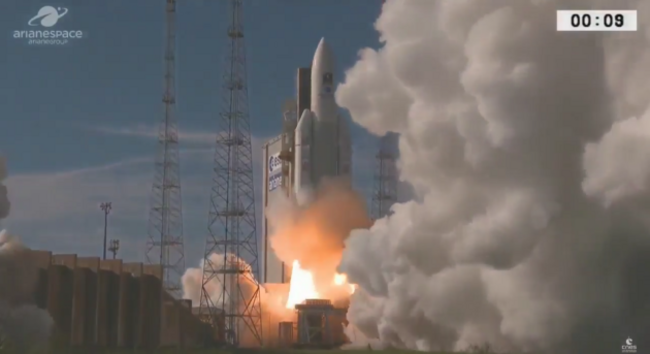
THE EU HAS successfully launched four more satellites into outer space, improving systems that help locate missing people and security services.
With 26 satellites in total, the extra satellites will help the EU’s global satellite navigation system to provide a more precise signal across a range of services.
Galileo provides positioning and timing services to around 400 million users since December 2016. With a then record precision of 20cm, Galileo will be the most precise satellite navigation system in the world.
Galileo currently provides three types of satellite navigation based services:
Vice-President of the Commission Maroš Šefčovič said: “Another milestone towards full operational capability of Galileo in 2020! Space is becoming a new economic frontier, as it is vitally linked to a growing number of sectors and driving their profound modernisation.
Elżbieta Bieńkowska, Commissioner for the Internal Market, Industry, Entrepreneurship and SMEs said that Europe has become “a true space power”.
Today we can say – we made it. But work and investment will go on under the new EU Space Programme.
Today’s launch, from the European spaceport in French Guiana, brings the constellation close to completion in 2020, which is when Galileo will reach full operational capability. By then there will be 30 satellites in the EU ‘constellation’.
Brexit
Galileo is a civilian system aims to ensure Europe’s independence from other satellite navigation systems and its strategic autonomy in satellite navigation.
It’s hoped that it will help the improve the job market, help the EU step up its security, and support technologies such as Artificial Intelligence, drones, and the Internet of the Things.
Other EU space activities include Copernicus (free and open Earth observation data of land, atmosphere, sea, climate change and for emergency management and security), EGNOS (regional satellite navigation system) and space surveillance and tracking.
In the contexts of Brexit, Britain wants continued participation in the EU’s Galileo satellite navigation system – but Brussels has rejected the idea.
Graham Turnock, head of the UK Space Agency, told AFP that Britain’s departure from the European Union in 2019 would hurt the industry.
Obviously we are talking to the EU about our future participation in the space programmes.
“We have said that we’d very much like to continue to participate in Galileo Copernicus, but it takes two sides to want to have that discussion.”
- with reporting from AFP

To embed this post, copy the code below on your site












have your say