TheJournal.ie uses cookies. By continuing to browse this site you are agreeing to our use of cookies. Click here to find out more »
Dublin: 11 °C Thursday 20 June, 2013

General strike taking place in Spain over labour reforms

Airlines are warning passengers who are due to fly to or from Spain, the Balearic Islands and the Canaries today to expect disruptions as demonstrations over austerity measures fill the streets.

Image: AP Photo/Pedro Acosta

SPANISH WORKERS ANGRY over labour market reforms formed boisterous picket lines outside wholesale markets, some TV stations went off the air and car factories were all but idled in the early stage of a general strike today.

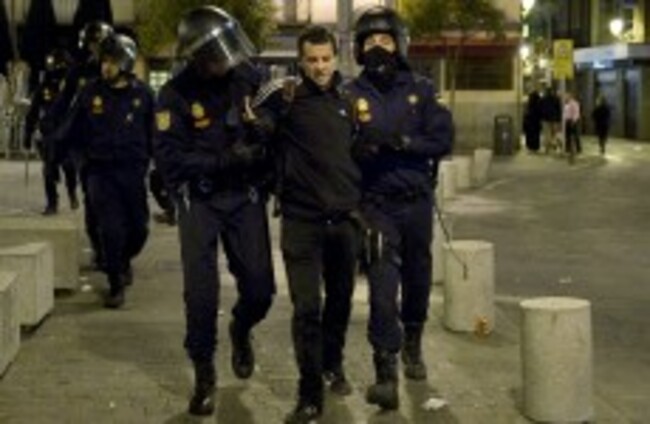
A total of 58 people were detained and nine were injured in scuffles as the strike got under way a minute after midnight, the Interior Ministry said.

Unions are challenging a conservative government not yet 100 days old, protesting changes to labour market rules long regarded as among Europe’s most rigid that include making it cheaper and easier for companies to lay people off and cutting wages.

Flight disruptions

Both Ryanair and Aer Lingus are warning passengers who are due to fly to or from Spain, the Balearic Islands or the Canaries today to expect disruptions.

Ryanair have cancelled a number of flights (see here) but says that anyone booked to travel on the cancelled flights can transfer free of charge to the next available Ryanair flight or apply for a refund.

Aer Lingus is advising its customers to monitor its website for information about travel disruptions and about their flight status.

British Airways has also confirmed that it expects delays and advises people to check the status of their flight before leaving for the airport.

Labour reforms

The demonstrations come just a day before the government will serve up even more austerity pain with a budget to feature tens of billions of euros in deficit-reduction measures.

Around Spain, unions are trying to bring the country to a crawl by guaranteeing only around 30 per cent of normal public transport service at rush hour times.

The union UGT said virtually all workers at Renault, SEAT, Volkswagen and Ford car factories around Spain, and at other industrial, mining and port facilities, honored the strike during the overnight shift. UGT said that overall participation in the strike so far was “massive.”

Picketers tried to block wholesale markets in Madrid and other cities and commuter train service were disrupted in Barcelona, but otherwise the situation was fairly normal in the early hours of the strike, Cristina Diaz, a spokeswoman for the interior ministry said.

Reports of injuries

Outside Atocha, one of Madrid’s main commuter and long-distance rail stations, picketers waved red union flags and blew shrill whistles as police looked on. Some picketers tried to convince a coffee shop owner to join them, and slapped a pro-strike sticker on his glass window.

Diaz said a Molotov cocktail was thrown at a police car in the eastern city of Murcia. Of six people injured, one was a police officer and five were civilians. She did not specify where or how these people were hurt.

Spanish National TV showed footage of police in Barcelona on horseback accompanying buses trying to leave a parking garage, and scuffling with a picketer. Regional TV stations in Andalusia in the south, Catalonia in the northeast and Madrid were off the air because of the strike.

The government’s cuts are designed to help Spain in its struggles to satisfy both the European Union and the international investors who determine the country’s borrowing costs in the international debt markets— and therefore have a lot of say in whether Spainwill follow Greece, Ireland and Portugal in needing a bailout.

On top of a round of spending cuts and tax hikes, and reform of the bank sector, last month Spanish Prime Minister Mariano Rajoy’s newly elected government passed a decree on worker’s rights. The piece of legislation, among other things, makes it easier to lay off workers, trim wages and modify other working conditions by citing concerns over, for example, productivity.

Joblessness at 50 per cent among young people

The idea behind the decree is to make Spain more competitive once the rest of Europe recovers and employers are less wary of hiring. The jobless rate here is now nearly 23 per cent, a eurozone high, and nearly 50 per cent among young people.

The country’s two main unions were hoping for enthusiastic turnout Thursday, more than during a general strike in 2010 when a Socialist government enacted its own, less aggressive labour market reforms.

“The people will say whether they are resigned to accepting the reforms,” said Ignacio Fernandez Toxo, head of one of Spain’s main unions, known as CCOO.

The government says it will not falter in its austerity drive, calling the reforms essential to creating jobs and reviving an economy that is expected to contract 1.7 percent this year.

Strikers are docked pay

“The question here is not whether the strike is honoured by many or few, but rather whether we get out of the crisis,” Finance Minister Cristobal Montoro said. “That is what is at stake, and the government is not going to yield.”

Unions face two problems, according to Jose Ramon Pin, a professor of management at IESE Business School. First, people who strike get docked a day’s pay, which few can afford in these hard times. Also, Spaniards appear resigned to the fact that the country needs painful reforms to help the economy recover from the collapse of a property bubble in 2008.

The government, which came to power in December after the Popular Party scored a landslide win over the Socialists, has a mandate to save the country from financial ruin, Pin said.

That means it is unlikely to worry much about its popularity rating.

“There are two elements: Spanish voters and international investors and right now the government is governing for the investors,” he said.

Additional reporting by Jennifer Wade

Flight disruption amid Spain’s anti-austerity protests>

  • Share on Facebook
  • Email this article
  •  

Read next:

Comments (16 Comments)

  • i am living here six years and i was at the pickets.today and the protests (even got stopped and searched by the police) here the new reforms are basically they have turned over all the bargainig power to employers there are no labour laws like in ireland every sector here has “convenios” which regulate working conditions so basically they can cut your wages tomorrow and if you dont like it dont let the door hit you on the way out then they can hire somebody off the dole and receive 3000 euros upfront then fire you after a.year and not pay a penny in redundency and the joe soap out on the street with no dole because he was topping up his wages with his dole and.its run out (here you can only dole for up 2 years) and the others who are now obliged to do community service.to get paid the.dole (while they get rid of council workers) so research a bit more before yoh comment and yes ive seen spanish and foreigners rummaging in bins for scrap and food even pensioners

    Reply
  • with regards to health and education they are getting rid of doctors and nurses and increasing.waiting lists so they can privatise the whole health system and education systems (one funny fact is every politician from city councils.to ministers.have official cars and in the local goverment of madrid.every member of the pp have 2 official cars the even caught the minister of the enviroment going to the hairdressers with two cars this from a.woman who denies that global warming exists and anybody who believes it is a terrorist) rant over

    Reply
  • People need unions in Spain, Imagine working for 700 or 800 a month and working up to 60+ Hours a week.

    Even the average Doctor gets less than our standard industrial wage, people are treated like dirt there by employers and scare mongered.

    The Social welfare system there is crap and you see everyday in Madrid for example people searching bins for food and anything that will help.

    Spain might have nice weather but the average person on the street has very little income and are just above the water barely.

    We have major problems here but there it is worse.

    They would be better coming out of the Euro aswell as it is a failed joke.

    Reply
    • Neil 29/03/12 #

      Replacing the euro with a devalued currency would make spanish labour cheaper. There would be less unemployment only because Spanish workers would earn even less. Employers love cheap labour.

      Reply
    • Neil 29/03/12 #

      And you´re talking rubbish when you try to paint Spain as some kind of third world country with people eating out of bins. They have a health system Ireland should envy, with health care centres in every large barrio. But its only because they dont have consultants on the extravagant wages we pay that they can afford to do that.

      Reply
    • My Girlfriend lives there and their health system is not as perfect as you mention, it is better than ours but still not great, plenty of waiting lists.

      And yes Spain is getting like a Third World Country because poverty and unemployment and hunger is widespread.

      Go and live there for a while and you will soon realise that the country is in bits and basically workers have zero rights and employers do what they want.

      I saw children in a part of madrid last week going through bins for food and anything they could fix or sell, explain to me how does that occur in a “First World” Country.

      Reply
    • Neil 29/03/12 #

      I´m in SPain right now. People are not paid as well as in Ireland. But that´s why they can employ more people to provide health services than Ireland can. That´s also why some tech companies in Irelnd are thinking of moving operations there. To say than SPanish people are living out of bins is a disgrace. The only people who might suffer that are the illegal immigrants which they don´t take kindly to.
      You can complain about the lower pay in SPain, but you cannot at the same time demand they leave the euro. Becuase guess what, that will mean Spanish people will be even cheaper labour! Thats the whole “advantage” of leaving the euro. You devalue the currency so you can pay people less overnight.

      Reply
    • Neil 29/03/12 #

      Robbie, leaving the euro means a devalued currency and lower paid workers. Cheaper labour. That´s why it´s a right wing idea. So that´s where you´re standing. With the Ganleyites and the UKIP types. You´re much more of a facist than I am.

      Reply
    • Robbie is spot on. I live there now and have lived there in the past. I was shocked to see the number of people searching in bins (of course this is not an extremely common sight but you do see it a fair bit). They work longer hours and for really low salaries. All that said life is quite cheap here so if you are one of the lucky ones you can live well. The health system is better (the primary reason being that it is free) but not by a huge amount as there are still several hours to wait in A&E and there is quite a bit of redundancy in the system. I had a three months wait to see a dermatologist. About rights for the workers – well just ask a non-national or even some Spanish and the common answer will be “what rights”?

      The conditions for funcionarios (civil servant) just changed today meaning that they have to work more hours for less pay. Their jobs are no longer secure – one of the autonomous regions of Spain couldn’t pay their public sector workers recently. There are protests quite often, quite a bit of civil unrest and civil disobedience. They didn’t report about the McDonalds and Starbucks getting burnt down or about the lady who got stabbed by a restaurant owner today among plenty of other incidents.

      It seems to be you Neil who is talking Rubbish!

      Reply
  • and to the 1st commenter last year in spain over six million workers voted in union elections to choose their union reps (here all businesses with more than 50 employees are obliged to have union representstion if they choose so keep quiet)

    Reply
  • The introduction of the euro and the straight jacket it imposed upon those within this block has been a root cause of the problems faced by many nations within this zone,although other elements contributed to the madness that now prevails,I would single out the euro for harsh treatment,and a weak and slavish political elite who placed an unworkable currency at our disposal. The people of Spain and indeed others must endure grave economic hardship to allay the failings of their politically impoverished leadership. A tragedy for the average person, whom always bears the brunt of such folly.

    Reply
  • Who do these spaniards think they are? Standing up for themselves and all that craic

    Reply
  • They just had an election and as usual unelected unions think they can run the show. I tell ya, it won’t be pretty if Spain needs a bailout. Measures like this do not help at all!

    Reply
    • Neil 29/03/12 #

      The unions in Spain can´t blame it all on the “bankers” as they have not had quite the mess we have had. And they can´t blame the trioika as they are not in a bailout (yet). Instead they are having to straight out demand higher levels of borrowing and bigger budget deficits. Borrowing from who though?

      Reply
    • Jimmy 29/03/12 #

      yeah how dare those pesky wage slaves stand up to their exploiters

      Reply

Add New Comment