Sign in. It’s quick, free and it’s up to you.
An account is an optional way to support the work we do. Find out more.
Sign in. It’s quick, free and it’s up to you.
An account is an optional way to support the work we do. Find out more.
IRISH PEOPLE ARE required to pay pension contributions for longer than any other country in order to get the basic State pension.
A report from the OECD this week placed Ireland at the top of the league table. Full entitlement to the State pension here requires an average of 48 weeks contributions or credits per year throughout a person’s working life, with a minimum of ten weeks’ contribution per year.
This means full benefit comes after 43 years of contributions.
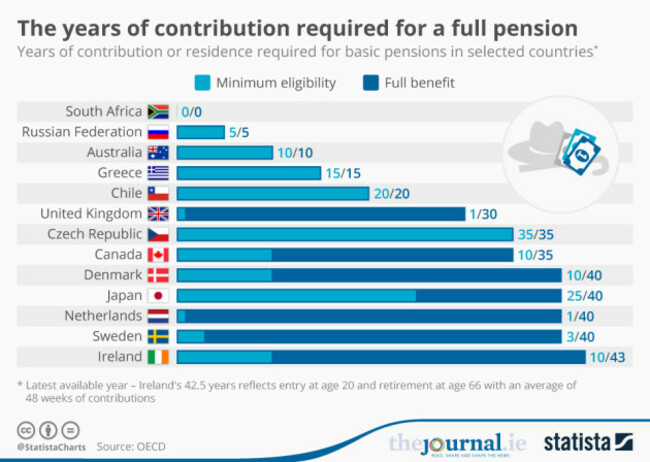
Luxembourg is not far behind, at 40 years, while 30 years are needed in both the UK and the Czech Republic.
Most countries also require a minimum number of years of contributions in order to receive any payment, ranging from one year in the UK and increasing to ten in Luxembourg and here in Ireland.
We also have a means-tested pension to provide a safety net for low-income elderly.
Across the OECD, some 12.6% of people aged 65 and over are living in relative income poverty. This is defined as an income that is below half the national median household income.
Pensioner poverty is most prevalent in South Korea, where just under 50% of retirees are living in poverty. Australia and the United States also have high levels of poverty among pensioners – 35.5% and 21.5% respectively.
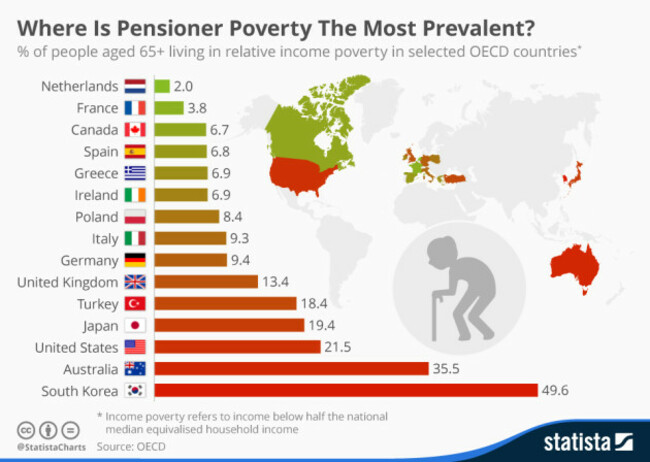
The Netherlands is at the opposite end of the scale with only 2% of its retirees struggling financially. In Ireland, 6.9% of pensioners are living in income poverty.
The report this week warned that 67 is becoming the new 65 in many countries, including Ireland. However it noted some reforms in the Irish system including protections for pensioners with defined benefit plans and the planned introduction of a mandatory occupational scheme.

To embed this post, copy the code below on your site















have your say