Sign in. It’s quick, free and it’s up to you.
An account is an optional way to support the work we do. Find out more.
Sign in. It’s quick, free and it’s up to you.
An account is an optional way to support the work we do. Find out more.
Updated at 7.40pm
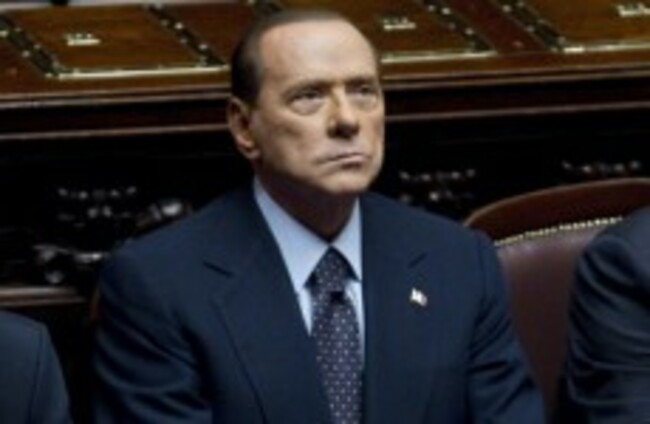
ITALIAN PREMIER Silvio Berlusconi prepared to resign today after parliament’s lower chamber passed European-demanded reforms, ending a 17-year political era and setting in motion a transition aimed at bringing Italy back from the brink of economic crisis.
A chorus of Handel’s “Alleluia,” performed by a few dozen singers and classical musicians, rang out in front of the president’s palace as Italians rejoiced at the imminent end of Berlusconi’s scandal-marred reign.
Respected former European commissioner Mario Monti remained the top choice to try to steer the country out of its debt woes as the head of a transitional government, but Berlusconi’s allies remained split over whether to support him.
Their opposition probably won’t scuttle President Giorgio Napolitano’s plans to ask Monti to try to form an interim government once Berlusconi resigns, but it will likely make Monti’s job more difficult.
Napolitano appealed Saturday for lawmakers to put the good of the country ahead of short-term, local interests — an indirect appeal to members of Berlusconi’s party and the allied Northern League to work with the new government.
“All political forces must act with a sense of responsibility,” he said.
Wide margin of approval
Berlusconi’s resignation was expected after the Chamber of Deputies, with a vote of 380-26 with two abstentions, approved economic reforms which include increasing the retirement age starting in 2026 but do nothing to open up Italy’s inflexible labour market.
The Senate yesterday easily passed the measures, paving the way for Berlusconi to leave office as he promised to do after losing his parliamentary majority on Tuesday. He chaired his final Cabinet meeting Saturday evening, after which he was expected to head to Napolitano’s palazzo to tender his resignation.
Berlusconi stood as lawmakers applauded him in the parliament chamber immediately after the vote. But outside his office, hundreds of curiosity-seekers massed to witness the final hours of his government.
“Shame!” and “Get Out!” the crowds yelled as Berlusconi and his ministers shuttled from one government palazzo to another.
“Finally” read one of the signs held up in the crowd. “Grazie Napolitano,” said another — an indication that, like financial markets, many ordinary Italians had come to the conclusion it was time for Berlusconi to go.
Earlier in the day, Berlusconi lunched with Monti in a clear sign the political transition was already under way, news reports said.
While members of his coalition and the euroskeptic Northern League remained opposed to Monti’s nomination, some lawmakers suggested they could support a Monti-led government for a few months to enact the additional EU-demanded reforms before elections are held in early 2012.
Regardless, it’s an ignoble end for the 75-year-old billionaire media mogul, who came to power for the first time in 1994 using a soccer chant “Let’s Go Italy” as the name of his political party and selling Italians on a dream of prosperity with his own personal story of transformation from cruise-ship crooner to Italy’s richest man.
Corruption trials
While he became Italy’s longest-serving post-war premier, Berlusconi’s three stints as premier were tainted by corruption trials and accusations that he used his political power to help his business interests.
His last term has been marred by sex scandals, “bunga bunga” parties and criminal charges he paid a 17-year-old girl to have sex — accusations he denies.
Italy is under intense pressure to quickly put in place a new and effective government to replace him, one that can push through even more painful reforms and austerity measures to deal with its staggering debts, which stand at €1.9 trillion, or a huge 120 per cent of economic output. Italy has to roll over a little more than €300 billion of its debts next year alone.
Markets battered Italy this past week amid uncertainty that Berlusconi would really leave and questions over whether Italy’s notoriously paralyzed parliament could rally around a replacement. But Italy’s borrowing rates pulled back after Napolitano made clear he intended to tap the politically neutral economist Monti to try to head an interim government to push the reforms through.
The yield on benchmark Italian 10-year bonds fell to 6.48 per cent yesterday, safely below the crisis level of 7 per cent reached earlier this week.
Greece, Ireland and Portugal all required international bailouts after their own borrowing rates passed 7 per cent. The Italian economy would not be so easy to save. It totals $2 trillion, twice as much as the other three countries combined.
An Italian default could tear apart the coalition of 17 countries that use the euro as a common currency and deal a strong blow to the economies of Europe and the United States, both trying to avoid recessions.

To embed this post, copy the code below on your site














have your say