TheJournal.ie uses cookies. By continuing to browse this site you are agreeing to our use of cookies. Click here to find out more »
Dublin: 13 °C Saturday 25 May, 2013

Life on Mars: how close are we to living in space?

Mankind’s fascination with space has long sparked fantasies of living away from Earth, but is this any closer to becoming a reality?

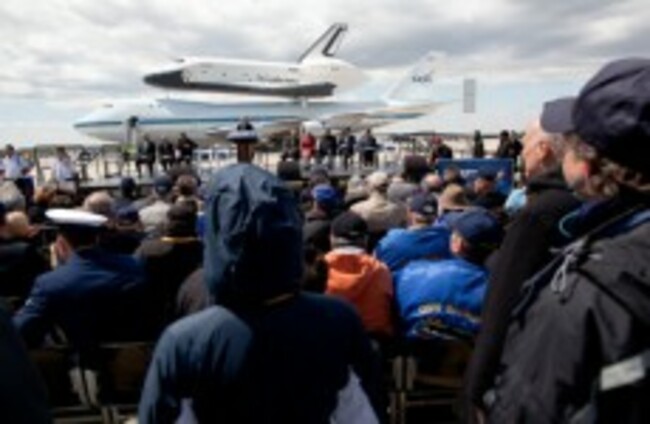
The shuttle Enterprise en route to its retirement location, New York city's Intrepid museum.
Image: John Minchillo/AP/Press Association Images

AS NASA PREPARED TO land another exploratory rover on Mars in little over a week, TheJournal.ie has been looking into humankind’s preparations for landing an astronaut on Mars.

Decades after the launch of space programmes around the world, just how close are we getting to living on the Red Planet – or anywhere in space, for that matter?

Getting there

In 2009, NASA released a comprehensive report following its review of human spaceflight plans. While the Augustine Report affirmed the ultimate goal of human exploration being to “chart a path for human expansion into the solar system”, the report suggested nearer destinations which should be considered as human spaceflight objectives in the short- to medium-term, including the Moon, Mars and near asteroids.

Currently, NASA is looking into ways to land a person on the surface of the Moon by the 2030s.

Last summer saw the end of the US space shuttle programme and retirement of NASA’s ageing fleet – but no immediate replacement service is in place. Since the shuttle retirement, international astronauts are ‘hitching’ lifts to the International Space Station on board Russian Soyuz rockets.

Dr John Charles from NASA’s Human Research Program (HRP) at the Johnson Space Center in Houston told TheJournal.ie that the difficulty now is trying to develop the right kind of spacecraft (and a suitable launching mechanism) which will accommodate astronauts for space flights of up to two-and-a-half years.

Too big and it’s unwieldy and fuel-heavy for travelling such distances, but too small and the space restrictions could take a toll on the astronauts’ health.

“We expect a Mars vehicle to be about as massive as the International Space Station – about a million pounds,” he said. “The ISS is huge; if six astronauts are on board and you loose sight of someone, it’s easy to lose them. And that’s actually happened. The guy wasn’t ‘lost’ but the others couldn’t see where he was because he was working on a project in a different part of the station.”

“A Mars vehicle will be necessarily more constrained in volume.”

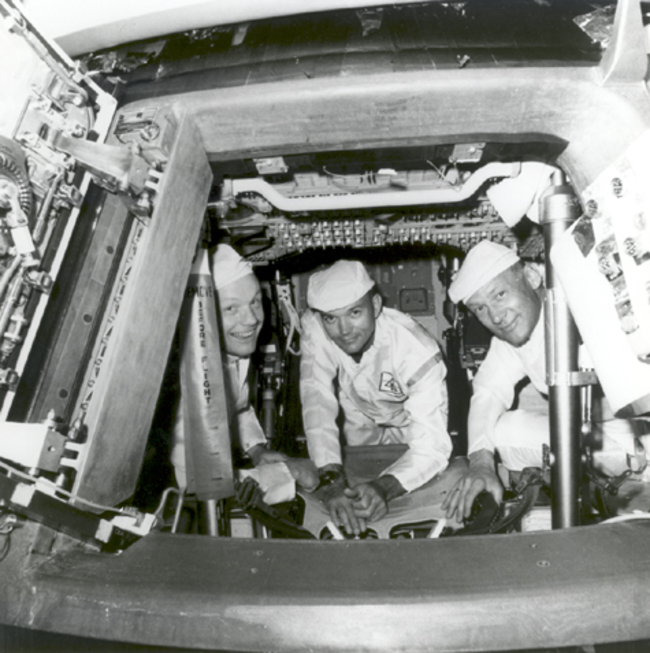
The Apollo capsules which travelled to and around the Moon in the late 60s and 70s were very small – just enough room for three people. But this was adequate for the short mission span and crew size.

But exercise is essential in keeping a crew fit and healthy through the physically-demanding space flight. Muscle mass, bone density and the cardiovascular system are all affected.

The HRP has identified the minimum exercise required to help astronauts maintain bone density, and researchers are looking into exercise to bolster muscle strength and cardiovascular systems in space.

Devices such as a treadmill and bicycle simulator are being tested as part of the research – but any equipment taken on board will have to fit snugly. Not just that – they will have to be designed for use in the more constricted space of the craft.

Apollo

The (very snug) Apollo 11 command module and its three crew members, from left, Neil Armstrong, Michael Collins and Buzz Aldrin carrying out an inspection ahead of their 1969 lunar mission. (NASA)

Living in space

Patterns of night and day are important for regulating human sleep cycles.

Massachusetts Institute of Technology in Cambridge, Massachusetts is conducting research into natural lighting and has a special laboratory which can replicate different patterns of night and day and study the effects on humans.

The Martian day is about 40 minutes longer than an Earth day – something NASA’s Dr Charles says could help astronauts in their adjustment because it’s easier to adapt when you’re able to sleep more, rather than less.

He also says that some people seem to have a better capacity to adjust to different time zones or daylight patterns than others and although Circadian rhythms haven’t been one of the criteria for selecting astronauts before, “it might be fortuitous” if the people selected for Mars would have longer rhythms.

Food – fresh and tasty

“It’s very attractive to live off the land  - to cut down trees, plant crops, scoop fish from the water, kill animals for food and clothing,” Charles said.”That’s not likely on Mars though.”

One option being pursued by researchers is the development of a kind of ‘mini-factory’ for propagating crops on the Martian surface.

The main component of the atmosphere there is carbon dioxide and scientists have discovered large quantities of subsurface ice; it could be possible for astronauts to use these elements to generate oxygen and water which could then be used to develop crops or to fuel a Mars launch vehicle.

“You might be able to establish a sort of Mars surface greenhouse to develop food crops and get mother nature to manipulate the Mars surface materials which are useful to the astronauts – but that’s a bit further down the stream,” Charles said.

Mars

Mars: 817 images taken by a camera on NASA’s exploration rover Opportunity combined to form a full-circle panorama. (NASA/JPL-Caltech/Cornell/Arizona State University)

In the meantime, the food supply for space missions has to be brought on board from Earth – but more work is needed on improving the nutritional content – and taste – of the pre-packaged food.

“The supply of food for the earliest missions in-flight is to use military food, the meals that are ready-to-eat,” Charles explains. “Those haven’t been found to be useful for long durations, such as two-and-a-half year missions because they’re are not fully provided with all of the nutrients you would need.”

“So the goal we’re pursuing now is to develop the right kind of food, and particularly the right kind of packaging for preserving the food and the nutrients. But the food has to be attractive and appealing or astronauts will lose interest in it – as shown on previous flights.”

Video, photos: Simulated mission to Mars ends after 520 days of isolation >

NASA refines Mars landing – but brings it closer to dangerous landing zone >

Read next:

Comments (27 Comments)

  • @Paddy BeBop

    ” “the total amounts (in nominal dollars) that NASA has been budgeted from 1958 to 2011 amounts to $526.18 billion dollars—an average of $9.7 billion per year”
    How many dead babies in Africa could have been saved with that type of money? ”

    First of all, it’s worth pointing out that the entire 50 year budget of NASA, some $526 billion, you mentioned here is less than the US’s military spending in 2011 alone.
    http://en.wikipedia.org/wiki/File:U.S._Federal_Spending_-_FY_2011.png

    And to answer your question of how much good this money could have done if put into foreign aid, then I’d imagine the US state department could tell you quite easily, as they currently spend twice NASA’s budget on non military foreign aid every year ($37.7 billion on non military foreign aid in 2011, vs $18.4 billion to NASA).
    They spend a further $15 billion on military foreign aid, but I thought it might be divisive to include that in the figure above.
    On top of this, US citizens themselves donate vast amounts to charities, some $280 billion in 2009 alone. http://www.philanthropy.iupui.edu/news/2011/06/pr-GUSA.aspx That’s half NASA’s entire 50 year budget in one year alone! And that’s just Americans, the rest of the world donates massive amounts of money as well. Africa received around $50 Billion in aid every last year, some 4-5 times NASA’s yearly budget. And on top of that, there’s solid evidence to suggest that the type of help Africa, and other developing regions, needd isn’t cash thrown at problems, but a fairly dramatic shift in world wide economics, attitudes and trade.
    So why don’t you climb down off your high horse, be aware that the world already spends more money on charity than space, and that in 2011 the US defence department spent in every 10 day period the same amount of money as NASA was given for that entire year. Perspective.

    Reply
  • The church is against any form of contraceptive and the pope has preached about it previously, condoms condoms condoms out out out!!

    Reply
  • How cool would it be to go there even to see it!!!

    Reply
  • Sinead 28/07/12 #

    Its more exciting,though, to talk about Mars and space than it is to talk about what going on on this planet!!

    Reply
    • children starving and people are pissing away €’s and $’s on space disgusts me

      Reply
    • Paddy, what about all the money that people piss away on smoking and cigs everyday? Do you realise that the space program over the years has created hundreds of thousands of jobs thereby keeping people out of poverty. With your way of thinking Columbus and all the other explorers would never have left their home countries to explore this world.

      Reply
    • “the total amounts (in nominal dollars) that NASA has been budgeted from 1958 to 2011 amounts to $526.18 billion dollars—an average of $9.7 billion per year”

      How many dead babies in Africa could have been saved with that type of money?

      Reply
    • not many if they’re dead! space exploration is important, we can’t stay here forever

      Reply
    • SeanS 28/07/12 #

      You could say the same thing about almost absolutely anything, as someone mentioned earlier, how many babies would be saved if we donated our alcohol and cigarette money to Africa instead of satisfying our own wants?

      How many babies in Africa could have been saved if instead of buying each other lavish christmas presents we sent the money abroad.

      How many babies in Africa could have been saved if we cut back on education funding and non essential health services and sent it abroad? Aren’t lives more important than fancy education and self-esteem?

      How many babies in Africa could have been saved if we completely forgo any sort of entertainment, be it Sky Digital, movie rentals, broadband, consoles, toys, gadgets etc etc and instead donated the money to africa?

      Just because you can’t see the merits of space exploration doesn’t mean there are none, it might be decades before we see the fruits of its labour but if we continually stuck to looking at life from a short term perspective we’d still be stuck in the dark ages.

      Reply
    • How much do you donate to dead babies in Africa?

      Reply
    • why are you talking about only africa as if they were the only poor people and there are rich africans as well.

      Reply
  • Paddy Bebop, in your statistic the total amount of money budgeted to NASA for the time period given wouldn’t equal the US defence budget for the last 2 years. Unfortunately people in the developing world young & old die in droves everyday. It’s not fair I agree but beyond giving to charity when I can there isn’t a whole hell of a lot I can do about it (on a personal level), that said I believe mankind should explore space. We are by our very nature an inquisitive lot so why not? Let’s do it.

    Reply
  • The more ‘dead’ babies you save the more overpopulated the world becomes and the less resources we have meaning we’ll have to explore space in search of resources to continue our existence. Ironic.

    Reply
  • We live in Space already. We are all little spacemen and women or didn’t you know. This is a planet. We are Earthlings…

    Reply
  • How about donating condoms to people in Africa so we don’t have to deal with excessive numbers of kids in the third world to begin with

    Reply
  • waste of money exploring space given the state of the world economy!

    Reply
    • @Paddy BeBop: Exploring space is never a waste of money and it’s a tiny fraction compared to military spending.

      Reply
    • Which hole are you talking thru?…perhaps if all these fools stopped having so many babies they would not be in such dire straights…..pushing the bounderies in space benefits all of mankind thru a deeper understanding of our universe and the accrued benefits of technological advancement….tell the Africans to use condoms And that will be much more helpful to them than us sending them or hard earned money

      Reply
    • Fools. That’s a bit harsh. These people don’t know any differently. Having large families is the done thing where they’re from. You don’t have to travel back too far in time to see that the average family size in Ireland probably exceeds that in Africa now.
      Yeah, give them condoms, and more importantly give them the education to see that all these large families aren’t helping their situation.
      People doing what they perceive as correct does not make them fools.

      Reply
    • Overpopulation is being caused by people living longer, not by ever increasing birth rates. It’s more valid to blame the developed world for increasing average lifespans. The birth rate in the third world hasn’t increased at all, in fact it is diminishing gradually over time. Another point about overpopulation is that a child or even a young adult uses up less resources than an aged person. Food for thought, pardon the pun.

      Reply

Add New Comment