Sign in. It’s quick, free and it’s up to you.
An account is an optional way to support the work we do. Find out more.
Sign in. It’s quick, free and it’s up to you.
An account is an optional way to support the work we do. Find out more.
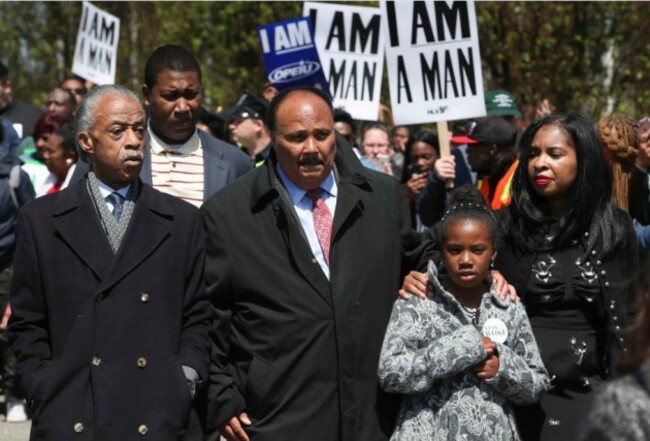
PEOPLE IN THE US and around the world have been marking the 50th anniversary of the assassination of Martin Luther King Jr. The civil rights leader’s death transformed him into a symbol of the fight for racial equality.
In a country still torn over issues of race and class, demonstrators rallied in Memphis, Tennessee, where the pastor and Nobel Peace Prize winner was slain aged 39 on a motel balcony by a white supremacist sniper on 4 April 1968, as well as in Washington where he delivered his historic ‘I Have a Dream’ speech.
“When we look at the state of race relations, we’ve made dramatic progress in 50 years — but we’re nowhere near where we need to be,” King’s activist son, Martin Luther King III, told ABC from Memphis, where he was taking part in a symbolic march.
“I think he’d be disappointed with some of the discourse that we see,” said King III, although he added that his father would “be very excited” by today’s activist movements including Black Lives Matter, the #MeToo campaign for women’s rights, and student-led movements against gun violence.
“He would know that we as a nation can, must and will do better.”
Now lionised for his heroic campaigns against racism and segregation, King was a controversial, radical activist who, with a mantra of non-violence, ardently campaigned against poverty and economic injustice, including what he called the continued “exploitation of the poor” and US wars abroad.
His 15 January birthday is a national holiday in the US, and a 30-foot statue in his likeness towers in Washington DC as a tribute to his life and work.
‘Still raw’
On the anniversary’s eve, prominent civil rights activist Reverend Jesse Jackson — speaking from Memphis’s Lorraine Motel balcony, where King was gunned down — said “the sore is still raw” from the fatal shooting.
“It’s always a source of pain and anxiety,” said Jackson, who was a member of King’s entourage and was at the motel when he was murdered.
It happened so suddenly, in the middle of a conversation, on the way to dinner. He’ll always be 39.
But his legacy, Jackson said, survives in the hearts and actions of demonstrators today wielding flags of racial, social and economic justice.
“You can fight to stop the loop of violence,” Jackson urged those activists. “We are much too blessed to be so violent as a nation.”
King catapulted into the national spotlight by taking the lead on a year-long boycott against racial segregation on local buses.
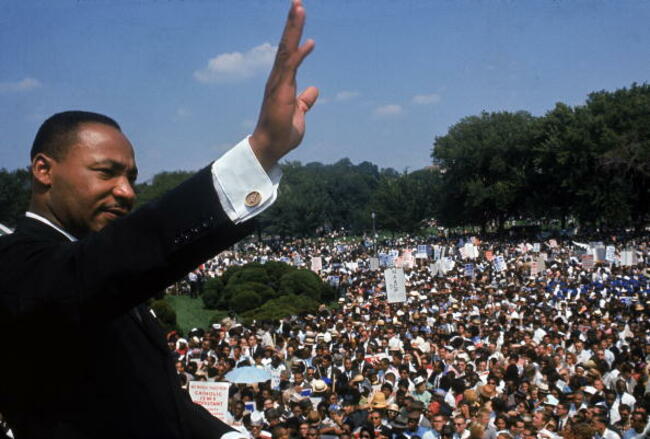
He is perhaps best known for the ‘I Have a Dream’ speech he delivered to some 250,000 demonstrators on 28 August 1963 as part of the March on Washington for Jobs and Freedom.
One year later he became the youngest Nobel Peace Prize winner at 35 for his non-violent resistance.
Prior to King’s assassination, which triggered an outpouring of grief and riots in more than 100 cities, he had travelled to Memphis to support sanitation workers striking for better conditions and higher pay.
Elmore Nickleberry, now 86, is today one of the last participants in that strike still on the job. ”The mood was mighty bad when he got killed. People started hollering, started crying,” Nickleberry told AFP.
He recalled that poignant moment of tension and pain, but Nickleberry said it is King’s call for non-violent action that lives on.
“He was a man of marching, he was a man that was non-violent,” the sanitation worker said. “That’s what I remember today.”
‘Promised land’
US President Donald Trump paid homage to the civil rights icon by proclaiming today a day to honour King.
“It is not government that will achieve Dr King’s ideals, but rather the people of this great country who will see to it that our Nation represents all that is good and true, and embodies unity, peace, and justice,” Trump said in a statement.
Trump has been sharply criticised for divisive comments targeting Latino and Muslim immigrants, and for refusing to condemn outright a violent white supremacist rally last year that ended in bloodshed.
Several US lawmakers travelled to Memphis for the day-long tribute featuring singing, prayer and speeches.
Laura Richardson, who works for a non-profit group, said she praised the “courage” within King “to go in love, go without violence, and never take a step back, and fight for everyone’s right”.
A crowd gathered at the Lorraine Motel, which has been transformed into the National Civil Rights Museum, while more than 1,000 also marched near a local union headquarters, where King had joined protesting workers on the eve of his assassination.
“I’ve seen the promised land. I may not get there with you,” King prophetically said that night. “But I want you to know tonight, that we as a people will get to the promised land!”

To embed this post, copy the code below on your site







have your say