Sign in. It’s quick, free and it’s up to you.
An account is an optional way to support the work we do. Find out more.
Sign in. It’s quick, free and it’s up to you.
An account is an optional way to support the work we do. Find out more.
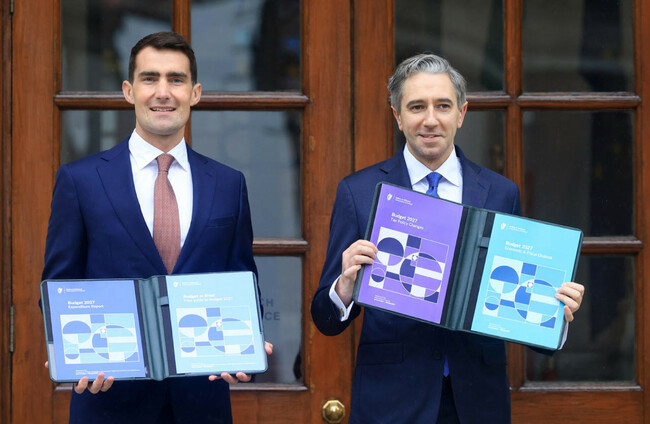

AFTER A CERTAIN point we’ve really got to ask ourselves: what are we even watching the budget for any more?
The coalitional nature of our government means that the weeks leading up to the budget announcement tend to be marked by disputes over which departments get what in terms of funding, and a process which is often described in the media as ‘kite-flying’.
Kite-flying is when a government minister throws an idea out there to see just how much pushback they can expect from the public. Some kites have big brass keys tied to the end of them and end up giving the minister a nasty shock, which is probably why poor Patrick O’Donovan didn’t get his €100 culture cards for kids.
But even though we spent so much time hearing about the internecine bickering that underpinned this year’s budget, the budget itself was a bit of a damp squib. I’ve never been sure what a squib is. Sounds like something that’s probably damp to begin with. Either way, Budget 2027 has been met with an almighty “meh”. And you know what, it serves us right for expecting anything different.
By this stage, you kind of know what’s going to be in the budget before it comes out. A few billion here or there to keep the hope of a Metrolink in this century alive. Expanded tax exemptions for landlords, naturally, lest the country collapse without their dutiful service. A few million for the greyhound industry, since we have it going spare. No surprises.
The price of cigarettes goes up incrementally, of course, finely balancing the stated aim of getting people to stop smoking and the unstated aim of making sure that enough people keep smoking for us to make some decent tax revenue out of it. We’re now going the same way with the vape juice. Vaping is almost certainly quite bad for us, but again, not quite bad enough that we’re prepared to stop making money off of it.
But for some reason, we seem to hold out a sort of phantom hope that some surprise measure will be announced that actually, straightforwardly, meaningfully improves quality of life in Ireland. Why do we think that? At this point paying attention to the budget is sort of like those nights where you keep opening the fridge door even though you know there’s nothing in there. Nights which will not be made any less frequent by the measures contained within this budget.
The Economic and Social Research Institute (ESRI) has already announced that this year’s budget will do nothing to lift any children out of poverty. Who knew that slightly reducing income tax on a small amount of earnings for a specific cohort of the population wouldn’t solve society’s worst ills?
According to an analysis by the Parliamentary Budget Office, this year’s package increases average household income by 0.3%. Poverty rates are expected to remain above 2024 levels. This is a pretty bleak outcome, particularly when you cross-check it against the sort of highfalutin, promissory language with which Minister for Finance Simon Harris introduced his budget measures.
“No one budget can achieve all the things that a government wants, but it can set us on a path. A trajectory. A way forward,” said the Tánaiste, as if we should all be grateful to be on the path at all, instead of lying in a ditch somewhere. “The path we’re setting out here today is an optimistic one. A path that brings us to a place in which work is rewarded, risk is repaid and investments in our future bear fruit for decades to come. A place in which the benefits of growth are widely shared, where everyone – regardless of circumstances – can get ahead, improve their lot and provide for their families.”
Getting ahead by 0.3%. Improving your lot by 0.3%. Providing 0.3% more for your family. If we imagine that Simon Harris’ proverbial path is 100 kilometres long, we’ve travelled about 300 steps.
Putting your hope in the finance minister and his budget to change the material circumstances of your life is sort of like reciting your Christmas wishlist to a teenage shopping centre Santa with a ponytail and an earring. You know that this guy isn’t going to do anything for you. You’re going to get a poorly wrapped plastic truck from one of the elves just like every other boy and be sent on your way. In this metaphor, the elves are the other cabinet ministers.
With this in mind, do we still really need a ‘Budget Day’? Maybe there is a way of responding to the needs of ordinary people that doesn’t prioritise haughty pronouncements over speaking to actual needs?
Making a day of it, with the speculation, and the speeches, and the posing with the glossy little folders, allows the government to create the impression that Budget Day is a real inflection point. That there is meaningful change afoot. In the end, what we actually get is a bastardisation of a bank holiday where the ratio of bank-to-holiday is like a million-to-one.
Nobody is arguing that the substance of the budget is unimportant, or that we should all stop paying attention to what remains a fundamental cornerstone of Irish governance. The issue is that we, as a country, seem to live in a state of cognitive dissonance when it comes to the budget. We know that it’s not going to make a major difference to our lives, not really, and yet we continue to participate in the charade.
What is perhaps strange about the way the budget is done, on a realpolitik level, is that it has a tendency to sandwich the good news in among all the disappointment. 33,000 extra hours of free counselling for men, young people and the LGBTQ+ community is good news, for example, but would probably have hit harder and drawn more attention if it weren’t announced alongside a fuel excise cut extension that does little besides remind us just how expensive fuel is.
What Irish people would like, one imagines, is any measure that could in any way counterbalance the abject horror we all feel whenever we reach the till at the end of the week’s big shop. Energy measures that address price levels at source, rather than credits that amount to little more than a bag of sticking plasters. Something that in some way acknowledges the bigger picture of hardship being faced by so many.
For example, this year’s budget comes against a backdrop of ongoing industrial action by hundreds of thousands of public sector workers, including nurses, teachers and civil servants. €1.2 billion was announced for a public sector pay deal, but that has already been dismissed as not enough by the unions. Presumably they also heard the 0.3% figure.
“I just get the sense that people want industrial action now irrespective of what happens,” Taoiseach Micheál Martin told Claire Byrne on The Claire Byrne Show.
It is a statement that betrays the attitude fuelling this year’s budget. That the people should be grateful for whatever it is they get, however little it might be. And you know what? Maybe they are. About 0.3% more grateful.
To embed this post, copy the code below on your site











have your say