Sign in. It’s quick, free and it’s up to you.
An account is an optional way to support the work we do. Find out more.
Sign in. It’s quick, free and it’s up to you.
An account is an optional way to support the work we do. Find out more.
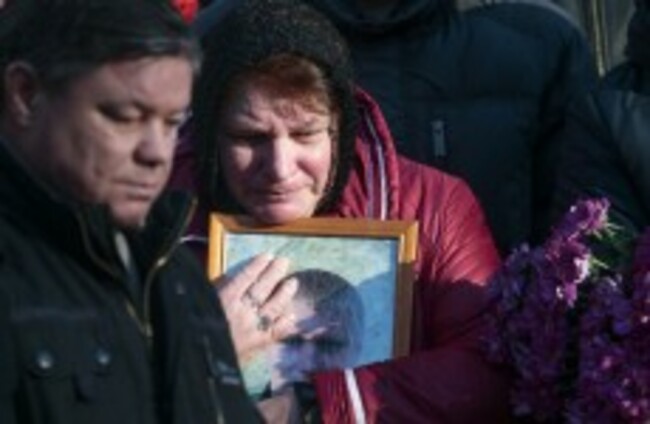
A NOISE WAS heard in the last second of the cockpit voice recording from the Russian plane that crashed last week in Egypt’s Sinai Peninsula, the head of the investigation team said last night.
The statement bolstered US and British suspicions that the plane was brought down by a bomb.
However, Ayman el-Muqadem warned it was too early to say what caused the plane to apparently break up in mid-flight. Analysis of the noise was underway.
“All scenarios are being considered … it could be lithium batteries in the luggage of one of the passengers, it could be an explosion in the fuel tank, it could be fatigue in the body of the aircraft, it could be the explosion of something,” said El-Muqadem.
US and British officials have cited intelligence reports as indicating that the 31 October flight from the Sinai resort town of Sharm el-Sheikh to St Petersburg was brought down by a bomb on board.
All 224 people on board, most of them Russian tourists, were killed.
Islamic State extremists claimed they brought down the Metrojet flight, without offering proof, saying it was in retaliation for Moscow’s airstrikes that began a month earlier against fighters in Syria.
El-Muqadem said debris was found scattered across a 13-kilometre (8-mile) stretch of desert, indicating the Airbus A321-200 broke up mid-air, but initial observations don’t shed light on what caused it.
Some pieces of wreckage were still missing, while the recovered pieces will be taken to Cairo for analysis, he said.
Call for help
Also yesterday, Egypt’s foreign minister, Sameh Shoukry, said countries that have suspended flights to Sharm el-Sheikh — which include Ireland, the UK and Russia, though the foreign minister did not specifically name them — did not share the intelligence that drove their decisions with Cairo.
Egypt “expected that the information available would be communicated to us instead of being broadcast” in the media, he said.
The crash one week ago dealt a huge blow to Egypt’s battered tourism sector, which is yet to fully recover from years of political turmoil. Russians comprise nearly a third of all tourists who visited Egypt in the past year.
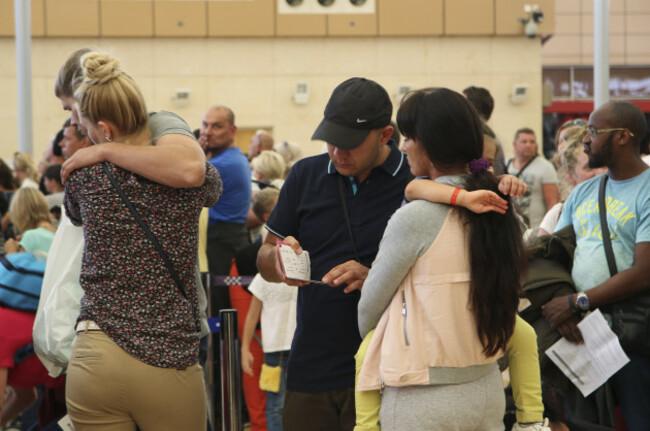
Thousands of tourists waited in slow-moving security lines at the Sharm el-Sheikh airport on Saturday as they tried to board charter flights home. Many complained about a lack of information from travel agents and airlines, but seemed to accept tight security measures.
Near miss
Meanwhile, Britain’s Guardian newspaper reported that investigators had determined that a missile that came within 1,000 feet (300 metres) of a plane carrying British tourists to Sharm el-Sheikh on 23 August was “probably a flare”. The Thomson jet was carrying 189 passengers.
Tui Group, which owns Thomson, said an investigation by Britain’s Department for Transport had concluded that the incident was not a “targeted attack” and likely connected to routine Egyptian military exercises in the area at the time. Thomson said there was “no cause for concern” for further flights.
The spokesman for Egypt’s Ministry for Foreign Affairs, Ahmed Abu Zeid, tweeted yesterday that the incident involved a “ground-to-ground fire exercise” at an Egyptian military base a few kilometers from the Sharm el-Sheikh airport.
The spokesman said airliners had previously been informed of the military exercise and that the Egyptian and British governments were “fully aware that plane was in no danger”.

To embed this post, copy the code below on your site













have your say