TheJournal.ie uses cookies. By continuing to browse this site you are agreeing to our use of cookies. Click here to find out more »
Dublin: 8 °C Sunday 19 May, 2013

Pacific island nation considers moving over climate change fears

Kiribatis president says some villages have already been relocated because of rising the sea level.

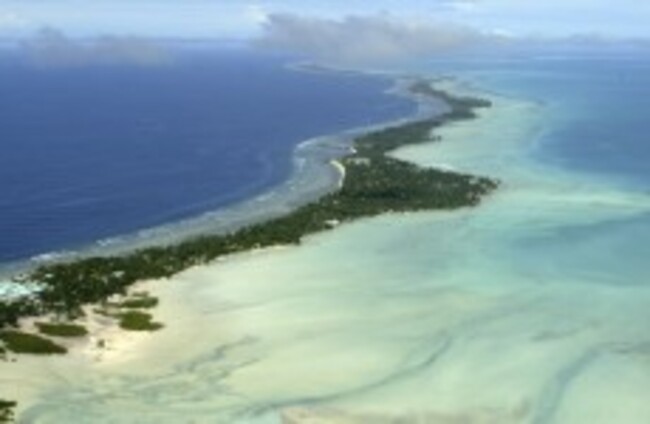
File photo of Tarawa atoll, Kiribati.
Image: Richard Vogel/AP/Press Association Images

FEARING THAT CLIMATE change could wipe out their entire Pacific archipelago, the leaders of Kiribati are considering an unusual backup plan: moving the populace to Fiji.

Kiribati President Anote Tong told The Associated Press today that his cabinet this week endorsed a plan to buy nearly 6,000 acres on Fiji’s main island, Viti Levu. He said the fertile land, being sold by a church group for about $9.6 million (€7.3m), could be insurance for Kiribati’s entire population of 103,000, though he hopes it will never be necessary for everyone to leave.

“We would hope not to put everyone on one piece of land, but if it became absolutely necessary, yes, we could do it,” Tong said. “It wouldn’t be for me, personally, but would apply more to a younger generation. For them, moving won’t be a matter of choice. It’s basically going to be a matter of survival.”

Kiribati, which straddles the equator near the international date line, has found itself at the leading edge of the debate on climate change because many of its atolls rise just a few feet above sea level.

Tong said some villages have already moved and there have been increasing instances of sea water contaminating the island’s underground fresh water, which remains vital for trees and crops. He said changing rainfall, tidal and storm patterns pose as least as much threat as ocean levels, which so far have risen only slightly.

Some scientists have estimated the current level of sea rise in the Pacific at about 0.1 inches per year. Many scientists expect that rate to accelerate due to climate change.

Fiji’s response

Fiji, home to about 850,000 people, is about 2,250 km south of Kiribati. But just what people there think about potentially providing a home for thousands of their neighbours remains unclear. Tong said he’s awaiting full parliamentary approval for the land purchase, which he expects in April, before discussing the plan formally with Fijian officials.

Sharon Smith-Johns, a spokeswoman for the Fijian government, said several agencies are studying Kiribati’s plans and the government will release a formal statement next week.

Kiribati, which was known as the Gilbert Islands when it was a British colony, has been an independent nation since 1979.

Tong has been considering other unusual options to combat climate change, including shoring up some Kiribati islands with sea walls and even building a floating island. He said this week that the latter option would likely prove too expensive, but that he hopes reinforcing some islands will ensure that Kiribati continues to exist in some form even in a worst-case scenario.

“We’re trying to secure the future of our people,” he said. “The international community needs to be addressing this problem more.”

Tong said he hopes that the Fiji land will represent just one of several options for relocating people. He pointed out that the land is three times larger than the atoll of Tarawa, currently home to more than half of Kiribati’s population.

Although like much of the Pacific, Kiribati is poor — its annual GDP per person is just $1,600 (€1,210) — Tong said the country has plenty of foreign reserves to draw from for the land purchase. The money, he said, comes from phosphate mining on the archipelago in the 1970s.

Read: Kiribati president suggests ‘floating island’ contingency plan >

Read next:

Comments (19 Comments)

  • Sell them Leitrim. There’s no one using it anyway.

    Reply
  • I’m very curious to see how this turns out. I can only imagine the anxiety of the people too.

    Reply
  • We have uninhabitated islands. We could sell for that amount.

    Reply
  • DNA tests show that present day Polar bears are descendants of the supposedly extinct Irish Brown Bear BUT has anyone checked out Leitrim?

    Reply
  • I wouldn’t take a free house in Leitrim, they have no interwebs in Leitrim.

    Reply
  • Very smart P.R. Expect their tourism numbers to go through the roof.

    Reply
  • Another scare story from the climate change fraternity.
    The problems being experienced by many of the Pacific Islands are due to overpopulation and overexploitation of resources and have nothing to do with climate nor are they new. People familiar with the locality will recall that the RAF base at Gan Island had a runway just 2 meters above sea level when abandoned in 1976 and that is still the case where it has become Gan International Airport. The increasing number of tourists who can now get to these remote is putting pressure on scarce water resources which are mostly just ‘lenses’ of freshwater which were just enough to sustain the local people and are not capable of feeding hundreds of showers plus all the other demands made by tourists. Sadly when the fresh water is extracted the sea can encroach and contaminate the remainder.
    Many of these wonderful islands suffer high levels of child mortality due to pneumonia and diarrhoea and Kiribati has a mortality rate of 43 per 1000 in the under 5 age group so you can’t blame the locals for wanting to leave and claiming that this is due to global warming is just one way of getting funds from the wealthier nations.
    This is not the first time land has been purchased in Fiji for this reason because long before climate change became a religion the people of Vaitupu bought Kioa in 1946 where they are now living happily in their traditional fashion.Until they get the tourism bug.

    Reply
    • mattoid 09/03/12 #

      The ‘climate change fraternity’ being the entire international scientific community…
      But don’t let that encourage you to extract your head from the sand…

      Reply
    • Mastoid, there is growing scepticism amongst the scientific community about global warming because of the GW cover-ups, falsifying of evidence etc.
      Scientific fact and scientific theory are not the same

      Reply
    • mattoid 09/03/12 #

      Can you please provide references for your comment about growing scientific scepticism?
      I presume you are referring to the so-called ‘climategate’ emails when you refer to falsification of evidence, however I think you’ll find that the scientists involved have subsequently been vindicated and that the accuracy of their scientific results has been confirmed. The emails involved are apparently a product of sheer exasperation that some sections of the wider community are refusing to accept what the scientific community know to be true.
      I would refer you to the following review of 928 published and peer-reviewed scientific papers bearing the keywords ‘climate change’. How many of these do you think found no evidence of anthropogenic climate change? None. Not a single one of the 928 papers published!
      This review took place in 2004, but you’ll find that the same level of scientific consensus exists today (leaving out non-reviewed junk science ‘studies’ funded by the fossil fuel industry)…
      http://m.sciencemag.org/content/306/5702/1686.full

      Reply
    • Isn’t climate change a fabulously nebulous morphing of global warming. Whatever ones side credit has to be given to the marketing of the theories. Bear in mind though that scientific consensus is not scientific fact. Both sides wish to claim the moral high ground but only time will offer proof. Remember also that if atolls in the pacific are subject to rising sea levels then Ireland is also but I’m struggling to find data to support rising seas around Ireland. Consider also that climate has changed since an atmosphere was first formed. Ireland suffered 2 of the coldest winters ever in a row, both were followed by crap summers. I do not need to see temperature data to know that global warming has not arrived in Ireland yet Met Eireann in both years reported that they were in the top 10 warmest years on average on record. Common sense says bollocks to that. Experience says that researchers, though qualified with more letters than the alphabet, should never be relied on for sage advice. Intelligence is no substitute for common sense.

      Reply
    • mattoid 09/03/12 #

      @ Kieran
      Lots of articles and anecdotes there, but still no peer-reviewed papers that have been published in scientific journals. This is the difference between genuine science and pseudo-science…

      Reply
    • mattoid 09/03/12 #

      @Paddy
      So you’re basically saying that we should be paying more heed to you feeling it ‘in your waters’ than years of empirical data gathering??
      You’re right on one point though, the term ‘global warming’ (as coined by the media by the way) is misleading to the layman. Whilst average global temperatures have risen at unprecedentented rates in the past century, science has always used the term ‘climate change’ in recognition of the fact that the precise way in which this disruption of climate patterns will manifest itself can include extreme local events of cold, rain and snow as well as heat and drought in other areas.

      Reply
    • @mattoid.
      You have failed to deal with the issues I raised regarding Kiribati and its appalling infant mortality rate.
      I will post a comment later on the subject of corruption within the climate change fraternity which has nothing to do with the world body of proper scientists and is specific to the fraudsters known as the Hockey Team and other less polite names.

      Reply

Add New Comment