TheJournal.ie uses cookies. By continuing to browse this site you are agreeing to our use of cookies. Click here to find out more »
Dublin: 8 °C Thursday 23 May, 2013

Column: Never heard of ‘fracking’? You will soon

Several firms hope to use a controversial new drilling method to tap vast gas deposits under Ireland. This could mean environmental devastation, writes filmmaker Johnny Gogan.

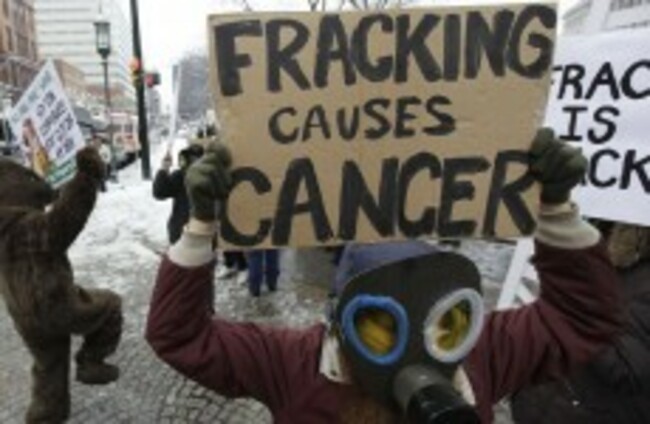
An anti-fracking protester in the US, where the process has stirred controversy
Image: Matt Rourke/AP/Press Association Images

BENEATH COUNTIES LEITRIM, Roscommon, Cavan, Sligo, Donegal and Fermanagh, there is an estimated natural gas deposit valued at a minimum €120billion at current market prices. This resource has been known about for many decades, but until now it was not deemed viable. However, the game is now on to explore and extract. The shale gas, embedded in rock thousands of feet below the land surface, has been trumpeted as the magic solution to clean energy supply in the decades to come.

The factor that has reinforced viability for interested companies is a gas extraction method known as hydraulic fracturing, or ‘fracking’. This method involves deep drilling – typically to depths of 6,000-7,000 feet – to reach the gas-bearing seam of rock. The drilling then continues on a horizontal trajectory along the seam. Then, the bore hole is sealed in concrete and a mixture of water, sand and so-called ‘fracking fluid’ – up to seven million gallons per bore hole (and there are currently 40,000 such holes across the US) – is forced into the bore hole in an effort to dislodge the gas from the fractured seam.

In the US, fracking fluid has been granted ‘proprietary’ status, like the secret recipe for Coca-Cola, thereby clouding its ingredients in secrecy. However, it is known to contain 596 chemicals including strontium, mercury, formaldehyde and a range of others which are damaging to human health.

The name that has been given by the companies involved to this chemical-laced fluid, left over after the gas has been extracted, is ‘produced water’. The companies claim to have been able to retrieve this water from the depths where it is employed, but this is now proven not to be the case – most notably in a study by researchers at Duke University in the US, which firmly establishes the connection between the fracking process and water contamination.

A second source of water contamination has been the leakage of natural gas from the fracking process into underground aquifers, resulting in the contamination of domestic and farming water supplies. In the US, there have been multiple cases where the gas has escaped into the water supplies. The 2010 documentary Gasland, which set out to highlight the environmental effects of fracking, contains an infamous scene in which a householder in Weld County, Colorado turns on their tap, then sets the tap-water alight.

Recent statements by Tamboran Resources, who have concessions to explore for gas deposits in Leitrim and Fermanagh, have confirmed that they intend to use hydraulic fracturing should they move to the next stage of exploration. As far as the company is concerned, there is no known alternative. Tamboran assert that contamination issues highlighted in the US have been due to poor concrete casings around the bore holes.

‘Wilderness areas’

In the United States, landholders have been lured into allowing companies onto their properties through generous financial arrangements. However, these have often come with non-disclosure agreements – and in many cases massive depreciation in the resale value of land. In some areas affected, it has become impossible in many cases for people to secure mortgages on land and house purchases. However, the law in Ireland differs, and campaigners are currently clarifying the conditions under which exploration companies can access privately-owned land – as well as airing concerns over the type of access that State companies will permit for exploration and exploitation.

The Department of Communications and Energy – whose Petroleum Affairs Division issued the licenses to Tamboran as well as the Irish-owned Lough Allen Natural Gas Company (Leitrim) and Energy Oil (Clare Basin) in the dying days of the Fianna Fáil administration – have indicated that any use of fracking will be subject to an environmental impact assessment and a process of public consultation.

Leitrim County Councillors have also taken action, requesting the companies involved to come before the council, outline their intentions and answer concerns. The issue has also been raised by Fermanagh MLA Phil Flanagan with Northern Ireland’s Minister for Enterprise and Energy Arlene Foster. The Fermanagh region contains officially-designated Areas of Special Scientific Interest and – like much of the Leitrim, Cavan and North Roscommon landscape – contains some of the country’s few remaining wilderness areas as well as being an important sink  for the Erne and Shannon systems.

Much of this awareness in Ireland has been raised by screenings of Gasland, which was nominated for an Academy Award for best documentary this year. The film has been responsible for raising the issue internationally and galvanising community response in Leitrim and Sligo, resulting in a petition calling for fracking in Ireland to be banned.

Internationally, fracking has now met with the opposition of the New York State Assembly and the French parliament, and has been outlawed in Quebec. However, a UK Parliamentary Select Committee has deemed that there was no risk to water quality from the process. But energy firm Cuadrilla Resources have been convinced to suspend fracking near Blackpool, Lancashire in early June – after two small earthquakes which geologists linked to their activity.

Johnny Gogan is a feature film and documentary filmmaker. He is chair of Cinema North West, the film company which has been distributing Gasland in Ireland, and a member of the Green Party of Ireland.

‘Serious concerns’ over gas drilling in Lough Allen>

Everything you ever needed to know about fracking>

Column: Want to boost the economy and create jobs? Drill for gas>

Read next:

Comments (33 Comments)

  • Correct me if I’m wrong but land owners have no rigths to minerals or gas discovered under their land?

    Reply
  • How can we even debate over this kind of method? If there are any safety concerns over the long term impact by Fracking then it should be outlawed, there will always be another method for these people to make a profit. Can we have a comment from the Environment minster please.

    Reply
  • Anything that involves mercury exposure is a big no-no.

    Reply
  • Surely there must be another way to get to that pot of gold?

    Reply
  • no surprises, no regrets. a different way or the highway.

    Reply
  • We may well be desperate. But we’re not THAT desperate….find another way. End of.

    Reply
  • I think it would be very hard to find people that are not members of these companies or the government to have anything good to say about fracking. The evidence is there, this process is damaging to health, land, animals and the environment. Other countries are banning it. They can’t all be wrong. I live in the Lough Allen Basin. I love it here. I don’t wish to see it turned into a desert-like industrial landscape. Think that’s being melodramatic, I don’t. Look for good news stories about fracking, you won’t find any. In the interest of balance I have been searching for positive fracking stories. Guess what? I did’nt find even one.

    Reply
  • Watch the film Gasland : http://www.vidxden.com/vzxoetasndz3
    And then,
    Please sign this petition to ban fracking in Ireland. Thank you
    http://www.gopetition.com/petitions/ban-hydraulic-fracturing-for-natural-gas-in-ireland.html

    Reply
  • For more info on fracking go to http://www.what-the-frack.org. There is also a link to the online petition there.

    Reply
  • I was at a meeting held by Tamboran in Enniskillen recently (6th September), where we were told they were putting six billion euro into the project and hoped to get a return of ten billion within a decade i think it was. How is it possible that this figure has jumped to 120 billion euro within the space of a week?! Where is everyone getting this number from?! And does anybody really think we will see enough of this money returned to the Irish economy to make this a worthwhile venture?
    I live in Fermanagh. You only need to google other areas in America which have been ‘fracked’ to see the very real damage which has been caused by the process. And in these areas the drilling has been 3 or 4km underground. Tamboran says they will not have to drill more than 1km down into Irish rock. This means the process will take place very close to the surface. If anything should go wrong, Tamboran can walk away. We cannot.
    I am asking people to forget about the ‘guaranteed wealth’ under the surface (at the meeting, their chief executive Richard Moorman, said there was a 70% chance of gas actually being present in the rock-and they DID NOT KNOW how much would actually be there). We are facing tough times. But selling out the tourist industry for something we know so little about -and which has been banned in other countries and is being vehemently protested against in areas where it has taken place- is absolutely ridiculous! These wells could run dry in 2,5, or 20 years. Our tourism industry, if properly developed, could provide ACTUAL jobs and revenue for years to come!

    Reply
  • Hope RTE put Gasland doc on so the mass of people have the opportunity to discuss and inform. If not maybe TV3 could. It shouldn’t really need discussion as it seems crazy to do that much destruction for money, but at least people could discuss it, & possible alternatives…

    Reply
  • Whatever about the problems that might be associated with fracking, this column was apparently written by someone promoting a movie so don’t take it at face value too readily.

    Reply
  • Fracking has been a safe process for almost 100 years now. Are we now taking our science instruction from film makers and watermelons?

    Reply
    • @ Blessed Be… Did you read the article? Did you read the case study by the SCIENTISTS from Duke University? Can you provide any evidence from reputable scientists to disprove their findings? Have you made any other comments on any other topic on The Journal other than pro Fracking comments??

      Reply
    • I wouldn’t bother Rory, Blessed Be has nothing intelligent to add to this debate as can be seen from the comment above and previous comments in articles relating to this topic. Some people just see money signs and want it all to go ahead tomorrow regardless of the devastation this process can cause to our beautiful landscape and wildlife and the lives of the people living there and the Shannon Erne Waterway.

      Reply
  • Cry me a river and pull out the Dollar

    Reply
  • Fracking! I say down with this sort of thing. Seriously though this solves a lot of problems. This time just buy off the locals. Shell could have saved a fortune !

    Reply
  • I would have thought we had enough politicians on this island to tap into to provide natural gas for years to come

    Reply
  • Far far too many blatantly one sided biased opinion columns appearing under the guise of journalism. Another example was the ridiculously badly written and thinly veiled promo for Oxfam’s IMF chair petition. Should be put in under ‘Letters to the Journal’ or something, not given front-page-like importance. I would say that the very least thejournal.ie could do is to invite an opposing opinion to balance things, lest they turn the publication into just another quasi-political blog.

    Reply
    • Hi there Eoin. This post, as you point out yourself, is an opinion piece. As such, it is one person’s opinion and chances are there are people who will disagree with it – and they are very welcome to post ripostes and reactions in the comments section. It is posted in the ‘Read Me’ column section of TheJournal and clearly marked opinion.

      On an extra note, there are links to news stories at the bottom of this piece written by one of our journalists that explain that the county council in the area is supporting the project and also outlining the opposition to it. There is also an explainer article for people – many of us, I’d wager – who have not heard of fracking or are not sure what it is.

      Reply
    • Thank you for your reply Susan. I did read the associated articles (noticing yet another unnecessary reference to the film Gasland). However, I would submit that the option to reply in the comments section is insufficient for two reasons.

      1) An official reply would have to create a user. With no restraints on usernames etc, anybody can create this official reply. 2) If this official reply is made in a comment section, it is easily drowned out by a determined mob.

      Both of these reasons put the original opinion in a superior light, and put any opposition at a natural disadvantage.

      Reply
  • I think you’re all forgetting the situation this country finds itself in.

    Reply
  • Eggfuel 08/07/11 #

    Interesting…

    Reply
  • I agree with another poster, listen to scientists not independent indie film makers. I work in tv and know how to jazz stuff up. It’s the same as drilling for oil, no problem till you have human error.

    Reply
  • €120,000,000,000….? Cha-ching! Let em use this fracking stuff I don’t ever plan on living 7,000 feet under the earths surface,

    or in Leitrim.

    Reply

Add New Comment