Sign in. It’s quick, free and it’s up to you.
An account is an optional way to support the work we do. Find out more.
Sign in. It’s quick, free and it’s up to you.
An account is an optional way to support the work we do. Find out more.
LAST UPDATE | 7 Aug
A SOUTH KOREAN satellite has captured the first pictures of the Moon’s fresh crash scene caused by a stray SpaceX rocket.
The Korea Aerospace Research Institute’s Danuri spacecraft flew over the impact site soon after the Falcon 9 upper stage inadvertently ploughed into the Moon on Wednesday.
Danuri made multiple passes, taking photos from lunar orbit that were released by the space agency on Thursday.
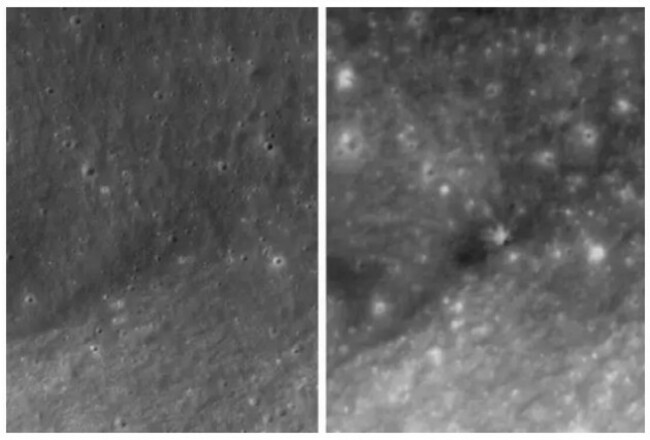
The terrain is noticeably darker where the rocket hit and carved out a crater, sending dust and rock everywhere.
The collision poses no danger to Earth.
“It might be possible for folks with a telescope to observe the plume of ejecta created by the impact,” said Benjamin Fernando of Los Alamos National Laboratory in New Mexico, the lead author on a recent paper on the anticipated impact.
“It is unclear how bright it will be, which is one of the reasons why we are looking to study this event,” the researcher told AFP.
Assuming all the propellant was spent, authors of the paper estimated the spacecraft weighs around 4,000 kilograms.
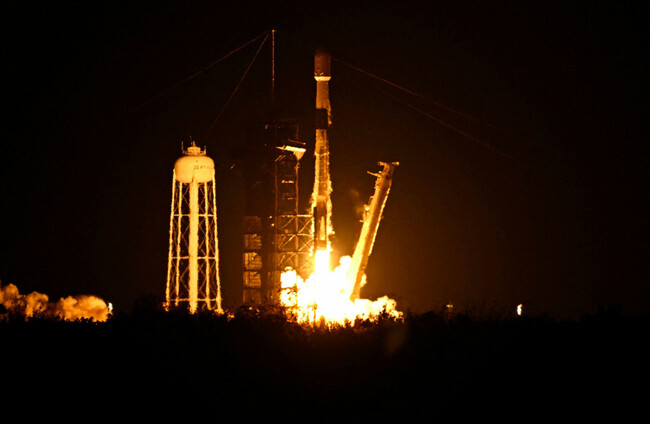
Elon Musk’s SpaceX launched Danuri from Cape Canaveral in 2022.
The company also sent a pair of private lunar landers to the Moon last year.
The upper stage from that launch is what crashed into the Moon this week at 5,400mph, placed on an accidental collision course by solar activity and gravity, according to SpaceX.
Generally, for such “high-energy missions,” SpaceX performs a manoeuvre to make sure the second stage “is safe per the appropriate rules and regulations,” said Julianna Scheiman, director of Nasa Science and Dragon Programs at SpaceX, at a Monday news conference.
“We did that,” she continued, but “what has happened is essentially a mixture of solar activity and gravity forces have put it on a path towards the Moon.”
Like many scientists, Scheiman added that “I also am very excited to see the observation.”
The paper authors encouraged both professional and amateur astronomers to attempt viewing or recording the collision.
“This event provides an opportunity to test a pipeline for localising impacts on the lunar surface for future seismic experiments, investigating the dust and plume dynamics from impact events on the Moon, and considering hazards from artificial space debris impacts,” wrote the research team.
Nasa hopes to soon establish a sustained human presence on the Moon, making it critical to better understand space debris in lunar orbit.
The Moon routinely weathers impact from space debris including meteoroids. Artificial collisions are less common.
In the 1970s, the US space agency carried out deliberate crashes during its Apollo program to collect seismic data.

To embed this post, copy the code below on your site














have your say