Sign in. It’s quick, free and it’s up to you.
An account is an optional way to support the work we do. Find out more.
Sign in. It’s quick, free and it’s up to you.
An account is an optional way to support the work we do. Find out more.
Updated: 12 May
THE DÁIL HEARD statements from TDs on the issue of mental health last night, amid increasing anger at the government’s decision to divert part of this year’s budget for mental health to other areas.
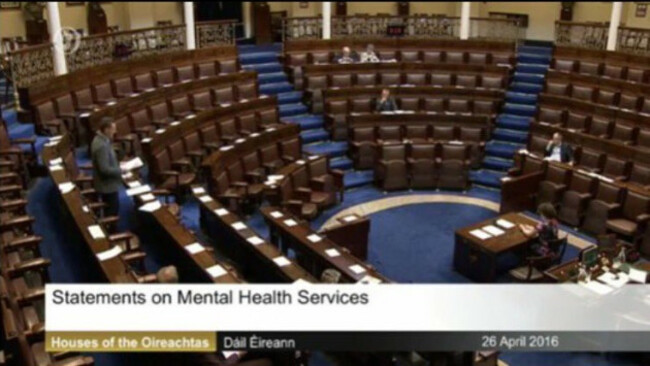
Throughout the evening, there was a negative reaction to the turnout for the debate, with many tweeting screenshots of an apparently close-to-empty Dáil chamber.
Some placed the number of TDs who showed up at 10, others at 40, while mental health awareness activists and artists the Rubberbandits posted a screenshot on Facebook which featured just seven deputies in the chamber, accompanied by the caption:
Here’s a photo of how many politicians turned up to speak about mental health in the Dáil today.
Is that accurate, though?
Béibhinn O’Connor in Dublin emailed us to ask whether it was actually the case that only 10 TDs showed up, so we consulted the official record of the Dáil, and combed through video of the debate to find out the truth.
Remember, if you see a claim you want tested, email factcheck@thejournal.ie.
Claim: Only 10 TDs showed up for a Dáil debate on mental health
Verdict: FALSE by a very wide margin.
67 TDs took part in some way. 33 spoke, 31 were present, and four presided over the debate. One TD presided and listened (Marcella Corcoran-Kennedy), and one TD presided, spoke and listened (Bernard Durkan).
A quick note to start. The purpose of this article is just to present the facts. It’s entirely up to you whether the turnout for Tuesday’s debate was acceptable or not.
The debate lasted three hours and 16 minutes, starting at around 3.19 pm, and ending at 6.35 pm.
There were 33 speakers. Here they are, grouped by party with the figures in brackets showing the number who spoke and that party’s total number of TDs:
Four TDs acted as chairperson over the course of the debate. They were:
In addition to the speakers, 30 TDs were present for at least some portion of the debate, based on our close analysis of the videos.
It is possible, of course, that other deputies may have entered and exited quickly enough that their presence wasn’t caught by cameras in the chamber. In which case, we will expand this list.
The TDs who attended, but didn’t speak, were (grouped by party as above):
So between speaking, presiding and listening to speeches, this is the breakdown of each party and grouping’s participation in the debate on mental health.
That’s 67 out of 158 TDs (42.4%)
It is quite rare for a large number of TDs to remain in the Dáil chamber over the full duration of a long debate without a vote, such as last night’s.
Typically, deputies drift in and out, delivering their remarks, supporting colleagues and opposing those on the other side of the house, and then leaving again.
The actual number of TDs in the house ebbs and flows over the course of a long debate.
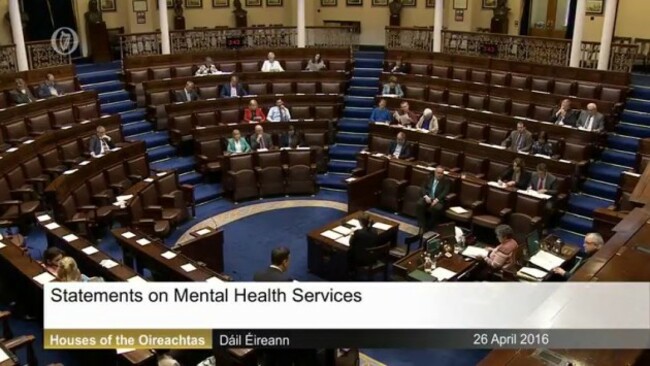
This screenshot, taken during Minister Varadkar’s opening speech on mental health last night, shows at least 29 TDs in the chamber:
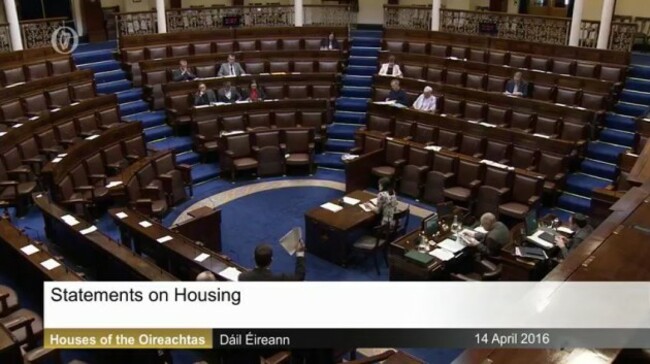
This one, taken at a similar stage of a similar debate – Minister Alan Kelly’s opening speech during “Statements on Housing” two weeks ago, shows only 12.
This is not to endorse standard Dáil practices, or make any claim about the relative importance of two different issues.
It is simply to point out that the distribution of attendance seen last night is far from unprecedented in Dáil Éireann.
For better or for worse, debates culminating in a vote, and formal set pieces such as leaders’ questions are often more densely packed than “statements” on a particular issue, however important.
Whatever your view on the importance of mental health, and the appropriate level of attendance and participation in last night’s debate, the facts are clear.
The claim that only seven, or 10, or even only 40 TDs showed up to debate mental health last night, is FALSE.
You can read the entire transcript of last night’s debate on mental health, here.
You can watch the debate here: Part 1 (starts on 49 mins), Part 2, Part 3, Part 4, Part 5.
Send your FactCheck requests to factcheck@thejournal.ie
Originally published: 27 April

To embed this post, copy the code below on your site









have your say