Sign in. It’s quick, free and it’s up to you.
An account is an optional way to support the work we do. Find out more.
Sign in. It’s quick, free and it’s up to you.
An account is an optional way to support the work we do. Find out more.
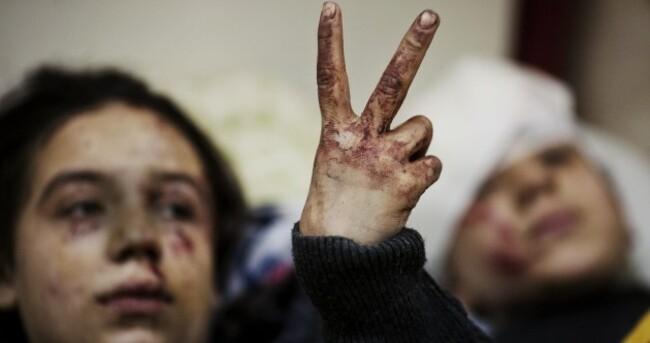
THIS WEEK MARKED the first anniversary of the unrest that has befallen Syria since an uprising against the current regime kicked off as part of the wider Arab Spring movement.
Taking the opportunity presented to them, Opposition forces across Syria mobilised to try and undermine and oust the long-serving Assad family. However, President Bashar Assad reacted not with diplomacy but with force.
The United Nations believes more than 7,500 people have been killed in the violence over the past 12 months. Restrictions on media crews have been in place since last March so independent verification of reports – on both sides – is impossible. As with all Arab Spring movements, social media has been used to report various atrocities and human rights violations with quite gruesome and violent videos and photographs appearing across YouTube, Facebook and Twitter.
Despite the Western world’s interest in developments in the Middle East, there has been little sign of a military intervention similar to that which was seen in Libya last April.
Of course, there has been some level of intervention – the world is talking about Syria. The UN Security Council has debated the issues and the UN and EU have implemented strong sanctions against the Assad regime.
As William Schabas, a Professor of International Law at Middlesex University, puts it, “It’s not as if the world is standing by, making no effort and saying it’s none of its business.”
But why was there a NATO-led intervention in Libya, where the violence against civilians did not escalate to the point it now has in Syria, where there has been none?
NATO’s secretary-general Anders Fogh Rasmussen has ruled out any intention to intervene in Syria. TheJournal.ie has asked a group of experts to explain this lack of movement:
“Very often, I get the question: ‘Why could you intervene in Libya but not in Syria?” – Rasmussen
But in Libya we had a very clear United Nations mandate and we had active support from a number of countries in the region. None of these conditions are fulfilled in Syria.
In a recent press briefing, Rasmussen gave this brief explanation on the main difference between Libya and Syria – international consensus. International law requires a resolution to be taken through the UN Security Council but both China and Russia have used their veto powers against proposed mandates which would allow for action.
Aaron David Miller of the Washington DC-based Woodrow Wilson International Center for Scholars told TheJournal.ie that China and Russia will be “very hard-pressed” to acquiesce to a Libyan model.
This becomes extremely important in an American context as the “whole issue of unilateralism has been a disaster for US credibility and foreign policy”.
“Iraq and Afghanistan are poster children for that,” says Miller, a Middle East and foreign policy expert. “Victory in both of those places are determined not by when we can win but by when we can leave. That is not a good place for America to be.”
The intervention in Libya, in contrast, had legitimacy, orchestrated by the UN Security Council. It had an executing arm in NATO, as well as regional support.
Clionadh Raleigh, a political science lecturer in Trinity College, adds that Europe – or any EU Member State – is not strong enough to lead an intervention instead of the US.
“Europe doesn’t have the stomach or the staying power,” she said, echoing Miller’s belief that a strategy has to be based on a coalition that is “willing and sustainable”.
“Powers have to be able to count on each other if the strategy does not work out how they wanted it to or in the timeframe they had planned,” he said.
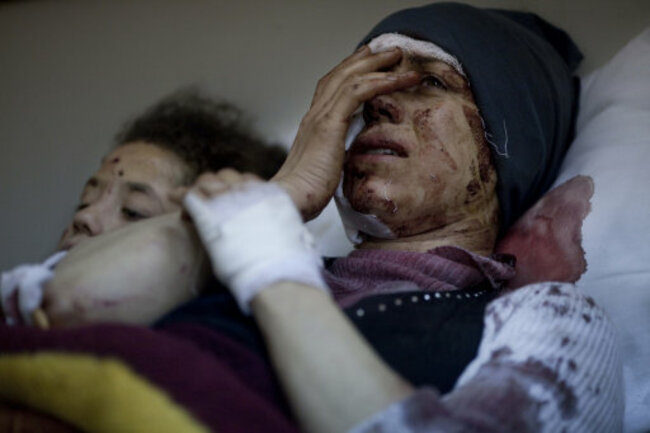
Aida, 32, recovers from severe injuries after the Syrian Army shelled her house in Idlib last Saturday. Image: Rodrigo Abd/AP/Press Association Images
“Libya was low-hanging fruit.” - Miller
One of the most basic differences between Libya and Syria is the quality of the regimes’ defences.
Libya had no serious air defences or chemical weapons. It was relatively simple to carry out airstrikes and train and arm the Opposition fighters in the North African country.
Syria is much more complicated, explains Miller.
It has a sophisticated air events system, chemical weapons and a serious military that is not going to fragment easily.
The geography and topography of Syria also makes a difference. Right now – from a military point of view – there are no safe havens and sanctuaries in Syria similar to those that were utilised in Libya. The Eastern half of Libya was almost immune to strikes and attacks but no area of Syria seems to be safe from Assad’s loyal forces.
Any discreet areas where Opposition fighters could be supplied from would need to be created and defended in Syria – a task which could prove difficult.
“The US cannot be dragged into another domestic conflict about regime replacement.” - Raleigh.
It is an election year in the US – something that cannot be overlooked when examining the international reaction to Syria.
“There really is no easy answer to the question of an American role right now,” says Miller. “Barack Obama is very sensitive to squandering American lives and/or resources on military adventures in which the goals are not clear and the means to achieve them are difficult to master.”
The Obama administration would have to share responsibility on any movement, as happened in Libya, which was an example of policy ran by committee.
But even with international legitimacy and regional support, Libya was still messy and it still took eight months to oust Gaddafi.
“The American public really doesn’t want to expend a lot of resources on involvements abroad and a President has to take all that into consideration before he commits himself to a risky proposition in an election year,” adds Miller.
The US could intervene and it could go badly. We could lose aircraft, Syria could be more resilient than expected and then there is an image of a small country besting a big one.
Schabas told TheJournal.ie that Assad’s own behaviour has been important – particularly when examining the Russian’s stance.
“Objectively, the violence in Syria is worse,” he says. “But there has been violence in other parts of the world during which the international community – or America – did not intervene. What’s the difference? It’s about diplomacy and delicate discussions.”
A year ago, Gaddafi totally isolated himself. He made “stupid” public statements that alienated him from people and leaders who could still have been counted as allies.
The League of Arab States eventually had not choice but to turn on him.
Assad still has a friend in Russia, which has made it clear it will not accept robust intervention. Therefore, Syria is not isolated in even remotely the same way.
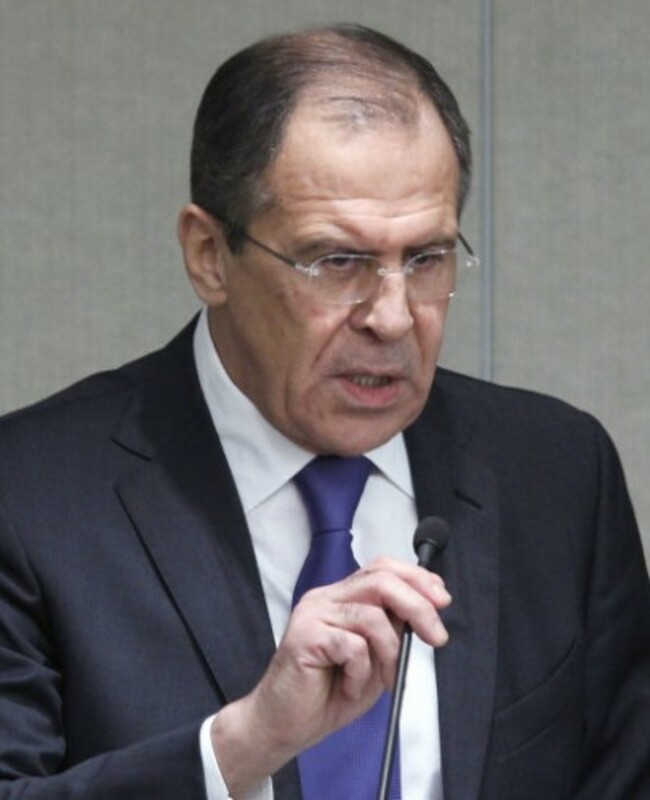
Russian Foreign Minister Sergey Lavrov tells parliament that Moscow is providing Syria with weapons to fend off external threats but has no intention to use military force to protect Assad himself. Image: Misha Japaridze/AP/Press Association Images
“NATO has no intention whatsoever to intervene in Syria. And that also includes arming the opposition.” – Rasmussen.
The Opposition in Libya came together and were recognised as the legitimate leaders of Libya within a short timeframe. A similar action has failed to materialise in Syria.
Raleigh explains that Syria’s Opposition is largely made up of former and mutinous soldiers who actually have materials to keep fighting with.
However, it also means that civil war could be closer and more civilians in danger. Syrian people who still support Assad – which are quite hefty in number – could be at risk and are likely to be killed by those who oppose him.
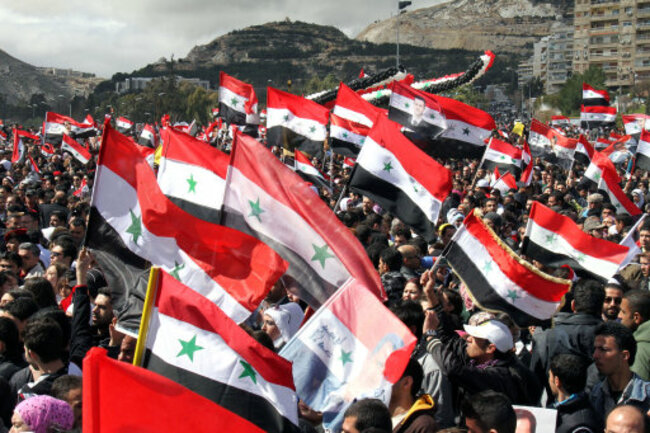
A pro-regime rally in Damascus on Thusday. Image: Bassem Tellawi/AP/Press Association Images
“The reason is that Allies find that a regional solution to the problems in Syria is the best way forward.” - Rasmussen
“Countries often have to fight these things out themselves,” says Raleigh. “Because to be successful, the next leaders have to topple the regime themselves- without outside help or civil war is somewhat inevitable.”
If they are assisted, they end up being successful but then there is quite a lot of questioning about holding onto power.
The regime could just end up retracting from Damascus, rebuilding and attacking at a later stage – leading to a prolonged, all-out civil war.
Raleigh explains that the domestic issue in Syria is about what group is going to be dominant.
“It is a domestic dispute during which atrocities unfortunately happen. It is shocking but it is not necessarily solved by someone else going in,” she explains.
“Obviously what is going on in Syria may have an impact on the regional stability.” – Rasmussen
An intervention in Syria could lead to a precarious and sensitive geopolitical situation, says Raleigh.
At the moment, Iran overwhelms that geopolitical narrative, however, as it has significant powers to destabilise the region. It therefore carries greater weight and importance for international powers such as the US.
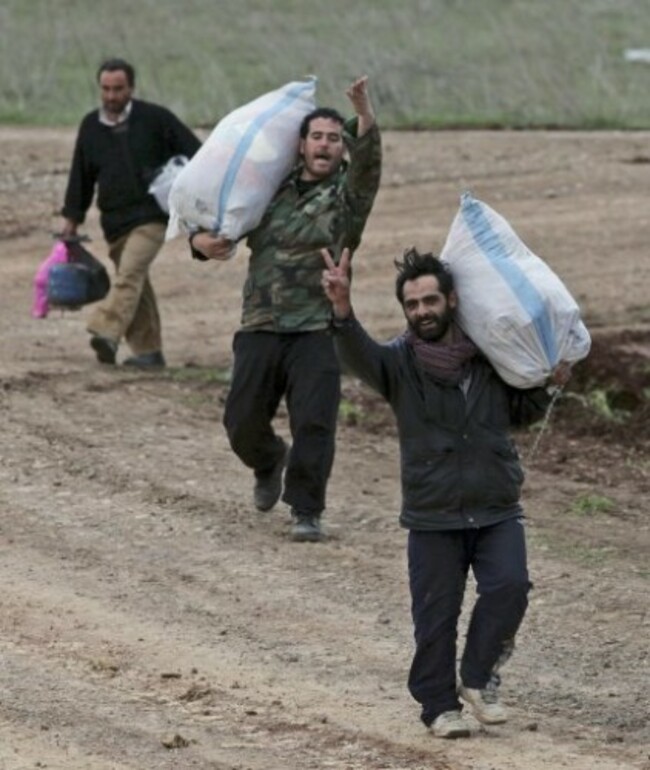
Turkey has taken somewhat of a lead in dealing with the situation locally but it is still wary of plunging itself into crisis. However, on Friday it said it was considering establishing a “buffer zone” along its border after 1,000 Syrians cross into its territory as refugees escape attacks by security forces. Such a move could solidify its position as the head of any movement and push forward any foreign involvement.
A group of Syrians fleeing violence in their country, walk towards the Turkish border near Reyhanli. Image: Burhan Ozbilici/AP/Press Association Images
“Bottom line is getting into these conflicts is a lot easier than getting out of them.” – Miller
Miller believes that timing is another important factor when comparing Syrian and Libyan Arab Spring experiences.
Libya came along at a very important time in the whole development of the Arab Spring, which has since become very complicated. It is less of a spring now and more of a slog. A winter, in fact.
“At that moment, it was important for the West. There was a hopefulness, a notion that we had to encourage democrats and send unmistakable signals to dictators. But now is not then,” says Miller.
“Syria does not catch the imagination like Libya did,” adds Raleigh. “Assad is not Gaddafi – he is not at the end of his days and any struggle against him will be longer.”
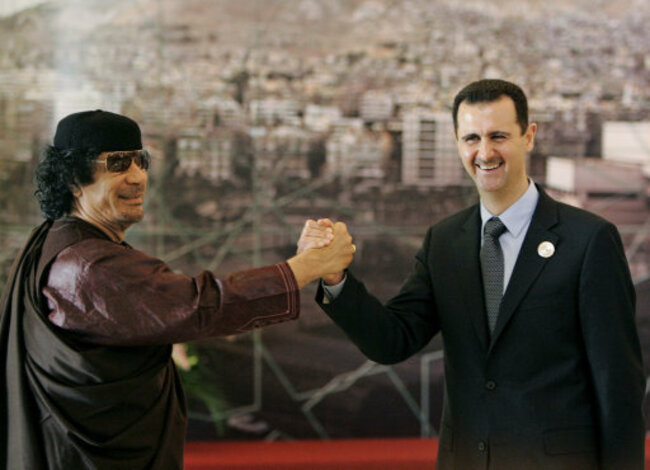
File photo of Muammar Gaddafi with Bashar Assad in 2008. When Assad took over from his father in 2000, many saw him as a fresh face who could transform the Assad dictatorship into a more modern state.
Miller believes that violence in Syria will continue and, as it does, the international community will deepen its actions.
“I suspect that America will make it unmistakeably clear that the goal is to change the regime – that is something that hasn’t been said yet. There has only been talk about how it is inevitable the Assads will fall,” he told TheJournal.ie.
There will also be more contact between America and the Syrian National Co-ordination Committee and there may be moves to provide non-lethal assistance to the Opposition.
The Russians will be pressurised into accepting a compromise on some sort of action or Security Council resolution. Sanctions will continue through the foreseeable future but it is still unclear how effective any of this will be.
Sanctions on their own certainly don’t bust regimes quickly as Iraq and Iran have proved.
“It’s a long movie but if the arc of killing intensifies, then there may well be a push to do something more dramatic,” predicts Miller, before adding he does not know what this could.
However, he says one thing that could facilitate action is if a serious crack in the regime appears.
“An Alwayi military commander who is worried about war crimes or simply becomes more enlightened to ‘do the right thing’ could accelerate such a crack and an international movement could build on that momentum,” concludes Miller.
The bottom line is that Syria’s situation highlights the nature of current world politics and its fear of the unknown. It is a complex issue for which the Libyan model of intervention is not a template. In fact, there is no model to emulate. Let’s just hope that on the second anniversary of the uprising, we are not still faced with the same questions about the same unknown.

To embed this post, copy the code below on your site










have your say