Sign in. It’s quick, free and it’s up to you.
An account is an optional way to support the work we do. Find out more.
Sign in. It’s quick, free and it’s up to you.
An account is an optional way to support the work we do. Find out more.
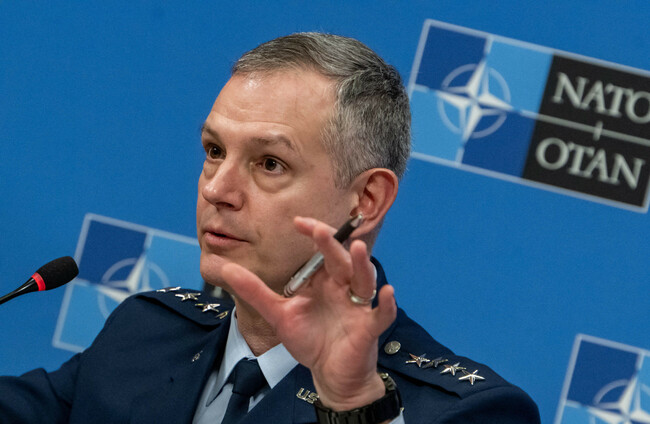
THE US GENERAL who leads Nato military forces has said Donald Trump’s anti-Europe “political rhetoric” is not what the “military to military” relationship looks like, which he claims is “rock solid”.
Speaking to The Journal in Dublin on Wednesday, General Alexus G. Grynkewich, who is Commander of the US European Command and Supreme Allied Commander Europe (SACEUR) at Nato, spoke in detail about Europe’s defence relationship, his view on Irish neutrality and whether Russia is about to attack the European Union.
There has been an increasingly tetchy relationship with the US government in the last two years, including direct verbal dressing downs against specific countries.
In 2026, JD Vance launched a tirade against what he said was Europe’s failure to adequately fund its own security. Trump has also taken a swipe at Europe’s failure to fund its own defence and pay what he believes is needed to make Nato effective.
Pete Hegseth, the US Secretary for War, has also launched attacks on Nato countries, withdrawn troops from Poland and elsewhere and launched a review of US troop numbers.
On the other side, Nato Secretary General Mark Rutte has led a diplomatic love bombing of Trump to keep the US onside.
Recently Matthew Whittaker, the US Ambassador to Nato, also speaking in Dublin said that he spends “a lot of time just calming everybody down”.
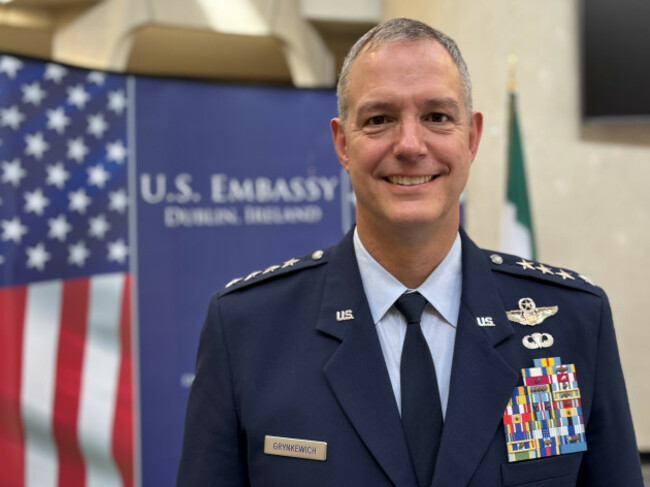
Grynkewich, who is the operational military leader for Nato forces, is of the view that the political commentary has nothing to do with the military communications going on behind the scenes.
“If I was Vladimir Putin, I’d pay more attention to the military-to-military relationships and other relationships that we have,” the General said.
“You know, there will always be a level of political rhetoric that happens for better or worse. And you know, it’s not my position to judge any of that.
“But I will tell you, throughout all the ups and downs of my time in the military, whether working in the Middle East or here, working with the 32 allies and our partners in Europe, the mil-to-mil relationships have been rock solid. We’re open and transparent with each other.
“We work together in a highly collaborative way, and that’s what I’d be concerned about if I was Vladimir Putin,” he added.
There has been some commentary from international defence correspondents that Britain may move into the role of SACEUR given the US political policy.
However, Grynkewich said that Donald Trump interviewed and appointed him to the role and he said he has a “mandate” to continue in the role.
“I’m going to fulfil that job as long as I’m in it, and so I think that shows American commitment.
“I like to say to people, ‘I’m right here. You know, I’m an American officer talking to you as Saceur. That should be a demonstration of the American commitment to this,” he said.
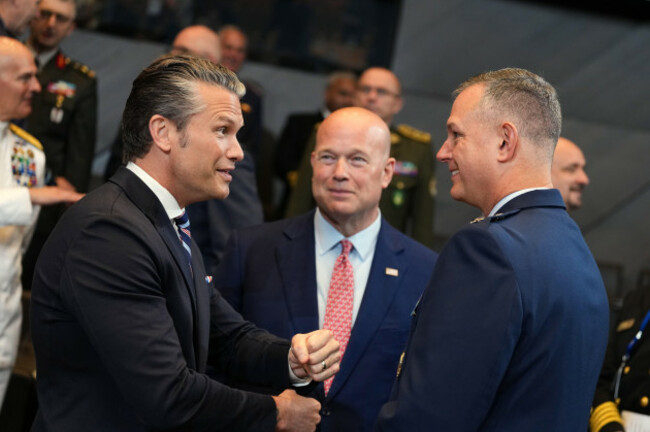
In recent years, concern has continued to mount that Russia may launch a conventional attack on a European country.
On Wednesday, German General Carsten Breuer, likely reacting to a major explosive drone incursion at Leipzig, told the Wall Street Journal that it was his country’s belief that Russia was testing defences to refine its tactics for a future conflict.
Grynkewich played down the threat, however, and said that he believes that Nato’s strength means that “Russia remains deterred”.
The General had said a similar statement in June and added in Dublin on Wednesday that it was critical to continue to make that deterrence a reality by making sure countries meet their Nato commitments on equipment and spending to beef up defences in Europe.
“I would say: I don’t have immediate concerns that Russia would consider an overt attack on alliance territory because I do believe that they are still deterred, but we’re going to have to work to keep it that way over the coming years’,” he said.
Since the end of World War Two, US troops have been based in various European countries to buttress the continent’s security. At its peak in the 1950s there were more than 400,000, but now there are between 60,000 to 100,000.
Firebrand Pete Hegseth’s review of US troop numbers could see reductions in Europe but Saceur said there is “no preconceived notion about what that might look like”.
He did say that the process will come down to him working ”with our [US] policy and political leadership on what we think the right mix of forces is over here to continue to deter and defend”.
“I know I’ll have my voice in that – political leaders can do what they like in the end, but I don’t think there should be an assumption that there’s going to be a drastic reduction or that there won’t be a drastic reduction. We just don’t know yet. It’s too early in the process,” he said.
When it comes to Ireland, and its defence capabilities he believes there is “space in the Irish body politic” to discuss neutrality and capacity to protect its interests.
“Ultimately, that’s an Irish decision, and not something that I would weigh in on. But I do think that it’s an important conversation to be had amongst the Irish people,” he added.
The General is also meeting the Minister of State at the Department of Defence, Thomas Byrne and the Chief of Staff of the Irish Defence Forces Lt Gen Rossa Mulcahy during his time in Ireland.

To embed this post, copy the code below on your site













have your say