Sign in. It’s quick, free and it’s up to you.
An account is an optional way to support the work we do. Find out more.
Sign in. It’s quick, free and it’s up to you.
An account is an optional way to support the work we do. Find out more.
LAST UPDATE | 9 Feb 2022
SOCIAL WELFARE PAYMENTS targeted at workers and working families on lower rates of pay could help to ease the burden of sharply rising energy and fuel prices on some of the most at risk, experts and advocates say.
Tomorrow, the Government will unveil a package of measures that it hopes will mitigate the intense cost of living pressures weighing on lower to middle-income households — those most vulnerable of having their purchasing power eroded by rising inflation.
At tonight’s parliamentary party meeting, Tánaiste Leo Varadkar told Fine Gael TDs that a “substantial” package was being prepared to help with the cost of living.
The Fine Gael leader said there would be a universal element that would benefit all households – and targeted elements for those most in need.
Colleagues heard the symptoms of inflation were being treated by Government, but added that a wider anti-inflation strategy is required.
Varadkar also said a big feature of the next budget should be reducing the cost of childcare.
Fuel Allowance increases ruled out
Speaking on RTÉ Radio 1 over the weekend, Taoiseach Micheál Martin effectively ruled out any increases to core social welfare rates like the Fuel Allowance as part of the measures that will be taken to tackle the cost of living.
But experts say increasing in-work benefits — such as the Working Family Payment (WFP) — in line with inflation and making them more widely available could be an effective response to the stark rise in household costs over recent months.
The WFP is a weekly tax-free payment available to employed people or couples on low pay, who have at least one child either living with them or dependent on their financial support.
Eligible candidates can then receive up to 60% of the difference between income limits — which are set by the Department of Employment Affairs and Social Protection based on the number of children within the family — and their average weekly family income.
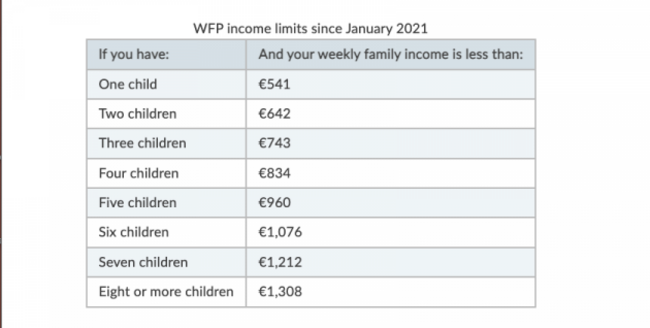
The income thresholds were increased by €10 per week in October’s Budget.
However, recipient families will not feel the benefit until June when the changes come into force.
Today, Sinn Féin proposed a ‘cost of living cash payment’ to individuals, based on their income. This would mean that a household would receive a €100 electricity grant, worth €113.50, plus a cash payment to each household earner.
This could range from €100 to €200 depending on how much they earn.
“An individual on an income of up to €30,000 would receive a Cost of Living Cash Payment of €200, and an individual on income of between €30,000 to €60,000 would receive a Cost of Living Cash Payment of €100,” Sinn Féin finance spokesperson Pearse Doherty said.
Analysis of Budget 2022
In its analysis of Budget 2022, published last October, the Economic and Social Research Institute (ESRI) highlighted that €10 increase across the income bands was not consistent with inflation projections at the time.
The hike corresponded to “a 1.8% rise in payments for many low-income working-age families with children”, which the ESRI said in its analysis was “below” the Department of Finance’s forecast rate of inflation for 2022 of 2.2%.
But the harmonised rate of Irish consumer price inflation hit 3% in December and the European Central Bank (ECB) now believes it could remain well above its 2% target across the Eurozone for much of 2022.
Overall, the ESRI found that Budget 2022 insulated most households from sharply inclining prices.
But Claire Keane, Senior Research Officer at the ESRI, told The Journal this week that people in the middle of the distribution weren’t quite as protected.
“We looked at the Budget and basically the lower end of the income distribution and the upper end were largely protected from the inflation numbers that were around the time because social welfare rates increased and there was an increase in tax bands,” she explained.
“But it was really people in the middle but towards the bottom of the distribution who didn’t get the sort of boost to their income to account for inflation.”
Ireland is an outlier to in-work benefits
Partially, that’s because the WFP is not available to people who do not have children, Keane explained, which highlights a major gap in Ireland’s system of social protection.
Ireland is a bit of an outlier when it comes to in-work benefits because you have to have children to qualify for the WFP, she said.
“So the UK and the US — they have equivalent benefits that exist for low-income workers,” Keane explained. “It doesn’t matter if you have children or not. You may get a bit more if you do have children.”
There’s also evidence that up to a third of people eligible for the WFP don’t avail of it, she added, “and this seems to be much more prevalent with this payment than with other payments”.
Against the backdrop of skyrocketing fuel and energy costs, Keane says there is an argument for increasing the weekly WFP income thresholds by more than the €10 announced in Budget 2022.
Collette Bennett, Economic and Social Analyst with Social Justice Ireland, said the Government should also consider bringing forward the start date for the new thresholds from June, which will be of “limited value” to working families.
“An increase is always welcome,” she said, “but certainly it isn’t in line with inflation that and with the cost of living increases that we’re seeing.
“What’s also quite stark about the timing of the increase is it’s coming in the summer, when we know that energy costs, fuel costs [which tend to be higher in the winter] are one of the main drivers of this increase in the cost of living.”
Bennett said the Government should consider a refundable tax credit to allow lower-income workers — many of whom don’t earn enough to use their full tax credit allowance — to claw back the balance.
In response to questions, a spokesperson for for the Department of Social Protection said it is “currently reviewing options for measures which could help ease the cost of living pressures many are currently facing”.
With reporting from Christina Finn and Gráinne Ní Aodha.

To embed this post, copy the code below on your site













have your say