Sign in. It’s quick, free and it’s up to you.
An account is an optional way to support the work we do. Find out more.
Sign in. It’s quick, free and it’s up to you.
An account is an optional way to support the work we do. Find out more.
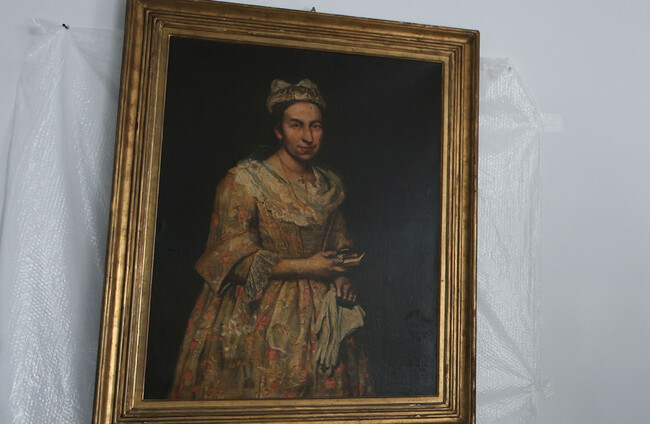
ARGENTINE AUTHORITIES HAVE recovered an 18th century painting stolen by Nazis from a Dutch Jewish art collector, which was discovered in a property ad this year and then suddenly vanished again.
The “Portrait of a Lady” by Italian baroque painter Giuseppe Ghislandi was missing for eight decades before being photographed hanging in the home of the daughter of a senior SS officer, who fled to Argentina after World War II.
Prosecutors said yesterday that the woman’s lawyer has returned the work after a major hunt for it that made headlines worldwide.
Showing off the piece, art expert Ariel Bassano told reporters it was “in good condition for its age, as it dates from 1710″.
He was quoted by the local La Capital Mar del Plata newspaper as valuing it at “around $50,000″.
The painting was recognized last week by the Dutch newspaper AD in photographs of a house for sale in the seaside resort of Mar del Plata.
It was hanging above a green sofa in the living room of Patricia Kadgien, daughter of SS financial advisor Friedrich Kadgien, one of several high-ranking Nazis to escape to Argentina after the war.
The painting was among over 1,000 artworks stolen from Amsterdam art dealer Jacques Goudstikker’s collection after the Nazi invasion of the Netherlands in 1940.
Its discovery generated a flurry of excitement on both sides of the Atlantic.
But as soon as it had been identified, it disappeared again.
When Argentine police went to raid the premises after being tipped off about the property ad, they found no trace of the artwork.
Kadgien and her husband were placed under house arrest on Tuesday after several failed police searches for the portrait.
According to Argentine daily La Nacion, the couple admitted in a court filing that they owned the artwork and said they believed any lawsuit over its ownership would fall under the statute of limitations.
Their lawyer, Carlos Murias, said that prosecutors were seeking to charge his clients with “concealing smuggling.”
If framed within the context of the genocide of Jewish people during World War II, the crime would not be bound by the statute of limitations.
The investigation arose from a visit to Kadgien’s home by Dutch journalist Peter Schouten, who was investigating her father’s past.
“We wanted to talk about her father because there were a lot of news stories about him in the Netherlands about ten years ago,” Schouten told Argentina’s Radio Rivadavia.
Schouten said he knocked on the door of the house and got no response but noticed a for-sale sign.
After searching online property ads, he spotted the painting in a photo of the house’s interior.
“I freaked out, of course,” Shouten recalled. “I sent all the information to Holland, where they worked with the official institutions and confirmed that yes, it was that painting, that there was no chance it was a replica,” he said.
He said he immediately contacted Kadgien to get her version of events but received no response and that shortly afterwards, the for-sale listing was removed from the property site.
Goudstikker, a leading dealer of Italian and Dutch 16th- and 17th-century masters during the wars, fled the Netherlands days after the Nazi invasion.
His extensive art collection was stolen and divvied up by Nazi officials led by Gestapo founder Hermann Goering.
After the war, the Dutch state retrieved some 300 works from the collection, most of which it later returned to Goudstikker’s heirs, but many others remain scattered around the globe.

To embed this post, copy the code below on your site















have your say