Sign in. It’s quick, free and it’s up to you.
An account is an optional way to support the work we do. Find out more.
Sign in. It’s quick, free and it’s up to you.
An account is an optional way to support the work we do. Find out more.

IRELAND IS RANKED 20th in a new study looking at how much progress countries need to make in order to reach health-related Sustainable Development Goals (SDGs).
The Global Burden of Disease study, published in The Lancet, is the first comprehensive analysis of trends from 1990-2014 and projections to 2030 for 188 countries.
The topics evaluated include children being overweight, maternal mortality, harmful alcohol use and smoking prevalence.
Singapore tops the list, followed by Iceland, Sweden, Norway and the Netherlands. Afghanistan is the lowest placed country, with the Central African Republic, Somalia, South Sudan and Chad making up the bottom five.
Ireland rates highly in many of the categories, which are marked out of 100, but gets one red mark for harmful alcohol use – we scored just 11 in this category, lower than any other country in the top 20.
To measure harmful alcohol use, researchers evaluated individual-level drinking (by age and gender) and population-level consumption and the associated health risks.
Ireland also scored poorly – 33 out of 100 – in relation to the prevalence of recorded child sex abuse cases.
Ireland scored full marks in nine categories – including disaster mortality, child stunting (impaired growth and development from poor nutrition), water quality, prevalence of household air pollution and hygiene.
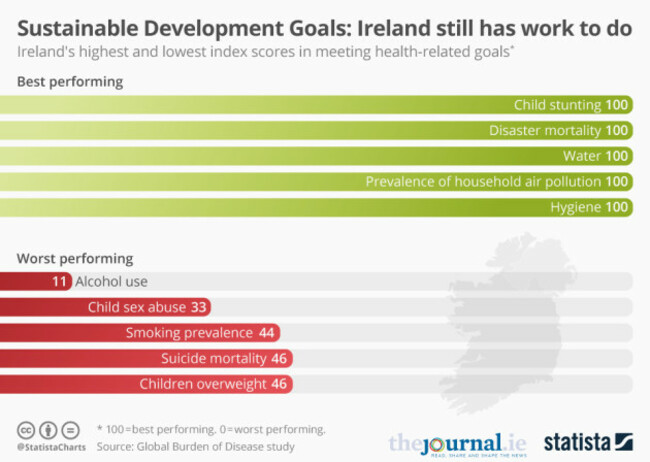
We scored 90 in terms of both road injury mortality (the death rate per 100,000 of the population) and vaccine coverage. The latter is defined as “the proportion of the target population covered by all vaccines included in their national programme”.
In 2016, 186 people were killed on Irish roads. No country in the study is projected to meet the SDG target for road injury mortality, which calls for a 50% reduction in the number of deaths worldwide by 2020.
Our six lowest ranking categories are (scores in brackets):
There are over 500 reported cases of suicide in Ireland each year (meaning the actual total is likely to be higher). The new research shows, on the basis of past trends, few countries are projected to achieve SDG targets on suicide mortality – ie reduce the rate by one-third from 2015 to 2030.
The 17 SDGs, otherwise known as the Global Goals, include 169 targets covering topics such as ending poverty, climate change, economic growth, health and education.
The new study estimates progress for 37 out of 50 health-related indicators included in the goals, which were agreed in 2015.
Poor performance
More than 60% of the countries evaluated are projected to meet health targets on under-fives, neonatal and maternal mortality, and malaria.
However, fewer than 5% of countries are projected to meet targets on children being overweight, tuberculosis and road injury mortality.
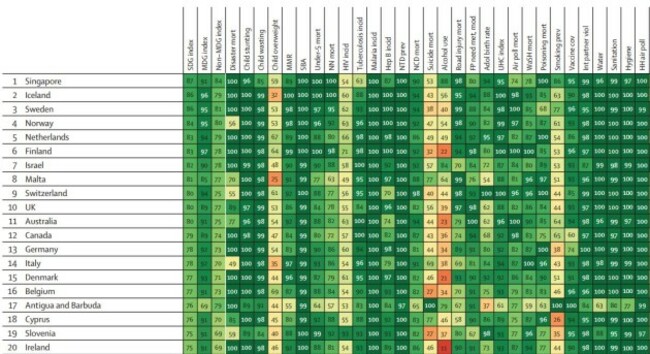
The UK came in 10th place on the list, while the US is 24th.
In comparison to other countries, Britain performed poorly on indicators of child sexual abuse, alcohol use, smoking prevalence and children being overweight (as did Ireland).
The US performed poorly on indicators such as suicide mortality, child sexual abuse, alcohol use and homicide.
China ranked 74th, with low scores on air pollution, road injury, poisoning and smoking. India ranked 128th, with low scores on air pollution, sanitation, hepatitis B and child wasting (acute malnutrition).
The authors of the study say its findings should help shape policies and investment in order to address long-standing and emerging health challenges. The research has been published to coincide with the 72nd session of the United Nations General Assembly, which is currently taking place in New York.
If you need to talk, contact:

To embed this post, copy the code below on your site













have your say