Sign in. It’s quick, free and it’s up to you.
An account is an optional way to support the work we do. Find out more.
Sign in. It’s quick, free and it’s up to you.
An account is an optional way to support the work we do. Find out more.
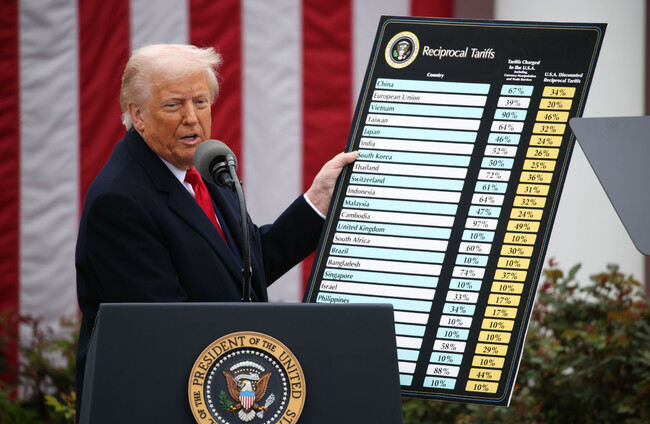
LAST NIGHT, DONALD Trump upended the global trade order as he stood in the Rose Garden of the White House.
Holding a chart with a list of countries and the tariffs the United States will be charging them, he claimed that the European Union charges tariffs of 39% on goods imported from the US.
He said the US will charge 20% tariffs on European Union imports in return.
“We’re charging them essentially half,” he said, saying the “reciprocal tariff” is 39%.
“They’re very tough, very, very tough traders. You think of European Union, very friendly. They rip us off. It’s so sad to see. It’s so pathetic.”
How did he come to this 39% figure though, and is it accurate?
The short answer is no, it is not.
At the top of Trump’s big chart of countries, it says that the figures representing the tariffs charged to the US include “currency manipulation and trade barriers”.
It is not clear what these terms include.
Immediately after his announcement last night, most economic commentators were scratching their heads over how he arrived at these figures.
The EU’s average tariff rate on US exports does not come close to the 39% figure claimed by Trump.
The World Trade Organization says the EU’s average tariff rate is 5%, while the European Commission says the average tariff on goods traded between the EU and the U.S. is about 1% for both sides.
The EU does impose significant tariffs of over 30% on some agricultural products such as dairy, but the weighted average tariff on US goods comes in at around 3%.
In the hours afterwards, it became clear how Trump had calculated his 39% – it all comes down to trade deficits.
Each country’s new tariff rate appears to be based on a formula that takes the trade deficit that America runs with that country and divides it by the exports that country sends to the US.
Then this figure, the final “tariff” number, was cut in half – this is why Trump said he was being “kind”.
This was first pointed out by James Surowiecki, a financial writer, in a post on X.
“So we have a $17.9 billion trade deficit with Indonesia. Its exports to us are $28 billion. $17.9/$28 = 64%, which Trump claims is the tariff rate Indonesia charges us. What extraordinary nonsense this is,” Surowieki writes.
Just figured out where these fake tariff rates come from. They didn't actually calculate tariff rates + non-tariff barriers, as they say they did. Instead, for every country, they just took our trade deficit with that country and divided it by the country's exports to us.
— James Surowiecki (@JamesSurowiecki) April 2, 2025
So we… https://t.co/PBjF8xmcuv
Following this, deputy White House press secretary Kush Desai published the methodology behind the calculations in a post on X.
Although Desai claims that Surowiecki’s analysis is wrong, his post essentially confirms that the formula used by the White House is based on the US trade deficit with a country and then divided by the country’s exports.
No we literally calculated tariff and non tariff barriers.https://t.co/GiWRU6gJDv https://t.co/TmzN1wcC2b pic.twitter.com/sjV9apMJ4F
— Kush Desai (@KushDesai47) April 3, 2025
Responding to Desai’s post, Surowiecki said it was “truly amazing”.
“The Deputy White House Press Secretary is claiming that I’m wrong, and that the ‘tariff rates’ on Trump’s chart were calculated by ‘literally’ measuring every country’s tariffs and non-tariff trade barriers,” he wrote.
He continued: “To prove it, he screenshots the formula the USTR says was used to calculate the reciprocal tariffs we imposed on other countries. And when you back out the Greek symbols, what is that formula? Trade deficit/imports – exactly what I said it was.
“I don’t know if the Deputy Press Secretary was misinformed, or is just being misleading. Either way, the Trump administration did not ‘literally calculate tariff and non tariff barriers’ to determine the tariff rates it’s imposing on other countries. As I said, it divided our trade deficit with a country by our imports with that country, and then multiplied by 0.5 (because Trump was being “lenient”).”
Separately, a White House official confirmed to reporters during a press briefing that the formula used was based on trade deficits.
The official said that the figures were calculated by the Council of Economic Advisers and that the model was based on “the concept that the trade deficit that we have with any given country is the sum of all trade practices, the sum of all cheating”.

To embed this post, copy the code below on your site














have your say