Sign in. It’s quick, free and it’s up to you.
An account is an optional way to support the work we do. Find out more.
Sign in. It’s quick, free and it’s up to you.
An account is an optional way to support the work we do. Find out more.
LAST UPDATE | 6 May 2025
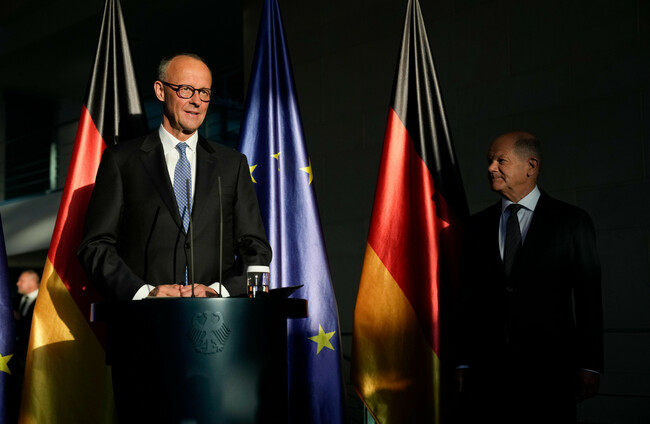
AFTER A SECOND vote in parliament today Friedricch Merz finally succeeded in his bid to become the next German chancellor, hours after he suffered a historic defeat in the first round.
He had been expected to smoothly win the vote to become Germany’s 10th chancellor since the Second World War.
No candidate for chancellor in post-war Germany has failed to win on the first ballot.
Merz received 325 votes in the second ballot.
He needed a majority of 316 out of 630 votes in a secret ballot, but only received 310 votes in the first round — well short of the 328 seats held by his coalition.
Three MPs abstained, with one invalid ballot, while nine MPs were absent.
Because the votes were secret ballots, it was not immediately clear — and might never be known — who had defected from Merz’s camp.
Merz’s coalition is led by his centre-right Christian Democratic Union and its Bavarian sister party, the Christian Social Union.
They are joined by the centre-left Social Democrats led by outgoing chancellor Olaf Scholz, who lost the national election in February.
Upon announcing the second vote, the head of the Union bloc in parliament, Jens Spahn, said, “The whole of Europe, perhaps even the whole world, is watching this second round of elections.”
Tánaiste Simon Harris offered Merz his congratulations in a post on X, saying that Ireland and Germany are “close partners and good friends at the heart of the European Union”.
Hours after being voted in as chancellor by MPs on his second attempt, Merz told the ARD broadcaster he wanted to “restore people’s trust in the political centre and ensure that they no longer feel it necessary to vote for a party such as the AfD.”
The new coalition, consisting of Merz’s conservative CDU/CSU alliance and the centre-left SPD, will offer Alternative for Germany (AfD) voters the chance of “returning to the political centre,” he said.
The AfD has notched up a string of electoral successes in part by capitalising on growing concerns about immigration in Germany at a time Europe’s top economy has been in the doldrums.
It won over 20 percent of the vote in February’s elections, second only to Merz’s conservative Christian Democrats, making it the country’s biggest opposition party.
Germany’s domestic spy agency last week designated the party a “right-wing extremist” group, accusing it of seeking to undermine the country’s democracy.
The AfD is taking legal action over the designation.
Merz also addressed Israel’s new offensive in Gaza.
Speaking to public broadcaster ARD, he said: “We view the developments of the last few days with considerable concern.”
“Israel has the right to defend itself against the brutal attack by Hamas terrorists on 7 October and everything that followed,” said Merz.
“But Israel must also remain a country that lives up to its humanitarian obligations, especially as this terrible war is raging in the Gaza Strip, where this confrontation with Hamas terrorists is necessarily taking place.”
He added that “it must be clear that the Israeli government must fulfil its obligations under the international law of war and that humanitarian aid in the Gaza Strip must be provided”.
Following the federal election result in March, Merz invited Israeli Prime Minister Benjamin Netanyahu to visit Germany, despite a warrant for his arrest being issued by the International Criminal Court.
Congratulations to @_FriedrichMerz on your election as Chancellor.
— Simon Harris TD (@SimonHarrisTD) May 6, 2025
🇮🇪 and 🇩🇪 are close partners and good friends at the heart of the European Union. We look forward to working closely with you and your government.
Herzlichen Glückwunsch!
Germany, the most populous member state of the 27-nation European Union, has the continent’s biggest economy and serves as a diplomatic heavyweight.
The new chancellor’s in-tray would include the war in Ukraine and the Trump administration’s confrontational trade policy on top of domestic issues, such as the rise of a far-right, anti-immigrant party.
His conservatives emerged as the largest party in the country’s February election, taking 28% of the vote as the far-right Alternative for Germany (AfD) came in second with 20% and the Social Democrats came third on 16%.
With reporting from AFP and Press Association

To embed this post, copy the code below on your site















have your say