Sign in. It’s quick, free and it’s up to you.
An account is an optional way to support the work we do. Find out more.
Sign in. It’s quick, free and it’s up to you.
An account is an optional way to support the work we do. Find out more.
FRIEDRICH MERZ – A man who became a corporate lawyer after leaving politics fifteen years ago and has never been a government minister – is set to become Germany’s new chancellor.
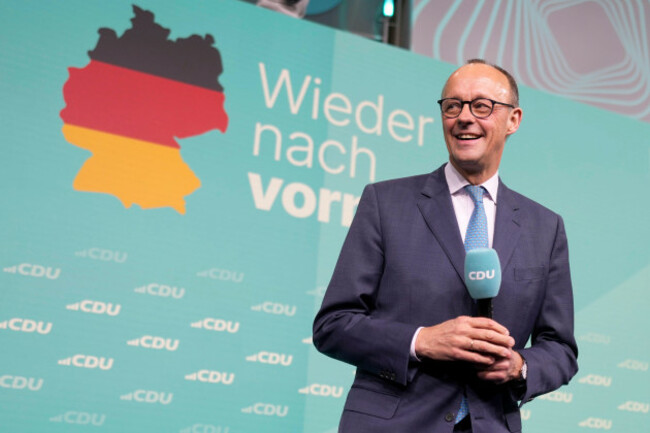
His Christian Democrat party (CDU) emerged as the largest party in the country’s election at the weekend, taking 28% of the vote as the far-right Alternative for Germany (AfD) came in second with 20%.
Outgoing chancellor Olaf Scholz’s Social Democratic Party (SPD) slumped to 16%, down by almost 10% from when they finished first four years ago.
Merz is expected to reach out first to the SPD as he seeks to form a coalition government. He has vowed to rule Europe’s largest economy by returning to his party’s conservative roots, and to rebuild Berlin’s international standing for “a Germany we can be proud of again”.
Polls had long declared him as the strong favourite to oust Scholz and bring an end to what Merz labels “three lost years” for Germany.
Merz, who is Roman Catholic, was born in 1955 and lives among the rolling hills and forests of the Sauerland region of North Rhine-Westphalia state.
He has been married for more than 40 years to Charlotte Merz, a judge, with whom he has three adult children.
A lawyer by profession, he was elected to the European Parliament in 1989 and soon after to the Bundestag, where his mentor was the late CDU powerbroker Wolfgang Schaeuble.
Merz’s ascent to power was derailed by former chancellor Angela Merkel in the early 2000s. She has described Merz as a brilliant speaker and complimented his desire for leadership, though she acknowledged this was a problem in their relationship.
“We are almost the same age … We grew up completely differently, which was more of an opportunity than an obstacle,” she wrote in her memoir Freedom.
“But there was one problem, right from the start: We both wanted to be the boss.”
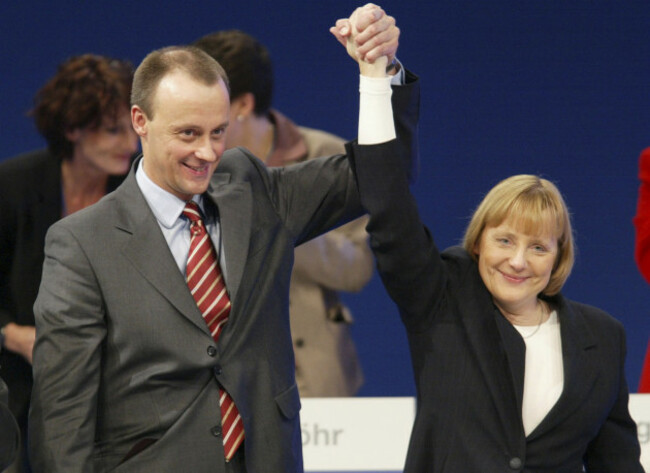
Merkel moved to consolidate her grip on Germany’s centre-right Union bloc after it narrowly lost a national election in 2002. She pushed Merz aside as leader of its parliamentary group, taking the job herself in addition to the leadership of the CDU she already held.
She went on to lead Germany from 2005 to 2021.
Merz turned his back on active politics for several years after leaving the parliament in 2009. He worked as a corporate lawyer and was on the boards of a number of international firms, becoming a millionaire in the process.
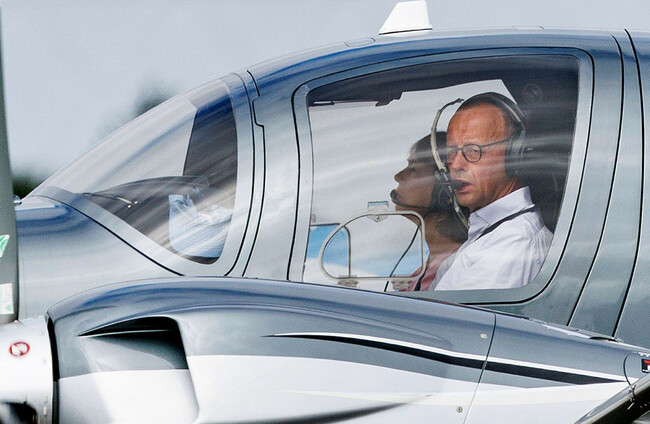
During that break, he often travelled for business to the US and China, though he never lived outside Germany. A hobby pilot who reportedly owns two private jets, he has sought to turn his long stint in the business world into a key selling point.
“Friedrich Merz is perhaps the most international chancellor Germany has had since the war — if he becomes chancellor,” said Volker Resing, who wrote the recently published biography Friedrich Merz: His Path To Power.
Merz launched his political comeback after Merkel stepped down as CDU leader in 2018 and announced that she would not seek a fifth term of chancellor.
However, he was narrowly defeated by centrist candidates more in Merkel’s mold in party leadership votes in 2018 and early 2021.
Merz persisted and was elected party leader in the third attempt, after the centre-right’s defeat by Scholz in Germany’s 2021 election. He cemented his power by also becoming the leader of the Union’s parliamentary group.
His CV and personal wealth have left Merz open to charges of being out of touch, an accusation he has rebuffed by insisting he belongs to the “upper middle class”.
Among Merz’s toughest pledges is to shut German borders to undocumented migrants, even if they seek asylum and to detain those awaiting deportation.
He has come under fire for some controversial statements in the past. He has labelled the sons of Muslim immigrants “little pashas” and accused some Ukrainian war refugees of “social welfare tourism”, before later apologising.
Last month, he sparked high drama in parliament – and waves of street protests – when he pushed through a motion signalling his immigration crackdown with support from the AfD, breaking a long-standing taboo of never dealing with the controversial party.
In other signals of a rightward shift, Merz has vowed a “zero tolerance” law-and-order drive, to reverse marijuana legalisation, limit “woke” policies and gender-sensitive language and study a return to nuclear power.
Merz argues all this will lure voters back from the AfD, who he has already vowed not to go into government with. But he may yet have to temper some of his policies as he seeks one or more coalition partners.
During the campaign, Scholz sought to portray his rival as a “hothead” and charged that his dalliance with the AfD signals he would one day rule with the far-right party – a charge Merz strongly rejects.
News magazine Der Spiegel has said Merz takes conflicts personally and is sometimes given to fits of anger, adding that “if Merz were a bullfighter, he would probably hold the red cloth in front of his stomach”.
Merz is pro-European and has warned against more paralysis in Berlin at a time US President Donald Trump is driving head-spinning change from the White House.
In a post on X, Merz insisted Ukraine “must be part of peace negotiations” after Trump unsettled European allies by reaching out to Russian President Vladimir Putin.
“Europe remains firmly by Ukraine’s side,” Merz said, as European leaders gathered in Kyiv to mark the third anniversary of Russia’s full-scale invasion.
Speaking late Sunday, he had warned a united Europe must build up its own defences as he had “no illusions at all about what is coming out of America”.
Merz is also a supporter of Israel, and criticised the decision of the International Criminal Court to issue an arrest warrant for Prime Minister Benjamin Netanyahu in November.
He has also called for migrants living in Germany to recognise “Israel’s right to exist” in order to achieve nationalisation.
In a statement today, Netanyahu’s office said he had a “warm conversation” with Merz and congratulated him on his win.
“Merz thanked the prime minister for his call and said he would invite him for an official visit to Germany, openly defying the ICC’s scandalous decision to label the prime minister as a war criminal,” the statement read.
With reporting from Press Association and © AFP 2025

To embed this post, copy the code below on your site












have your say