Sign in. It’s quick, free and it’s up to you.
An account is an optional way to support the work we do. Find out more.
Sign in. It’s quick, free and it’s up to you.
An account is an optional way to support the work we do. Find out more.
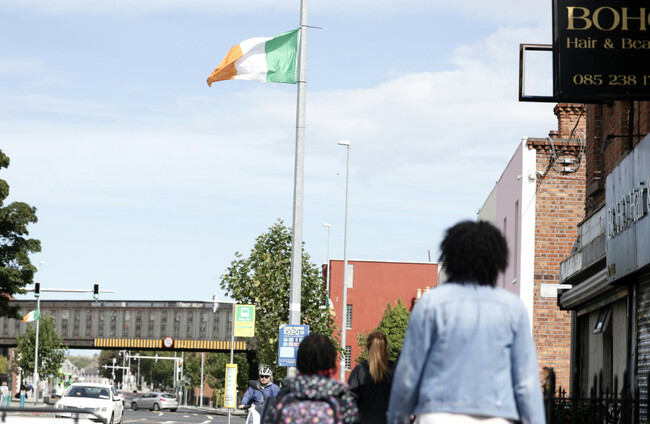
A CONVERSATION AROUND the use of the tricolour began this week, when Dublin City Council suggested it would take action over the impromptu appearance of the flag on lampposts around the capital.
There are concerns that the flags are being used as a form of ‘territorial marking’ rather than straightforward patriotism, but some groups have reacted strongly to the idea of the council removing the Irish flag online.
The stand-off reflects a wider unease over how the flag has been appropriated by anti-immigrant groups seeking to “reclaim” it, and follows a similar trend playing out in the United Kingdom.
Those responsible have said they are flying the flag to show patriotism, but others have said the motivation stems from anti-migrant sentiment amid tensions over immigration in Ireland and the UK.
Taoiseach Micheál Martin said this week that Ireland is now “at a tipping point” when it comes to anti-immigration sentiment, while Tánaiste Simon Harris claimed that society must not allow the far-right to “hijack” the Irish national flag.
If developments across the Irish Sea are anything to go by, the dispute could become a wider talking point over the next few months – particularly in the run-up to the presidential election.
This week’s discussion about flag-flying in Dublin followed a similar trend in England, where Union Jack flags and white flags bearing the red St George’s cross both began to appear in large numbers in towns and cities over the summer.
As is the case with the tricolour in Ireland, it’s not unusual to see either of these flags sporadically in the UK – often flying from public buildings or on display in town centres.
The Union Jack is also waved on national days or at celebrations, while the St George’s flag is likewise a common sight at sporting events – particularly by supporters of English national soccer and rugby teams.
But the flags have also been used frequently by fascist groups in the UK since the 1970s, when they have been deployed during marches by groups like the English Defence League, the National Front and the British Union of Fascists.
The fact that so many English flags and Union Jacks have begun to appear in towns across England in a short space of time is not a coincidence.
The trend is down to a campaign that began in two suburbs of Birmingham called Weoley Castle and Northfield, where the Union Jack and the English flag were draped on lampposts across several streets during August.
The flag-hanging was claimed by a group on Facebook calling itself the Weoley Warriors, a self-described “group of proud English men” who wanted to show England that “all is not lost”.
It’s not known who is behind the group, but the trend soon spread to other towns and cities in the UK as part of a far-right social media campaign called Operation Raise the Colours.
Flags soon appeared en masse in cities like Bradford, Newcastle, Norwich, as well as in parts of London, while people began spray-painting the St George’s cross on white roundabouts and Zebra crossing in a show of patriotism.
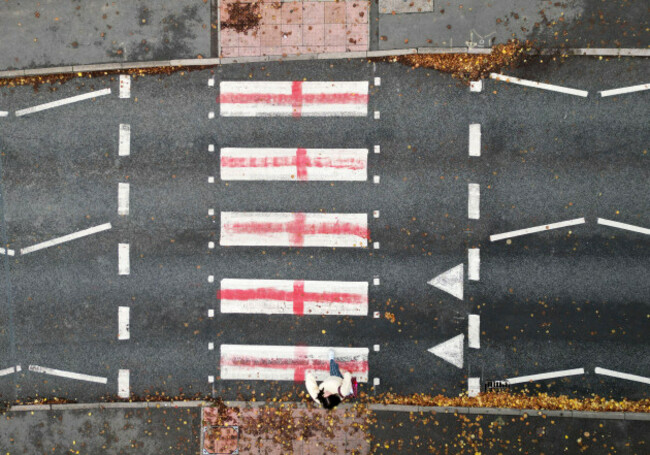
As the campaign has ramped up, so have instances of alleged criminality: in Lincolnshire, a church wall was painted with the St George’s cross, while in Essex, a man was arrested on suspicion of committing criminal damage after crosses were painted on a number of homes.
Anti-racism group Hope Not Hate claims the wider campaign is organised by far-right activist Tommy Robinson and his ally Andrew Currien (also known as Andy Saxon).
Robinson has taken to social media in support of flag campaigns in England and abroad in recent weeks, while claiming that those who attempt to take down flags are “wrong’uns” and “weirdos”.
On his X account, Currien prominently links to a fundraiser asking people to help the campaign group pay for flags; he claims to have put up 1 million flags around the country and last week said the group aims to “provide a further million flags, not only for lampposts, but also for the biggest free speech festival too”.
Councils across England began to respond in various ways; some issued warnings about the danger of hanging flags, while others began removing flags – prompting a backlash and claims that councils were acting unpatriotically.
The debate has reached the highest levels of UK politics, with Prime Minister Keir Starmer attempting to straddle both sides this week by saying he is “very encouraging” of the flying of flags, while questioning flags being flown “purely for divisive purposes”.
Coinciding with the campaign in England, a similar trend has begun in several other countries abroad – including in Ireland, where it as part of an emerging stand-off over the tricolour’s use by anti-migrant groups.
Irish groups have promoted a self-proclaimed bid to ‘reclaim’ the Irish flag, which has featured heavily at demonstrations and pickets against accommodation for people in international protection over recent years.
In recent weeks, the flag has appeared in increasing numbers on lampposts in areas where this accommodation is located and in suburbs like Finglas, Coolock and Ballyfermot.
It wasn’t until Dublin City Council said this week that it was considering taking action over the trend that the campaign here went mainstream.
Speaking on RTÉ earlier this week, independent Dublin City councillor Malachy Steenson – who was involved in anti-immigration protests in East Wall in late 2023 – claimed that those who wanted to remove flags “despise the Irish nation and have attempted to bring it down for years”.
Tommy Robinson has even commented on the situatoin here, sharing a news report about Dublin City Council this week to his account on X this week, with a caption claiming that “for every flag taken down, 100 will go up, nobody can’t stop the patriotic wave”.
Others have sought to gain capital out of the issue, notably immigration critic and presidential hopeful Nick Delehanty, who this week proposed new laws to “ban the flying of foreign flags alone”.
Calling for “more respect for our national flag”, Delehanty claimed his proposal would be similar to “strict laws” that exist in Denmark that he suggested prohibited foreign flags from being flown on their own, or other ‘organisational’ flags (ie the EU flag) from being flown higher than the national flag.
However, the rules in Denmark are not a law around the flying of flags in any circumstances; instead they relate to the flying of flags from flagpoles only.
The Danish laws do not apply to flags of neighbouring countries (Finland, the Faroe Islands, Greenland, Iceland, Norway, Sweden, and Germany), while ‘organisational’ flags are permitted.
The country’s minister for justice is also allowed to grant exemptions from the ban under the law, such as instances where the Ukrainian flag can be flown.
It should also be noted that a similar flag protocol - a set of conventions about the flying of the flag that are observed by the government and Defence Forces – already exists in Ireland.
Among the guidelines laid out in the protocol are that no other flag or pennant should be raised above the tricolour when it is flown, that it should only fly between sunrise and sunset (except on certain occasions) and that it shouldn’t touch the ground when it is being lowered – all of which were proposals made by Delehanty this week.
This week, some Dublin City councillors described the use of the tricolour by anti-immigrant groups here as the “weaponisation” of the national flag and a means to “mark territory” in the streets of the capital.
The current trend of hanging flags on lampposts is a direct copy of the same trend in England, and like in the UK, is part of a wider use of the flag as a symbol in the context of protests against immigration.
In the past two years, far-right activists have taken to ordering large quantities of the tricolour and handing them out at demonstrations; a prominent individual in the movement this week took to social media to claim personal responsibility for the recent use of the flag in parts of Dublin.
Unsurprisingly, Dublin City Council’s concerns have prompted a backlash online, with a growing narrative emerging among far-right and anti-immigrant groups that seeks to paint the State and its employees as anti-Irish.
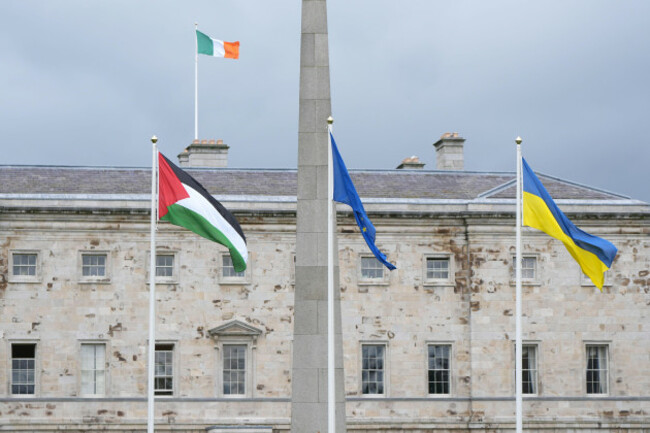
Some on social media have pointed out instances of foreign flags being flown at prominent locations like Leinster House (where the tricolour is still flown higher than other flags).
Others have sarcastically questioned whether other aspects of Irish culture – like the playing of Irish music or speaking the Irish language – will be ‘banned’ next.
These narratives are forming before any decision has even been made.
Dublin City Council chief executive Richard Shakespeare said this week that the local authority was aware of the “concerns expressed by both elected members as well as members of local communities and residents’ groups regarding the proliferation of the national flag being hung across particular areas of the city”.
Council officials were expected to meet with senior gardaí this week, and to have contacted local groups to discuss the issue before taking any decisions.

To embed this post, copy the code below on your site









have your say