We need your help now

Support from readers like you keeps The Journal open.

You are visiting us because we have something you value. Independent, unbiased news that tells the truth. Advertising revenue goes some way to support our mission, but this year it has not been enough.

If you've seen value in our reporting, please contribute what you can, so we can continue to produce accurate and meaningful journalism. For everyone who needs it.

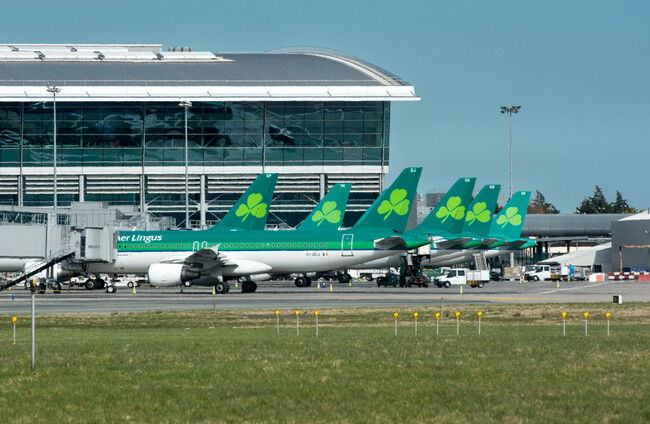
Aer Lingus planes pictured at Dublin Airport. Alamy Stock Photo

Dublin Airport's passenger cap could mean fare increases and 'US retaliation', airlines tell TDs

An US aviation spokesperson said that there is “very strong potential” that Irish airlines would lose a number of flight connections to the US if the passenger cap is not lifted.

ENFORCEMENT OF THE passenger cap at Dublin Airport could have “catastrophic” economic consequences and could lead to fare increases, reduced passenger numbers and even pushback from the US government, airline spokespeople have said.

In opening statements to the Joint Oireachtas Committee on Transport today, airline executives and international aviation bodies repeatedly called for urgent action to scrap the 32 million annual passenger limit at Dublin Airport, arguing it is already constraining growth and threatening Ireland’s connectivity.

Lynne Embleton, chief executive of Aer Lingus, told the committee that the cap is now a “historic anachronism that needs to be urgently removed”.

Embleton said that the airport handled 36.4 million passengers last year, meaning full enforcement of the cap would require a reduction of more than 4 million journeys, over 12% of current traffic.

“That would have a catastrophic impact on connectivity, on the airport, and on the wider Irish economy,” Embleton said.

She warned that each one million passengers lost could translate into €1.4bn in lost economic activity, more than €320m in lost tax revenue, and up to 37,000 jobs.

“These are not abstract figures,” Embleton said.

“They reflect potential lost jobs, lost routes, reduced connectivity, constrained tourism, foregone investment, and reduced competitiveness relative to peer economies.”

Similar concerns were echoed by international aviation groups appearing before the committee.

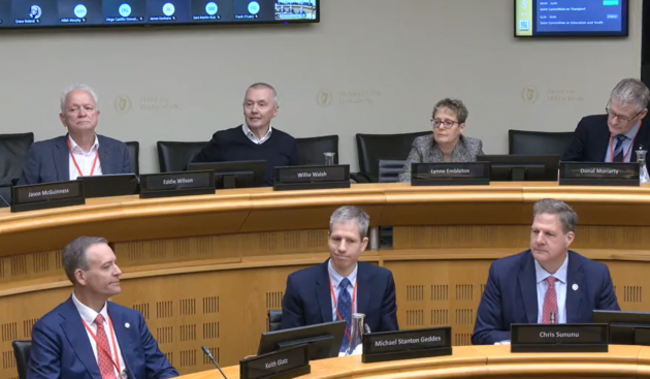
Screenshot (189) Aviation industry spokespeople speaking at the committee hearing today. Oireachtas TV Oireachtas TV

Chris Sununu of Airlines for America said the restriction has moved beyond a planning issue and is now a “policy decision with direct economic consequences”.

He pointed to Dublin Airport’s role as Ireland’s main gateway to North America, saying its connectivity underpins tourism, trade and foreign direct investment.

“Constraining that connectivity is not a marginal policy choice. It carries national consequences,” he said.

Sununu estimated that reducing passenger numbers by around 4 million could cost the Irish economy between $4 billion and $6 billion, largely through lost tourism spending and wider knock-on effects.

“When market access for US carriers is constrained in ways that conflict with international agreements, it triggers scrutiny, and, in some cases, retaliatory measures that would impact both sides of the Atlantic,” he added.

Questioned by committee chair Michael Murphy on what the retaliatory US measures could be, Sununu said there is a “very strong potential” that Irish airlines would lose a number of flight connections to the US.

He added that active conversations are taking place between Airlines for America and the US government on Dublin’s passenger cap. Sununu accused Ireland of breaching the EU-US Open Skies Agreement (an open skies air transport agreement that allows any airline of the EU or US to fly between any point in either territory) due to the passenger cap.

“If you think the US administration is going to have one of their bilateral agreements, that has been in place a long time, violated, and that they are just going to take it, in case you haven’t read the headlines, that’s not what these guys do,” Sununu told the committee.

Willie Walsh, head of the International Air Transport Association, said the cap now poses a “real and immediate risk” to Ireland’s connectivity and economic competitiveness.

“Aviation contributes more than $20bn to Ireland’s GDP and supports approximately 128,000 jobs,” Walsh said, adding that uncertainty around capacity is already influencing airline planning decisions.

Walsh stressed that timing is critical, noting airlines will begin planning their summer 2027 schedules later this year, and Dublin Airport’s capacity declaration due by 1 October.

“If certainty is not restored before then, airlines will be forced to plan on the assumption that the cap remains,” he said. “Ireland risks losing connectivity that may not return.”

Representatives from US carriers also highlighted the international implications of the cap.

Meanwhile, Eddie Wilson of Ryanair said the airline believes the cap may breach EU-US aviation agreements and is limiting growth.

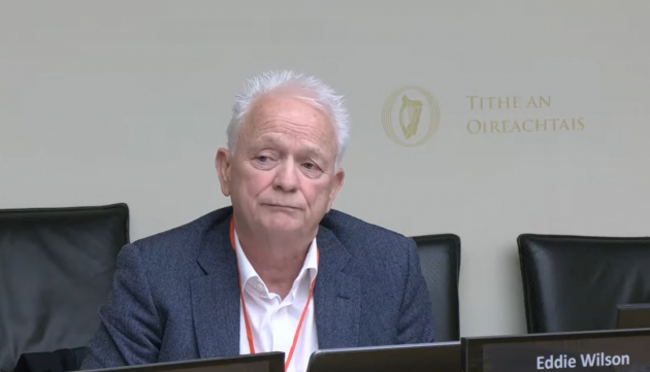
Screenshot (190) Eddie Wilson speaking at the committee hearing today. Oireachtas TV Oireachtas TV

He told the committee that, if the cap were removed, Ryanair could increase its Irish passenger numbers to 35 million by 2035, with Dublin Airport potentially reaching 45 million passengers overall.

Wilson also said such expansion could support more than 20,000 additional jobs between the airport and the wider tourism sector.

The committee is examining the government’s planned Dublin Airport Passenger Capacity Bill 2026, which would allow the Minister for Transport to revoke or amend the current limit, originally imposed as part of a 2007 planning permission.

While the cap is currently not being enforced due to ongoing legal proceedings, it has been warned that this temporary reprieve may not last.

The hearing marks the beginning of detailed scrutiny of the proposed legislation, with further sessions expected to hear from additional stakeholders, including community representatives and environmental groups.

Readers like you are keeping these stories free for everyone...
A mix of advertising and supporting contributions helps keep paywalls away from valuable information like this article. Over 5,000 readers like you have already stepped up and support us with a monthly payment or a once-off donation.

Close
37 Comments
This is YOUR comments community. Stay civil, stay constructive, stay on topic. Please familiarise yourself with our comments policy here before taking part.
Leave a Comment
    Submit a report
    Please help us understand how this comment violates our community guidelines.
    Thank you for the feedback
    Your feedback has been sent to our team for review.

    Leave a commentcancel

     
    JournalTv
    News in 60 seconds