We need your help now

Support from readers like you keeps The Journal open.

You are visiting us because we have something you value. Independent, unbiased news that tells the truth. Advertising revenue goes some way to support our mission, but this year it has not been enough.

If you've seen value in our reporting, please contribute what you can, so we can continue to produce accurate and meaningful journalism. For everyone who needs it.

The war on human thought Educational institutions must take back control from AI

Artificial Intelligence is promising efficiency while eroding original human thought, and it’s time the education sector fought back.

AI IS COMING for human thought. Studies show that a majority of students in Ireland and beyond are using AI tools. Without denying the myriad of useful applications in a variety of fields, as university lecturers we increasingly see that it is poison for education in the humanities and social sciences. Historian Matthew Connelly is right to frame the advancement of AI as an “attack” or even a “war” on human intelligence. This is not only a danger for educational institutions, it is a societal one.

Schools and universities are at the forefront of this battle. They have to develop proactive responses to AI in order to protect a culture of human thought. We should stop trying to integrate AI into our curriculums, and we would be naive to pretend that the errors AI-tools still make are some kind of insurance. They are getting better every day, and recent studies show people, including lecturers, are not as good at identifying AI-generated writing as we imagine. If we want thinking to survive as a human endeavour, we have to shield students, and indeed ourselves, from AI.

Of course, there are applications of AI that can push the frontier also in the humanities and the social sciences. Digital methods more broadly can be insightful tools. Any educational institution that does not want to lose touch has to educate their students in the digital state of the art, including AI. But the vast majority of our time should be devoted to the teaching of critical thought, outside of digital environments and AI.

Corporate might

As educators, we have been fighting a losing battle for years. The advent of digital tools and the emergence of the smartphone created unprecedented environments of distraction and an abundance of digitally available sources. Years before AI, historian Lara Putnam argued that digitisation risked sacrificing depth to broad but superficial knowledge.

AI accelerated this dynamic but also changed the stakes. Hannah Arendt’s distinction between knowledge and know-how is a useful way of describing the drastic shift AI embodies. In her eerily prophetic book The Human Condition, published in 1958, she argued that technological development might lead to machines so complex that humans will not be able to keep up. We might have the know-how to create such machines, but lack the knowledge to understand what they do, “so that from now on we would indeed need artificial machines to do our thinking and speaking.”

In AI, we now have such machines. As the CEO of Anthropic put it: “We do not understand how our own AI creations work.”

AI is imperfect at imitating human thought, but it is getting better all the time. Much of its progress is driven by economic and military aims. People and businesses find AI tools useful for speeding up and automating mundane tasks so we cannot expect societal pressure to stop its current trajectory.

In spite of this, educational institutions are in a powerful role to shape their own destinies. In our limited realm as educators, we have vast autonomy and can create spaces that protect knowledge against AI-driven know-how.

Such protection is urgently necessary. Economists estimate AI will come for already skilled workers, requiring higher qualifications across the job market. In this environment, any educational institution has to ensure that their graduates are creative, intelligent, and adaptable thinkers. AI is detrimental to this task. Studies show that AI use has negative impacts on cognitive development and intellectual independence.

Pushing against the normalisation of AI 

First of all, AI is not hard to use. That is the whole point. We do not need to train students; they have trained themselves. We should instead remind them of all the potential unintended consequences of mass adoption of this very new technology. Leaders of AI companies are also talking about this. Sam Altman (OpenAI) worries that we might be hurtling towards human extinction. Jack Clark (Anthropic) doesn’t want his children growing up with sycophantic AI companions shaping their personalities. Tech bosses also restrict their children’s use of technology while trying to push it on everyone else.

AI can produce good work in academic settings. But why would we want it to? Writing is a form of thinking, and the more students struggle to communicate their ideas in written form, the more they are thinking and the better their brains are getting at all kinds of things.

For an AI to produce an essay is an easy and boring thing. For a brain to produce an essay is a complex and almost magical thing. We do not need speed or quantity, but depth and continuous engagement. There is no bottleneck in the production of essays in history, economics or literature.

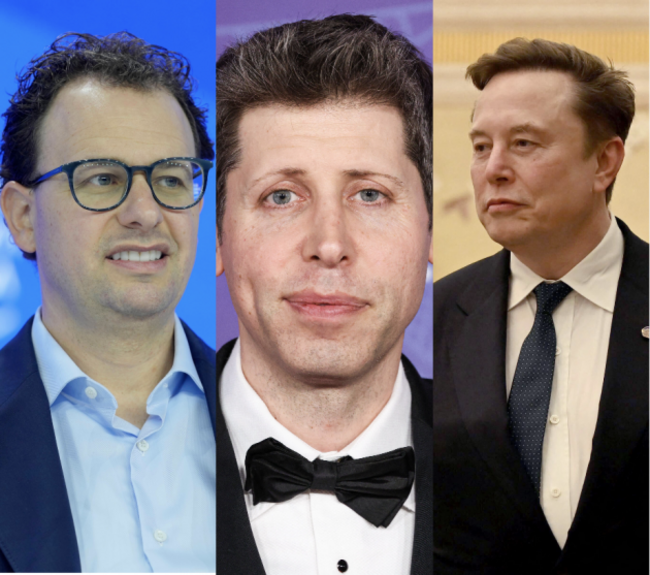
Screenshot 2026-05-19 at 16.04.23 The giants of AI.. Anthropic (Claude) CEO, Dario Amodei, OpenAI (ChatGPT) CEO Sam Altman and Grok CEO Elon Musk. Alamy Alamy

Universities across the globe have responded to AI by placing higher weights on blue-book exams. But we lose something essential when we stop asking students to develop and write an essay over weeks. Instead of giving up the format, educational institutions should create infrastructures in which thinking and writing can happen outside AI environments.

Potential solutions do not require big investments or curriculum changes, but a series of practical and cultural adaptations: Go back to providing course readers instead of electronic copies. Require students to lock away their smartphones. Lock distraction sites like TikTok or Instagram on school and university networks. Require attendance at classes and provide time to read and write. Offer digital detox retreats as part of the curriculum. Only allow AI where there are clear methodological and pedagogical reasons for its use. Ask educators, not tech companies, to decide the clear use cases.

While these measures are easy to implement, they require a change in our culture. Any place has a set of explicit and implicit rules that enable it to perform its function. A music club is a place to dance, a cemetery is a place to remember, and a university is a place to think.

As educational institutions, we should stop throwing our hands in the air in the face of AI and exert our authority over the spaces we control.

Juliana Adelman and Roman Birke are Assistant Professors in History and Modern European History at the School of History and Geography at DCU.

Readers like you are keeping these stories free for everyone...
A mix of advertising and supporting contributions helps keep paywalls away from valuable information like this article. Over 5,000 readers like you have already stepped up and support us with a monthly payment or a once-off donation.

Close
Comments
This is YOUR comments community. Stay civil, stay constructive, stay on topic. Please familiarise yourself with our comments policy here before taking part.
Leave a Comment
    Submit a report
    Please help us understand how this comment violates our community guidelines.
    Thank you for the feedback
    Your feedback has been sent to our team for review.

    Leave a commentcancel

     
    JournalTv
    News in 60 seconds