We need your help now

Support from readers like you keeps The Journal open.

You are visiting us because we have something you value. Independent, unbiased news that tells the truth. Advertising revenue goes some way to support our mission, but this year it has not been enough.

If you've seen value in our reporting, please contribute what you can, so we can continue to produce accurate and meaningful journalism. For everyone who needs it.

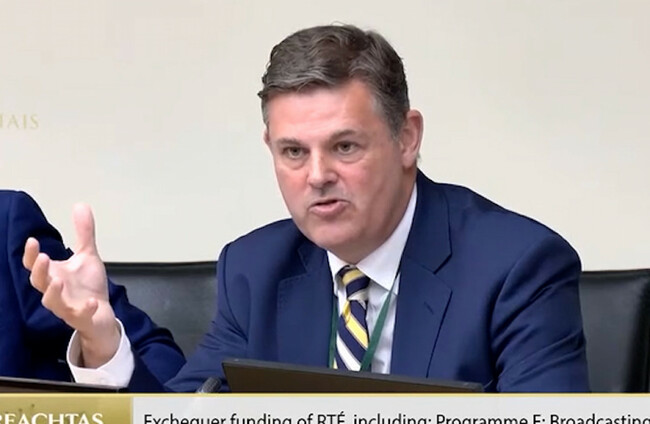
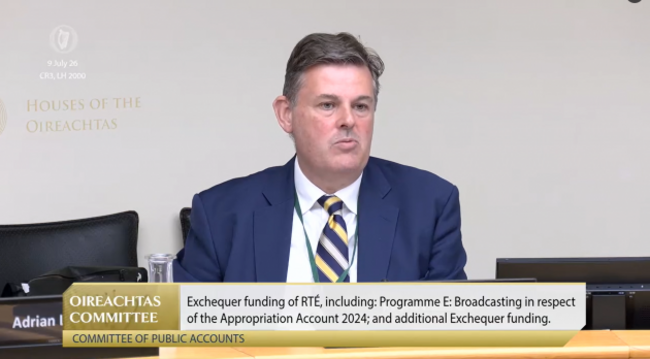
The broadcaster is appearing before the Public Accounts Committee this afternoon. Oireachtas TV

Kevin Bakhurst says RTÉ will need more government support as he defends spending

The director-general said he would “appeal very strongly” for a similar multiannual €725 million commitment when it next comes for review in 2027.

RTÉ IS “NOT in the business of being cheap as chips”, the broadcaster’s director-general said, as he admitted some outsourced productions have increased in price.

Kevin Bakhurst also indicated that RTÉ’s commercial revenue and licence fee receipts would fall roughly €60- €65 million short of its operating costs in 2028, after a government support package runs out.

The government is currently supporting RTÉ with a €725 million support package from licence fee receipts and a direct top-up from the Exchequer.

Bakhurst said the organisation was “tightening its belt” as it strengthened its financial position and “reversed the trend of reporting deficits”.

The Journal / YouTube

However, he said it was “impossible” to give overall cost savings from outsourcing programmes to the independent sector.

Bakhurst appeared before the Public Accounts Committee today after new payment controversies emerged at the station, defending RTÉ as not a “tinpot” organisation.

On the overall financial position, he said the reversal from deficits arose out of “tighter cost controls” supported by a new commercial strategy – as well as the government’s €725 million multiannual funding commitment for 2025-2027.

The director-general said he would “appeal very strongly” for a similar multiannual commitment when it next comes for review in 2027.

image (13) The broadcaster is appearing before the Public Accounts Committee this afternoon. Oireachtas TV Oireachtas TV

Bakhurst said RTÉ was driving commercial funding “as hard as we can”, but added: “In the end, public service media – in my view and in our view – is a public good and it does require public investment.”

Asked by Fine Gael TD Grace Boland how much additional state funding RTÉ would be looking for from 2028, Bakhurst said discussions had not started.

He added: “We will need public funding. We will need funding from either the licence fee or a similar source of public funding.”

Asked if it would be a reduced amount, he said these were choices to be made by the media regulator, the Oireachtas and the government.

The committee was later told the level of “top up” from the government last year for RTÉ’s budget after commercial revenues and licence fees were accounted for was roughly €55 million.

Bakhurst then agreed with Fine Gael’s Joe Neville TD that, depending on inflation, the gap between its operating costs and revenue from commercial operations and licence fee receipts could be up to €65 million in 2028 – without any additional government support.

RTÉ has committed to outsourcing programming as part of a strategy of cost reduction and supporting the independent production sector.

Up For The Match, which airs as two specials on the eves of the All-Ireland hurling and football finals, is among programmes to be outsourced.

Bakhurst told the committee the revised format of the show will cost RTÉ more than the in-house production.

The director-general said the organisation makes a “business case” for each outsourced programme but added that public value is a question of cost and “delivering the best quality programme” for its audience.

“The value of something is not just how much we pay for it; it’s what the value is to the audience as well.”

He said Up For The Match is “costing a little bit more” as it has changed from a studio-based show to a live production from Croke Park.

Bakhurst said it had sought ideas from the independent sector through a “proper process” and “chose the very best creative idea”.

Later asked by Fianna Fáil TD Albert Dolan why RTÉ could not deliver the programme from Croke Park itself, he said RTÉ always does outside broadcasts through contractors and added that the sports department was “flat out” with “steam coming out their ears” with GAA games and the World Cup.

He said staff availability was a factor, with some personnel potentially needed for the coverage of the finals themselves.

Asked for the overall cost saving from outsourcing, Bakhurst said this was “impossible to say”.


He told Boland: “It’s not solely about ‘is it a cheaper programme?’ We’re not in the business of being cheap as chips. We’re in the business of providing high-quality content.”

Pressed on whether outsourcing had seen an increase in costs for taxpayers, he said: “Some are cheaper and some are more expensive.”

Bakhurst said potential “efficiencies” identified in consultant-led reviews into the news and operations divisions will “feed into” targets for voluntary exit programmes.

He said artificial intelligence had replaced a “very insignificant number” of jobs in RTÉ so far.

“We’re taking, you know, I would say a relatively measured approach to it.”

He said RTÉ “will always have human oversight of journalistic decisions”.

Asked by Social Democrats TD Aiden Farrelly to clarify this comment, he said: “What it means is you have editors and journalists and producers who are doing the work.

“They may use AI tools, but in the end, the humans will do the journalism.

“We’re not going to generate our journalism via AI, but AI is already a useful tool that we already use in some areas in news and current affairs.”

Bakhurst also told the legislators that Patrick Kielty, who recently renewed his contract to host the Late Late Show, would not have a base annual pay above a cap set at the director-general’s salary, which is currently €250,000 – but could be due to rise.

The committee was told that Public Expenditure Minister Jack Chambers had yet to approve or decline a recommended pay increase for Mr Bakhurst which was left at his department by Culture Minister Patrick O’Donovan in March.

Asked about Kielty’s new contract, he said: “No one is employed directly on more than the director-general earns.”

Later under questioning from Sinn Féin representative Cathy Bennett, the director-general said TDs often contact RTÉ about what to air and not air.

He added, to laughter: “They’ll venture an opinion and we should listen because sometimes they’re right – but I would say mostly they’re not.”

Close
29 Comments
This is YOUR comments community. Stay civil, stay constructive, stay on topic. Please familiarise yourself with our comments policy here before taking part.
Leave a Comment
    Submit a report
    Please help us understand how this comment violates our community guidelines.
    Thank you for the feedback
    Your feedback has been sent to our team for review.

    Leave a commentcancel

     
    JournalTv
    News in 60 seconds