Sign in. It’s quick, free and it’s up to you.
An account is an optional way to support the work we do. Find out more.
Sign in. It’s quick, free and it’s up to you.
An account is an optional way to support the work we do. Find out more.
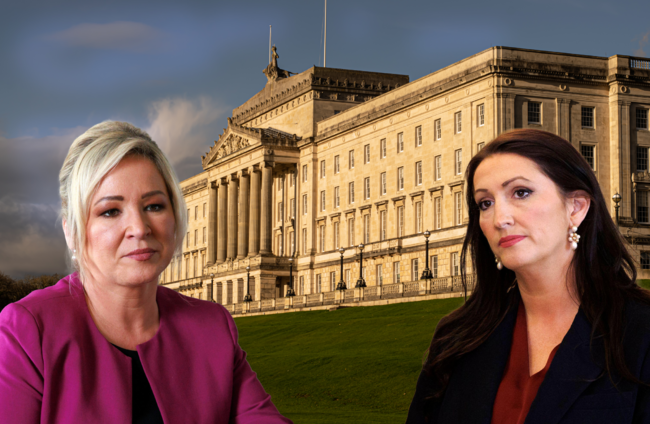
TWO WEEKS AGO, speculation was mounting in Northern Irish political circles and the media that Stormont could be on the brink of yet another collapse.
It was sparked by comments from two senior Sinn Féin figures, Senator Conor Murphy and party chair Declan Kearney, which some interpreted as a warning that the party was preparing the ground for another breakdown in power-sharing.
But the talk of collapse – something people in the North are all too familiar with – was quickly put to bed when First Minister Michelle O’Neill made clear she had no intention of bringing down the Executive.
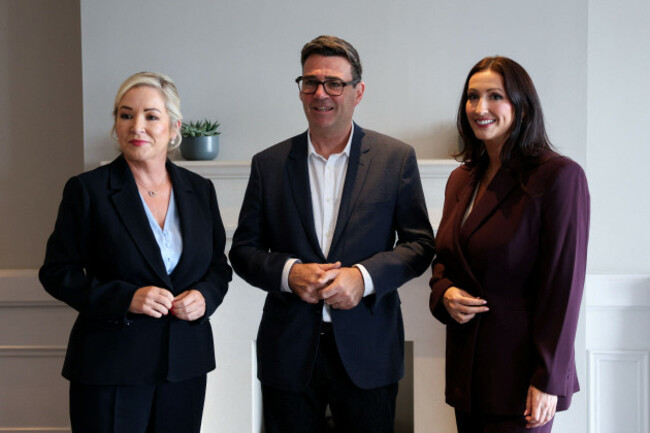
The speculation, however, was not coming from nowhere. Stormont still has no agreed multi-year budget, and with little apparent progress following new British Prime Minister Andy Burnham’s visit this week, the question now seems less about whether the Executive is in trouble and more about whether there is a way out.
Before Burnham’s visit, The Journal spoke to ministers, the leader of the opposition and voters in Belfast about whether devolution can be held until next year’s elections, and – if either Sinn Féin or the DUP decides to pull the plug – whether this time could mark the end of power-sharing for good.
For Sinn Féin Finance Minister John O’Dowd, the immediate problems facing the Executive come down to two things: money and the intentions of its biggest unionist partner.
O’Dowd had already moved to quash speculation that his party was preparing to collapse Stormont, telling The Journal that Sinn Féin was “committed to power-sharing”.
But he pointed the finger at the DUP, saying it had been “almost an open secret” in political circles that there had been discussions about its intentions ahead of next year’s election.
“There’s always been a serious question mark around the DUP’s support and adherence to the principles of the Good Friday Agreement,” O’Dowd said.
He added that speculation has “heightened” around what the DUP’s next move may be as the Unionist vote looks set to seriously splinter.
“We have reflected that publicly, as have others,” O’Dowd contended.
He said that it is easy to be pessimistic about the stop and start nature of Stormont’s delivery, but pointed out that in the last 30 years the North has changed “beyond all recognition”.
“What has created that change? Politics.”
O’Dowd added that when the Executive comes together to focus on an issue, “we can make real differences”.
The DUP’s Gordon Lyons – Stormont’s Communities minister – said any suggestion that his party is moving towards pulling the plug is nonsense.
“They’re lashing out. They’re trying to blame other people, and there’s a long list of people that they have been blaming. They blame the Labour government. Likewise, they’ve blamed Conservative governments, they are not prepared to take responsibility for themselves,” he insisted.
While Sinn Féin have accused the DUP of “economic illiteracy”, Lyons says that they themselves have demonstrated an aversion for negotiations and tough politics.
“In a power-sharing arrangement, you have to sit down and work these things out. When Sinn Féin don’t get their way, they stamp their feet and blame other people,” he insists.
The two parties have clashed majorly on the ‘Good Jobs Bill’, which would reform employment rights in the North, end zero-hour contracts and offer additional parental leave.
The DUP has blocked the legislation, accused of playing a game of political tactics with an important issue – but that’s not how Lyons sees it.
“We’ve offered a compromise, and Sinn Féin refused it,” he said.
(The DUP offered to fast-track certain elements of the legislation if Sinn Féin agreed to drop trade union provisions that the DUP views as bad for business.)
Speaking to both men, it’s clear that they believe the other’s party is totally at fault for the current dysfunction at Stormont.
“It’s fairly clear to the public that the relationships between the two largest parties are toxic, sniping, filled with petty squabbles, allegations and counter-allegations,” social policy professor with University of Ulster Deirdre Heenan says.
She argues that this behaviour is leaving voters wondering what difference Stormont makes at all.
“There’s a feeling that we are moribund, and that we keep going, but no problems actually get addressed or fixed.”
For Heenan, the most pressing question is not whether Sinn Féin or the DUP will walk away in advance of the next elections, it’s whether the Stormont system is viable anymore at all.
“The public in Northern Ireland are being asked to take a choice between no government, where someone collapses the government and we are in a long period of drift and decay, or bad government,” she says.
“Those aren’t great choices.”
Mid-Ulster Councillor Denise Johnston told The Journal that there is a risk of either of the two largest parties collapsing the executive if they feel it will bolster their position come the next election.
Johnston said that what local councils can achieve in the absence of a sitting Stormont is hugely constrained.
“Councillors get tarred by the same brush as the MLAs, and it lowers people’s confidence in politics and politicians all round,” she said.
Johnston said that council initiatives – like Mid-Ulster’s campaign to stop school buses being overtaken in high speed limit areas – cannot inspire further legislative change with no Ministers in place to lobby.
She further pointed out that without an executive it’s the British secretary of state for Northern Ireland who sets local authority rates.
“What we’ve seen is that it’s used to pressure the parties to go back into government so last time… it was set very high. That impacted people in the middle of a cost of living crisis, and would again,” she said.
SDLP MLA Matthew O’Toole says that reform is the only way forward (his position as opposition leader has only existed for the past 10 years, and is itself the product of reform).
“Currently Stormont exists, but it is not functioning well,” is his grim assessment.
His party is proposing that the rules be changed on how Stormont’s speaker is elected, the titles of first and deputy first minister need to be equalised, and that the ability of parties to veto legislation needs to be weakened while cross-community protections remain in place.
O’Toole admits that these changes are not the full overhaul he thinks Stormont needs, but are designed to be realistic in terms of inspiring short-term change.
So what’s his ideal system?
“A United Ireland,” he’s quick to answer. “But the way to get to that, in my opinion, is to radically improve the way we govern the North right now.
“You cannot say, ‘Well, we’re going to have a border poll in three, five, six, 10 years’ and have that as an alibi for not improving people’s lives in the interim.”
Perhaps more declaratively than any other British PM in recent history, Burnham came out this week and said that a border poll in Ireland is not part of his agenda for the next three years.
His comments have incensed Sinn Féin who have accused him of “burying his head in the sand”, while the DUP has taken some comfort from them, saying that Burnham has put the “nonsense” about a “border poll” to bed.
In reality, Burnham’s comments change nothing. The Executive has still been left without the additional funding they’d hoped to secure from Westminster, and is facing going into an election next year on that basis.
For both Sinn Féin and the DUP, then, the coming months are crucial. Having promised to keep Stormont standing this time, it’s up to Michelle O’Neill and Emma Little-Pengelly to show that it can actually deliver, at a time when people are questioning not just the parties running Stormont, but the institution itself.
To embed this post, copy the code below on your site













have your say