We need your help now

Support from readers like you keeps The Journal open.

You are visiting us because we have something you value. Independent, unbiased news that tells the truth. Advertising revenue goes some way to support our mission, but this year it has not been enough.

If you've seen value in our reporting, please contribute what you can, so we can continue to produce accurate and meaningful journalism. For everyone who needs it.

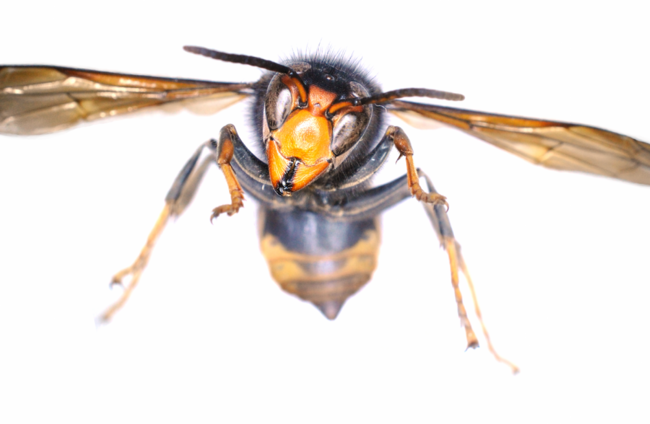
Asian Hornet A. O’Hanlon/National Museum of Ireland

An Asian Hornet (the kind known for bullying bees) has been found and captured in Cork

It’s only the second time Ireland has had a confirmed report of an Asian Hornet, a wasp species that poses a “significant threat to biodiversity”.

AN ASIAN HORNET has been captured in Cork in what the government has said is a “significant threat to biodiversity in Ireland”.

Asian Hornets are a type of wasp indigenous to southeast Asia and an invasive species present in many European countries, though rarely seen in Ireland.

The National Parks and Wildlife Service (NPWS) has confirmed a recent sighting and subsequent capture of an Asian Hornet in Cork.

They pose a biodiversity threat because they have the capacity to significantly devastate honeybee populations by hunting them down and ‘colonising’ their hives.

A member of the public reported the sighting to the National Biodiversity Data Centre’s website.

The report included a photograph and entomologists confirmed it showed an Asian Hornet.

A survey team was deployed to the area for monitoring and surveying conducted.

Initially, no evidence of a hornet nest or any other hornet activity was observed, but subsequent surveillance led to the trapping of an Asian Hornet yesterday.

More monitoring is set to continue over the coming weeks to determine whether the case involves just the one individual hornet or if there is evidence of a larger population. 

The Department of Local Heritage has said the sighting has triggered a government-led response and a new taskforce.

The Asian Hornet Management Group, chaired by the NPWS, will coordinate efforts to gather further information and monitor the situation over the coming weeks. Its membership includes the Department of Agriculture Food and the Marine, the National Biodiversity Data Centre and the National Museum of Ireland.

Beekeeping associations have also been briefed and are “playing their part” to watch out for any more evidence of Asian Hornets.

This is only the second time a verified sighting of an Asian Hornet has been confirmed in Ireland.

The first identification was of a single hornet in the Dublin area in 2021. 

“Asian Hornets are a threat to our native pollinators and our biodiversity. We must take even a single sighting very seriously,” said Minister of State for Biodiversity Christopher O’Sullivan. 

“NPWS responded quickly to this report, with a team of experts rapidly tasked to monitor and survey the area. One individual was captured and a co-ordinated response is now underway through a new cross government taskforce who will continue to monitor the situation,” O’Sullivan said.

“We are also very grateful for the support of beekeepers and their associations in this endeavour.

“This incident shows us that members of the public are our eyes on the ground. Early detection is key if we are to prevent the establishment of this invasive species.

“I urge everyone to be vigilant and inform themselves so that they can recognise and report any sightings of the Asian Hornet to help us contain this invasive species and protect our biodiversity.”

Members of the public are being asked to watch out for any Asian Hornets and to report any suspected sightings through the National Biodiversity Data Centre’s Alien Watch reporting portal.

The advice to the public is that if someone suspects they have spotted an Asian Hornet, they should not attempt to disturb or capture the hornet.

Although they not generally aggressive to humans, Asian Hornets may sting if provoked.

Any photographs, location coordinates or samples (if safe to collect post-mortem) of Asian Hornets are highly valuable to the response team.

Asian Hornets can sometimes be confused with native species such as the giant woodwasp, the dark giant horsefly, or the common wasp.

Readers like you are keeping these stories free for everyone...
A mix of advertising and supporting contributions helps keep paywalls away from valuable information like this article. Over 5,000 readers like you have already stepped up and support us with a monthly payment or a once-off donation.

Close
49 Comments
This is YOUR comments community. Stay civil, stay constructive, stay on topic. Please familiarise yourself with our comments policy here before taking part.
Leave a Comment
    Submit a report
    Please help us understand how this comment violates our community guidelines.
    Thank you for the feedback
    Your feedback has been sent to our team for review.

    Leave a commentcancel

     
    JournalTv
    News in 60 seconds