Sign in. It’s quick, free and it’s up to you.
An account is an optional way to support the work we do. Find out more.
Sign in. It’s quick, free and it’s up to you.
An account is an optional way to support the work we do. Find out more.
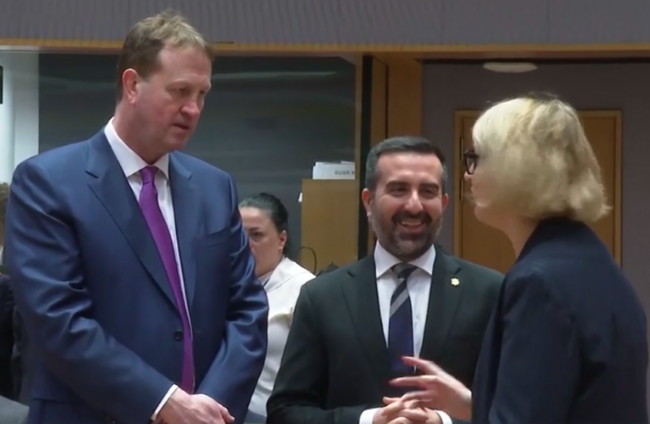

JUSTICE AND HOME affairs ministers from across the EU discussed the potential impact of war in Iran on the movement of refugees to Europe today.
Ministers and officials were keen to emphasise that this was a precautionary discussion, with Magnus Brunner, the European Commissioner for Migration, telling journalists this evening: “At the moment we don’t see any outward movement from Iran towards other countries in the region, but of course we always need to stay vigilant.”
Cyprus, which currently holds the rotating EU presidency, said the possibility of a migration crisis like that of 2015 “cannot be overlooked”, although there are no indications yet of a new wave of refugees.
It is six days since the US and Israel launched a wave of strikes on Iran that have killed over 1,200 people, including at least 165 in the bombing of a girls’ school.
US-Israeli strikes have killed Supreme Leader Ayatollah Ali Khamenei and other senior leadership figures, including the defence minister and the army’s chief of staff.
The European Union Asylum Agency (EUAA) said on Tuesday that even partial destabilisation of the regime in Iran, a country of 90 million people, could cause refugee movements “of an unprecedented magnitude”.
“Displacement of just 10% of Iran’s population would rival the largest refugee flows of recent decades,” the EUAA said, adding that this scenario was “highly speculative”.
The EUAA made the remarks in a report published after the US and Israel’s war began, but which was largely drafted beforehand. The agency noted that Iran entered 2026 engulfed in nationwide unrest linked to economic collapse and political repression.
Asked on Wednesday for a fresh assessment as the Iran war spread across the region, the EUAA said it was “not in a position to comment on any impact the ongoing hostilities in the Middle East may have”.
“The situation remains very fluid and it would be irresponsible to make any hypothetical or predictive statement,” it said.
There were just 8,000 applications last year for asylum in the EU from Iran. In total, 822,000 people applied for asylum in the EU, Norway and Switzerland last year – a 20% reduction on the year before.
Iran itself is host to the third-highest refugee population in the world at 2.7 million people, mostly from Afghanistan, according to UN Refugee Agency data.
Brunner, the commissioner for migration, said this evening that he believed the EU to be in a “very different situation” than it was in 2015, when one million people fled to Europe across the Mediterranean.
Half of these were escaping war in Syria. Almost 4,000 people drowned trying to get to Europe in 2015.
“We have put our European house in order with all the reforms of migration,” Brunner said, adding that this was proven by a 50% reduction in “illegal border crossings” in two years.
After years of difficult negotiations, the EU agreed a Migration and Asylum Pact in 2024 to speed up decisions on asylum claims of people who arrive from outside the EU and require member states to share the cost of hosting refugees. The new rules must be applied from June this year.
NGOs working with refugees have argued that the rules will not ease pressure on the southern countries where refugees enter the EU, and are likely to erode people’s right to seek asylum and have their application processed fully and fairly.
Nicholas Ioannides, the Cypriot deputy minister of migration and international protection, told journalists this evening that “the long-standing, volatile situation in the Middle East won’t be an impediment to the implementation of the pact, but it might test its effectiveness, and that’s something that we need to be prepared for”.
This morning, Johan Forssell, Sweden’s migration minister, said a new refugee crisis “is not an option” for Europe, adding that the asylum pact was an “important step forward”.
Minister for Justice Jim O’Callaghan represented Ireland at today’s meeting.
With reporting from AFP.

To embed this post, copy the code below on your site














have your say