We need your help now

Support from readers like you keeps The Journal open.

You are visiting us because we have something you value. Independent, unbiased news that tells the truth. Advertising revenue goes some way to support our mission, but this year it has not been enough.

If you've seen value in our reporting, please contribute what you can, so we can continue to produce accurate and meaningful journalism. For everyone who needs it.

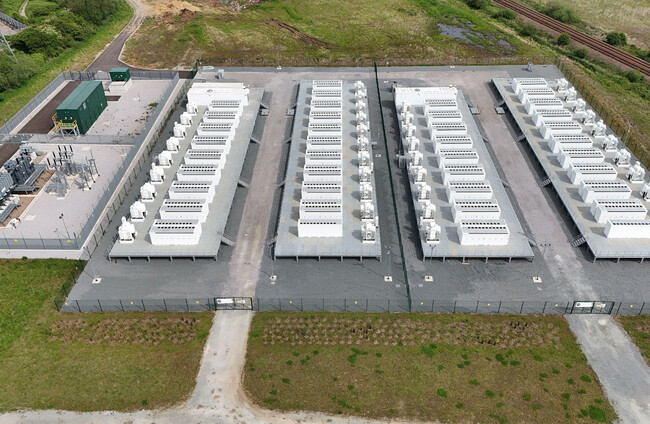
The Pillswood Battery Energy Storage System (BESS) Cottingham, East Yorkshire, UK. Alamy Stock Photo

Do battery storage systems really pose a risk of a 'Chernobyl of Ireland'?

Experts told The Journal that concerns are understandable but fires are extremely rare.

THE DEVELOPMENT OF battery facilities for the storage of electricity produced from renewable energy sources has caused some alarm in areas where they will be built in Ireland.

Locals have cited concerns about the environmental and health impacts in the event of fires, with one concerned Galway resident telling the Irish Independent he feared a fire could turn the Cregmore area into a “Chernobyl of Ireland”.

The kind of facilities in question, battery energy storage systems (BESS), are seen as crucial to the transition to renewable energy needed for Ireland to meet its emissions targets.

Protest

In late February, residents of Cregmore in Co Galway held a protest against the construction of a BESS facility by Power Capital Renewable Energy in the county, pointing to the hazardous chemicals that can be released into the air and groundwater if the batteries were to go on fire and saying they had not been consulted about safety measures.

They also pointed to a recent fire at a battery production plant (a different kind of facility) in Claregalway last January, which led to the evacuation and closure of nearby schools. 

One demonstrator told the Irish Independent that her children attend a school close to the planned battery installation.

“I’m concerned about the BESS batteries and if they go on fire what will happen?” she said. “I don’t understand why our politicians and our government aren’t addressing our concerns more seriously.”

Local independent councillor Noel Thomas also complained about the effect of the installation on the scenery, calling the site “an absolute abomination” that left him “disgusted”. 

Concerns about the risks associated with fires at BESS installations are understandable, according to experts who spoke to The Journal.

However, they also said such incidents are extremely rare and that fire prevention measures are standard across the industry. Research has also shown the environmental impacts of BESS fires are not widespread. 

What is a battery energy storage system?

A BESS facility stores excess energy produced by renewable energy infrastructure like solar and wind farms. Because the energy levels produced by wind and solar power can rise and fall due to weather conditions, it can lead to shortfalls in the electricity grid.

Battery storage systems are designed to fill those gaps by storing energy and releasing it to the grid when it’s too cloudy or the wind is not strong enough.

Most of these storage systems use lithium-ion batteries, similar to those found in phones, laptops and electric vehicles.

What happens when these batteries catch fire?

Battery fires can be caused when a battery cell short circuits, leading to a chemical reaction that makes heat increase uncontrollably.

These fires release hazardous chemicals into the air when they burn and can sometimes take days to extinguish.

One chemical that can be produced when these batteries combust in hydrogen fluoride, which can cause burns if it comes into contact with skin and irritation to the eyes, nose and throat.

Other substances that can be released include cobalt, manganese, and PFAS (sometimes called forever chemicals).

When a battery fire is being extinguished with water, these substances can then also contaminate soil and groundwater.

How serious are the risks?

Fires at BESS facilities are very rare and advancements in prevention and mitigation practices have made them even less likely.

When fires do occur, the environmental and public health impacts are not wide-ranging.

A 2025 Fire & Risk Alliance study conducted for The American Clean Power Association that examined BESS fire incidents found that environmental monitoring data “does not support claims of widespread contamination”.

“Airborne emissions are short-lived and localised, soil and water contamination risks are minimal, and existing firefighting strategies further mitigate potential environmental harm,” the study found.

“Battery fires can be quite complex, based on the type of battery chemistry that is being used,” said Hugh Geaney, associate professor at the Department of Chemical Sciences and Centre for Battery and Energy Materials Research at the University of Limerick

“Some harmful chemicals like HF (hydrogen fluoride) can be formed from combustion of the liquid electrolyte and the active materials, but it has to be noted that these are in small amounts (<<1% of the fumes generated).”

The California-based Clean Coalition, a non-profit organisation that promotes the transition to renewable energy, says:

“While these risks are real, modern BESS designs have significantly mitigated them through advanced safety technologies.”

Those safety measures include housing battery cells in individual modules to help prevent the spread of fire if one overheats and combusts.

BESS installations also typically feature automatic fire suppression systems that quickly extinguish blazes before they escalate.

“Historical data shows that no BESS fire has ever spread beyond its facility, with risks comparable to Class A fires, similar to house fires,” according to Clean Coalition.

Damian Flynn, associate professor of electrical and electronic engineering at University College Dublin (UCD), noted that these storage systems are typically located outdoors, rather than in a closed space, which also reduces the chances of a fire becoming larger.

The blaze that took place in Claregalway in January occurred at a Xerotech battery plant, an indoor site, which made the fire much more severe than one at an outdoor BESS facility would be.

The fire led to the evacuation of two nearby schools and the business park where the factory was located. 

The Xerotech site was not a BESS facility. The company, which has since collapsed, made batteries for electric vehicles. The fire was caused by a chemical reaction in a container in which lithium batteries were being stored.

Firefighters, some of whom had to be hospitalised, battled the blaze for two days as drains were blocked and water was recirculated to stop contamination from any run-off. 

Regulation of the energy storage industry is standardised across the EU and enforced by various government agencies in Ireland.

According to the Irish government’s Electricity Storage Policy Framework of 2024, “There are a variety of safety and regulatory stages incorporated into the planning, development, integration and running of new electricity storage installations on the island of Ireland.

“The Government believes that clarity of these processes is vital for public confidence in the work carried out by the electricity storage sector.”

On the issue of fire risks, the policy framework notes:

“Under Section 13 of the Fire Services Acts 1981 & 2003, Fire Authorities may advise a planning authority in relation to applications for planning permission for development and permission for the retention of structures, Section 34 (which relates to permission for development and for the retention of structures) of the Planning and Development Act 2000.”

Additionally, experts have noted that operators in the industry are incentivised to keep these installations as safe as possible. For one, they represent a significant investment, but they are also part of a fledgling industry that wants to assure the public that the technology is safe.

“Battery arrays are expensive and it is very much in the interest of companies deploying BESS arrays to invest heavily in systems to protect against fires that could destroy their assets,” said John Gibbons, an environmental campaigner and the founder of climatechange.ie.

“This, along with effective regulations, should mean that BESS facilities should pose no unusual or unique risk, especially when sited well away from homes, schools etc.”

‘Understandable’ concerns 

At the same time, Gibbons said he can understand why people have concerns, as did the other experts who spoke to The Journal.

“Reading the news, people might expect that the likelihood of a fire is much higher than it actually is,” said Geaney of University of Limerick (UL).

“I think it is essential that BESS installers engage with local residents to detail emergency plans in the unlikely event of a fire. It is unfair to paint locals as irrational or unreasonable, particularly if they have not been consulted with during the installation,” he said.

“New technologies can be intimidating and the news has lots of stories about battery fires (from scooters to EVs).”

Flynn of UCD said that, as with all new technologies, “there is the risk of things going wrong, and decisions must be made on the ‘risk’ of things going wrong and the ‘reward’ of things going as expected.

“For battery energy storage systems, it seems very clear that the rewards clearly exceed the risks.”

Readers like you are keeping these stories free for everyone...
It is vital that we surface facts from noise. Articles like this one brings you clarity, transparency and balance so you can make well-informed decisions. We set up FactCheck in 2016 to proactively expose false or misleading information, but to continue to deliver on this mission we need your support. Over 5,000 readers like you support us. If you can, please consider setting up a monthly payment or making a once-off donation to keep news free to everyone.

Close
JournalTv
News in 60 seconds