Sign in. It’s quick, free and it’s up to you.
An account is an optional way to support the work we do. Find out more.
Sign in. It’s quick, free and it’s up to you.
An account is an optional way to support the work we do. Find out more.
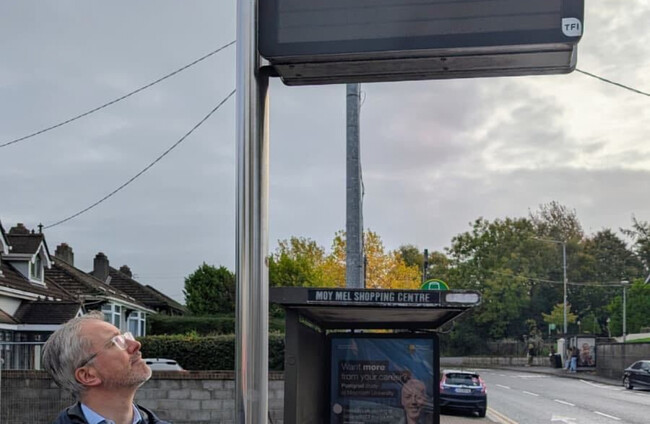
THE NATIONAL TRANSPORT Authority (NTA) has said there is “no simple solution” for how to fix out-of-order real-time electronic display screens at bus stops.
It has tried a myriad of ways to get disconnected displays working again, ranging from trialling different electricity connections to using battery-powered screens, as a way of avoiding having to join a lengthy queue to join the ESB grid network.
The NTA’s roughly 800 Real-Time Passenger Information monitors are supposed to give information about when the next bus will arrive for waiting passengers, but it is coming under pressure over repeated breakdowns.
It has now been urged by the Green Party to get to grips with exactly how many of its monitors are breaking down across the country.
NTA deputy chief executive Hugh Creegan told Green leader Roderic O’Gorman that it has looked for workarounds and “achieving an alternative power supply” for the signage to avoid having to wait in line for a fresh connection by ESB Networks, but these efforts have been without success.
Creegan blamed “significant delays” on the “time required for ESB Networks to provide a connection to the grid”.
O’Gorman, also a TD for Dublin West, told The Journal that it has been frustrating for Dubliners, as he cited how separate real-time monitors in Blanchardstown have been out of order for almost all of this year, while other displays outside Leinster House have also recently broken down.
O’Gorman added that it is “not clear to me they have a handle on how many real-time monitors the problem affects, or how they are going to fix it”.
I’ve been raising the issue of broken real-time monitors with them since February, and they still aren’t getting monitors repaired, including two in my own village of Blanchardstown.
The Dublin West TD said separate real time monitors in Blanchardstown have been out of order for almost all of this year, while other displays outside Leinster House have also recently broken down.
When a monitor stops working, the NTA first tries to reconnect it by integrating it into the existing shelter. If that is not possible, the NTA then seeks a new connection from ESB Networks, but this can take several months and more to happen.
The monitors were installed originally by councils but were taken over by the NTA in the past 10 years.
The situation is further complicated by current regulations preventing the NTA from managing a connection to the public lighting system.
In recent weeks, Creegan wrote to O’Gorman telling the TD that the NTA has examined whether legislation allowing the private development of electricity wires could be of use.
The proposed Private Wires Bill would allow private electricity grids to be created linking specific generators with specific users.
Creegan said the NTA’s initial assessment is that the Private Wires Bill is “unlikely to provide a mechanism for circumventing the current regulatory framework or a legal route” for reconnecting standalone display poles, meaning the NTA must continue to pursue the ESB Networks connection process.
He outlined how the NTA checks to see if a bus shelter can have its defunct electronic signage into an adjacent, existing shelter to get a connection that way. If that method isn’t a runner, then the NTA examines whether it can power individual standalone display poles, but this needs a planning process and still requires a new connection to the ESB Network.
On this last option, Creegan said this is “likely to take some time” to complete and get a bus stop display working again.
Yet another attempt to solve the issue was tried with “battery-powered” signage, which would eliminate the need for a grid connection facilitated by ESB Networks. However, Creegan said this suffers from a “lower-powered screen” which has caused “accessibility challenges” for people with vision difficulties during trials.
“A further design which avoids these issues is being actively considered,” Creegan said.
The NTA was asked by The Journal if it knows how many electronic displays are not working around the country. It did not respond in time for publication.
O’Gorman said it was important that a solution is found to fix the disconnected displays.
“Using public transport should be as easy as possible for people. That’s why real time monitors are so important for giving people accurate information about when the next bus will arrive at a stop,” O’Gorman said.
“But it looks like there is a really significant issue about what power source these monitors are plugged into, which could see many of them being turned off and left idle for months.”

To embed this post, copy the code below on your site











have your say