Sign in. It’s quick, free and it’s up to you.
An account is an optional way to support the work we do. Find out more.
Sign in. It’s quick, free and it’s up to you.
An account is an optional way to support the work we do. Find out more.

SMALL BUSINESS OWNERS have no faith that the judiciary will competently investigate crimes against them, leading to widespread under-reporting.
The Irish Small and Medium Enterprises association annual National Crime Survey found that almost one in five (18%) of business owners do not report crime to the authorities because they think it will be seen as trivial or that it’s likely to go unpunished.
Only 5% of business owners surveyed have faith that if they were a victim of crime, the perpetrator would be apprehended, while 3% had faith that the judiciary would then act as a deterrent to the criminal against repeat offences.
Attack on business
ISME chief executive Mark Fielding said that “any attack on a small and medium business is an attack on business viability, economic stability and, by extension, social prosperity”.
Not only does the small business sector appear to be under attack from crime but the probability of repeat victimisation is high and criminals know the risk of apprehension and penalty is low.
ISME called for the introduction of a single, national definition for business crime in Ireland “to enable these offences to be properly tagged, measured, analysed and ultimately solved by the Gardai”.
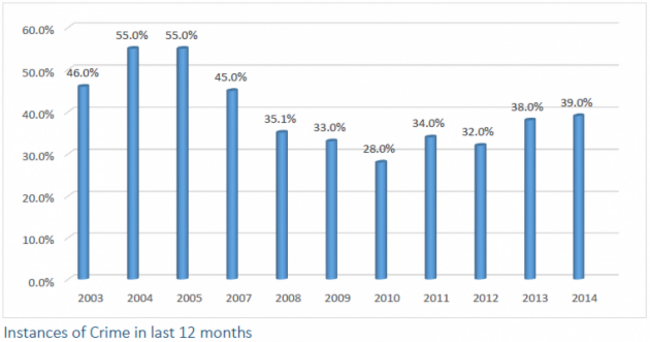
The small business lobby pointed out that while there has been a marked decline in crime against small businesses since 2005, the figures for this year are still the highest since the recession began in earnest in 2007.
Cost of crime
The survey found that the average cost of crime and crime prevention per enterprise is €14,242, with the direct cost of crime having risen by 136% during the recession.
The total cost of crime to businesses, ISME argued, comes to €1.5 billion per year.
Dublin recorded the highest incidence of crime with 53% – which was at 39% in Leinster. Dublin County was at 37% and Munster was at 33%.
The retail sector was most affected with 64%, followed by manufacturing and construction at 44% and 42% respectively.

To embed this post, copy the code below on your site















have your say