Sign in. It’s quick, free and it’s up to you.
An account is an optional way to support the work we do. Find out more.
Sign in. It’s quick, free and it’s up to you.
An account is an optional way to support the work we do. Find out more.
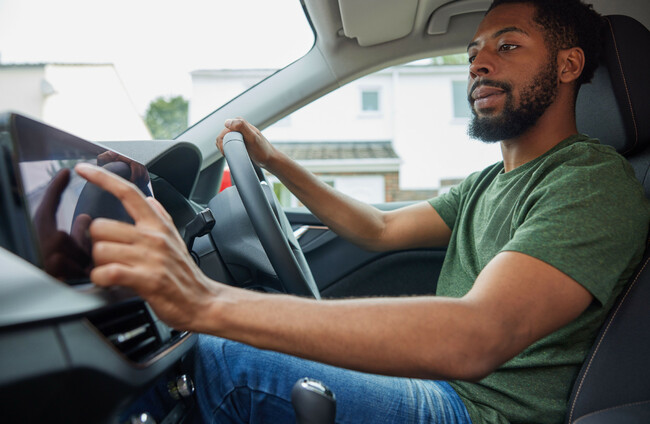
TOUCHSCREEN CONTROLS IN modern cars pose a road safety risk, a representative of Euro NCAP, the consumer organisation that gives safety ratings on cars, told an event in Dublin this afternon.
Touchscreens in newer cars for functions such as changing the radio volume or air conditioning temperature, or for driver controls such as turning on fog lights, are taking drivers’ eyes off the road, Dr Ilse Harms of the European New Car Assessment Programme (Euro NCAP) told a Road Safety Authority (RSA) conference on distracted driving.
James Lawless, the Minister of State responsible for road safety, acknowledged the risk posed by interactive touchscreens in cars.
Lawless said legislators and policymakers will need to “keep up” with the challenges posed by distracting dashboards, as well as by phone use at the wheel.
“The challenge for us now is that the activity has moved to a dashboard, so you may not have to hold the phone but you can still be merrily YouTubing your way along, participating in a discussion or chat or flicking through your podcasts, without ever touching your phone – because now it’s on your screen and youre infotainment model in front of you,” Lawless said.
Euro NCAP, the consumer information organisation, is currently developing a new testing protocol that will take into account whether controls for key functions in the car can be safely used. This will be implemented from 2026.
Five-star (the highest) Euro NCAP ratings are requently used by car manufacturers to promote their newest models – but under the new protocol, five-star ratings will not be available if key functions cannot be safely used by drivers.
Ilse Harms of Euro NCAP said that the market for new vehicles now contains more vehicles with larger screens, and these screens increasingly perform more functions.
“When we say ‘bring back buttons’, what does it mean? It does not mean that we want every single function to be a button, as that’s not necessary,” Harms said.
However, traditional controls had some “very good properties” when it comes to how drivers interact with them, she added. Whereas traditional buttons and knobs are intuitive and easy to understand and use, with a smooth screen the user must look to see what their finger is doing.
“That means that when you’re using screens, by default you’ll require people to look for more time at a screen, and therefore away from the roadway,” Harms said.
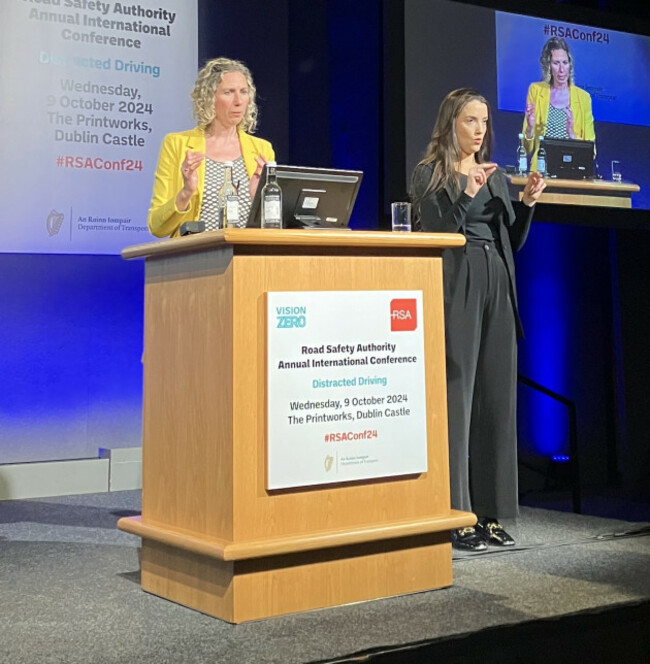
The conference also heard of the high prevalence of phone use by drivers in Ireland.
Dr Kiran Sarma, a psychologist at the University of Galway who has researched the problem for the RSA, said enforcement was essential to tackle the problem of mobile phone use by drivers.
As first reported by The Journal in May, NUI Galway’s research for the RSA found that drivers estimate the risk of being caught using the phone while driving at “zero”, with drivers indicating they were too dependent on their phones and too entrenched in the habit of using them while driving to stop by themselves.
Sarma said: “Drivers are basically washing their hands of their internal motivation to change their behavior and saying, ‘I need to look externally for a powerful external motivation to prevent me falling back into the habit of being dependent on my phone and using it in the vehicle’.”
Sarma also emphasised that distraction at the wheel must be understood as being not only visual but also physical – when hands are off the wheel – and, most importantly, cognitive.
That means anyone who thinks it’s safe to use their phone while they’re stopped at a red light should think again.
“What the evidence is saying is that if you’re stopped on red and you pick up your phone, depending how engaged you are in the phone and what you’re looking at, when you look back up and you drive off, for length of four football fields you are cognitively distracted.
“It’s 20 to 30 seconds later that your mind returns fully to the task in hand,” Sarma said.
Minister Lawless said he has asked officials from his department to examine creating a driver re-education programme for persistent reoffenders, such as those who are repeatedly caught drink driving or speeding.
Rather than waiting until a driver has 12 penalty points to put them off the road, the state would intervene when a person gets to, say, six points, or if they had two committed two speeding offences.
Lawless said offenders would be required to pay for the courses, which could last two days. He said he believed such a programme would have a “significant deterrant effect”.
There was a standing ovation at the conclusion of the conference for a powerful video on the dangers of texting while driving created by students from CBS Mullingar.

To embed this post, copy the code below on your site














have your say