Sign in. It’s quick, free and it’s up to you.
An account is an optional way to support the work we do. Find out more.
Sign in. It’s quick, free and it’s up to you.
An account is an optional way to support the work we do. Find out more.

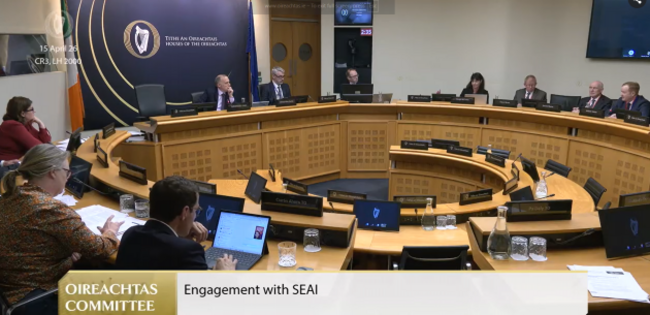
THE STATE AGENCY responsible for home energy efficiency schemes told the Oireachtas Climate Committee today that “cash upfront is an issue” for homeowners hoping to retrofit.
The committee were quizzing the Sustainable Energy Authority of Ireland (SEAI) on a recent ESRI report highlighting the amounts homeowners need to stump up for a deep retrofit.
The report found that after government grants are taken into account, a deep retrofit can still cost a median €16,000 for an apartment and €43,000 for a detached house.
SEAI chair Dermot Byrne acknowledged that retrofitting is a “big investment for homeowners” who do not qualify for the Warmer Homes Scheme for people in receipt of certain social welfare payments.
“Cash upfront is an issue,” Byrne said.
Byrne said many contractors now do not ask homeowners to pay them the portion of their bill that will be covered by government grants until after the homeowners draw down the funding, generally once the project is complete.
“A lot of contractors now will actually do that for you,” Byrne said. “We can’t require them, because otherwise we might leave people out of the contract base, but some contractors will do that. So it’s worth checking around.”
Independent TD Barry Heneghan, who supports the government, said lower middle-class families are being “left behind” by the retrofitting system.
Sinn Féin TD Pa Daly also highlighted the cost issue.
He alleged that a “green divide” now exists whereby homes in more affluent areas seem to have more access to the scheme as they have more funds available for the upfront costs.
In response, Byrne said that two thirds of the SEAI’s funding goes towards the Warmer Homes Scheme, and the other third goes towards funding other homeowners.
Daly, of Sinn Féin, highlighted the ESRI recommendation to explore more affordable carbon-efficient alternatives to retrofitting, such as Hydrotreated Vegetable Oil (HVO) fuel for home heating.
However, Margie McCarthy, Director of Research and Policy Insights at the SEAI, said that HVO fuel needs to be directed towards transport at the moment, and also highlighted that Ireland would need to import it which doesn’t contribute to the country’s energy security.
Ciaran Byrne, director of retrofitting at the SEAI highlighted low cost loans for retrofitting, amongst other support measures.
He said many European countries are now looking to Ireland as a guide for retrofitting.
Another major finding of the recent ESRI report was that the high costs associated with retrofitting are only somewhat offset by heat and electricity bill savings.
The ESRI noted research from both Ireland the UK indicating that homes with better BER ratings do not necessarily use less energy. It could be that people living in poorly insulated homes are underheating them to save money, and when insulation is improved, people can use more heating.
However, Dermot Byrne argued that there are multi-layered benefits to retrofitting.
“Immediately you get the benefit of the warmer home, the more comfortable home, the healthier home. So that is critical. So that’s why people do this,” he said.
McCarthy said retrofitting created health benefits in terms of respiratory and mental wellbeing.

To embed this post, copy the code below on your site












have your say