Sign in. It’s quick, free and it’s up to you.
An account is an optional way to support the work we do. Find out more.
Sign in. It’s quick, free and it’s up to you.
An account is an optional way to support the work we do. Find out more.
THE PUBLICATION OF the 1926 Census has shone a small light on the lives of almost three million people who were living in Ireland exactly a century ago.
As the first major State records following the more than a decade of upheaval, from the Rising through to the Civil War, they carry plenty of insights into households on 18 April a century ago.
The records showed this week how Irish life has changed dramatically in 100 years, especially in rural Ireland, with the number of people employed in the agricultural sector having fallen from 51% in 1926 to 4% in 2022.
But for many of our readers, their main aims when diving into the Census were about gleaning what detail they could on their ancestors and their local area. But there was also some confusion over what exactly their family called themselves back in the day.
A Drumcondra mystery
Christopher Moran traced the whereabouts of a former Royal Fusillier in Drumcondra, as he explained below.
For an easily distracted Drumcondra native interested in discovering hidden stories and curiosities in his North Dublin neighbourhood, Census ’26 has finally helped close this local history mystery.
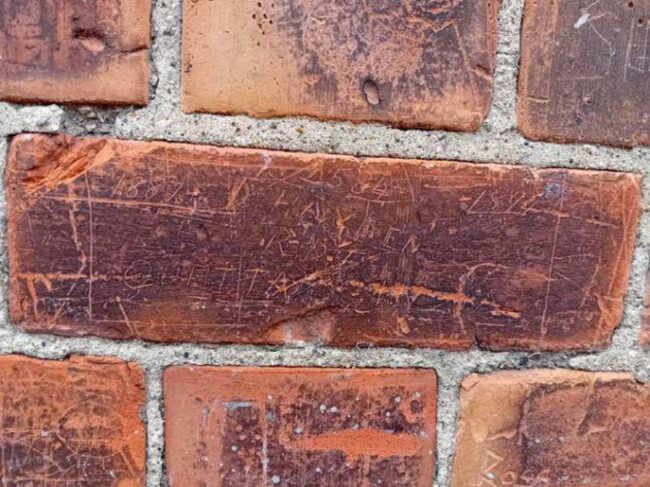
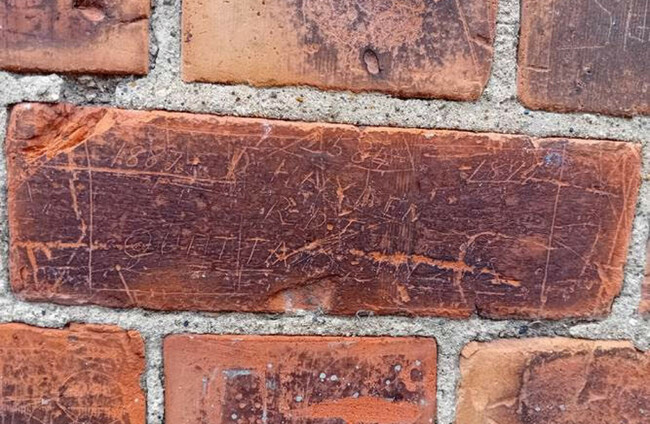
Tracing the path of the former Tolka Mill Race with my daughters, eye-spying graffiti scratched into the brickwork of our 130-year-old Drumcondra homes, we recently uncovered the ghost of this Royal Dublin Fusilier –Denis Hayden.
Born on 6 April 1868 to Anne Byrne and Mark Hayden of number 10 Bishop Street, Dublin, census records show that this labourer’s son began service with the Royal Dublin Fusiliers in May 1885 following his 16th birthday.
Hayden, a slight boy of 5ft 3in, weighing just 8 stone at his heaviest, was earlier rejected as ‘unfit for Her Majesty’s Service’ on the grounds of being (not unsurprisingly!) underweight. In January 1887, aged 18, Denis successfully attested with the Royal Irish Fusiliers in Dublin, committing himself for up to 12 years of service.
Following postings in Mullingar and the Curragh, on 2 January 1889, Denis arrived a world away from Bishop’s Street, in Quetta, India (modern-day Pakistan).
This was a small frontier town with a British garrison. A place where the British Surgeon General would warn of unsanitary conditions and cholera and historian P.S.A. Berridge called a “forbidding and inhospitable desert and mountainous country”.
Of his time in India there is little record. The station hospital in Neemuch, however, shows that unlike Kipling’s Jack Barrett who “there gave up the ghost”, Denis survived but not without suffering. A bout of pneumonia left him hospitalised in Hyderabad throughout the winter of 1893.
Denis left Quetta on the SS. Victoria on 11 October 1894, returning to Ireland where he transferred to the army reserve, his future uncertain.
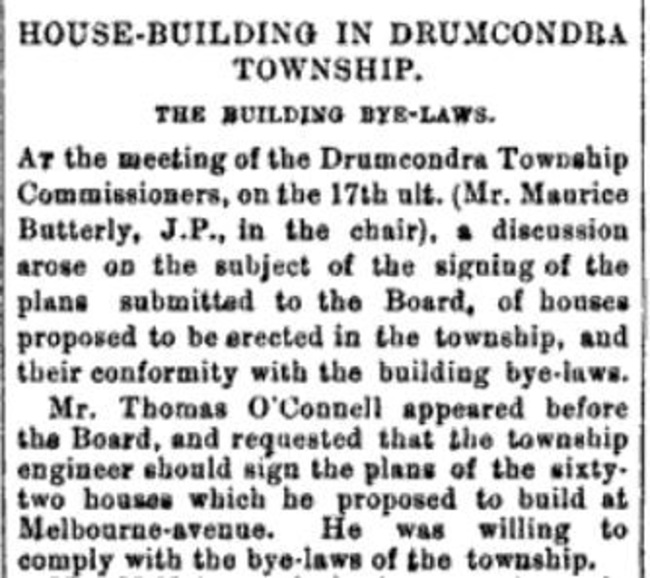
By the mid-1890s, as Denis returned home, Dublin itself was changing. In Drumcondra, cattle dealer turned property developer Thomas O’Connell, now ensconced in the residence that is today the Millmount House pub, pursued his plans with the Drumcondra Township Commissioners to build 62 houses at ‘Melbourne Avenue’ by the banks of the Tolka.
Here as the century ends, in the employ of O’Connell’s contractors, the worldly ex-serviceman Denis Hayden is a labourer once again. And on the site of today’s Millmount Avenue, hidden off-street, in a moment of reflection he inscribed his memorial.
Of what was in store for Denis we know little. Enough, however, to suggest that the life to which he returned to Dublin was very hard.
Denis married Mary Smyth with whom he had a daughter, Mary in 1901. Tragically the child succumbed to tuberculosis and is buried in the Angel’s plot of Glasnevin Cemetery, Dublin. Denis and Mary, like many others, were living in the South Dublin Union Workhouse at this time.
But with last weekend’s release of Census records for 1926, the story of Denis Hayden is revived. Here, in 1926 we see him, still married 25 years on to Mary and gainfully employed with the Dublin Corporation.
We see that he is now living at 32 St. Kevin Street Lower. While not salubrious, it is heartening to see that he is one street over from where he was born on Bishop Street, returned finally to his own family and people.
All in all, a healthier picture than where we left him in the early 1900s.
And should there be any doubt, here is my favourite detail. The unmistakable signature from his Attestation to the Royal Irish Fusiliers on the 21st January 1887 and nearly 40 years later, as the head of his household in 1926.
In these signatures, a lifetime apart reunited by the 1926 Census, we can see the immutable youth, Denis, the mark of our younger selves which we carry with us through our whole lives and in the hardened, clipped Hayden the man with very literal world-experience, both good and bad, whom he became.
Denis died on 14 April 1934.
A weathered monument stands in the North West corner of Quetta Cemetery by the Old Gate, erected in memory of the 2nd Battalion Royal Dublin Fusiliers who died between 1893 and 1896.
A discreet personal mark to a returned soldier has lain hidden in plain sight off Millmount Avenue for over 130 years.
A rural Wicklow reader looks back on his local area
I have found it sadly fascinating to check on progress, as it were, and see all the people I (born 1960) knew as old recorded there as younger folk.
I have scanned through some of the names of assorted relatives and family friends. I recall from my childhood years, also noting several entries as people who died relatively young but whom my parents would still talk about, even visiting their graves if at funerals, but now sadly forgotten by the current generation.
This included two sisters of my maternal grandfather who are recorded as kids but who both died when my mother was young and whom she had photos of and often sadly described as the aunts she never had.
Next time I am in the family cemetery I resolve to visit their graves especially.
The same reader noted the prevalence of ‘servants’ living with families
Several farmsteads I remember as very small places had unrelated lads or girls living with the family as ‘servants’. God only knows what life was like for them, although I suppose that in pre-machine days there was plenty of farm work at least, but all these ‘servants’ must have worked for a pittance.
The farm of a granduncle of my father’s that I know only consisted of 30 acres – and half of it bog – had a live-in farm labourer. It is hard to see how they were all supported there.
I noted a few ‘fosters’ I knew of as well – farming out surplus kids to relatives was quite common and many people did not grow up in their actual family home back then.
A Limerick woman in Dublin found out details about her family, and her new home
I found my grandad had a brother who died of TB shortly after the Census was taken. I had never heard of him and my grandad was six, and his brother five, so they must have been close.
I also looked up the house we are doing up and found out it was brand new at the time of the Census and a 10-year-old boy had just moved in with his family.
The 10-year-old boy in my household who is just about to move into the same bedroom exactly 100 years on is now afraid the room is haunted by a kid from 1926.
The state of housing was a problem for some back then, too
The number of people packed into small houses, you can check the number of rooms and I remember some of the places as really tiny from childhood visits, is incredible.
My three-room paternal grandparents’ place already had three adults (my great-grandmother also lived there) and four kids and there would be two more – where did they all fit?
Several readers were quite confused over the details of their grandparents and great-grandparents
The ages given by my paternal grandfather seemed to be estimates! My grandfather had himself as being 50 and my grandmother as 35.
However, we know from birth registers, he was in fact 53 and she was 39. Maybe that was just the way it was back then?
Others had similar gripes
It’s nice to have these documents. Particularly given that this was the first census since the creation of our Free State. What’s also good for myself and my children is that we all actually met and knew my parents who were alive in 1926. I know that not many of my friends or my children’s friends had family members who were alive at that time. Maybe for generations to come these historical documents will be something to be really valued and appreciated.
Some readers were interested in what jobs people held at the time
As did this reader researching their own family:
I have since discovered that my grandfather was a photographer who worked with WD Horgan on Henry Street, the man who filmed the Civil War. A very interesting find as my grandad would have worked closely with him.
A woman in Meath found a happy coincidence
I’ve discovered that my great-grandmother was named Eliza – her great-great-granddaughter Elisa (my niece, whose Italian mother picked her name just because she liked it) was born last year. Such a cool coincidence.
I also discovered that my great-grandmother, Ellen, was the head of household (widowed), living with her three children, in 1926 – they lived in the house that my three children and I now live in, exactly 100 years later.
Unfortunately, some readers have trouble finding records
I have tried to find information on my father’s and mother’s family. I was able to give date of birth, street where my great-grand parents lived but, I was unsuccessful. I had no problem finding information in the earlier census. I’m very disappointed!
This man eventually found a way into the records
Finding my mother’s family proved to be difficult. I entered her name and address but no results appeared. I tried different variations of her name. I tried both of her parents’ names, separately, but again I got the no results reply.
I was getting quite disappointed but I wasn’t giving up. I kept on trying. Lastly, I went in through the map. I found the street name, then the number of their house and I found them. I was relieved.

To embed this post, copy the code below on your site















have your say