Sign in. It’s quick, free and it’s up to you.
An account is an optional way to support the work we do. Find out more.
Sign in. It’s quick, free and it’s up to you.
An account is an optional way to support the work we do. Find out more.
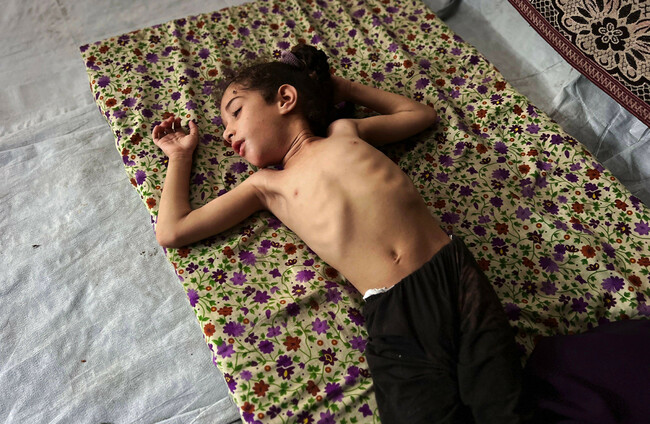
TENS OF THOUSANDS of children under the age of 5 are experiencing “unprecedented” levels of preventable starvation due to war and aid blockades in Gaza, according to new research published in one of the world’s leading medical journals.
The study, published by The Lancet and led by the UN agency for Palestinian refugees (UNRWA), estimates that more than 54,600 children in the besieged territory are acutely malnourished, including more than 12,800 who are “severely” malnourished.
Its authors say that increases in death and starvation in Gaza will occur if the war does not end and the global community does not provide ongoing help to those living there.
Dr Akihiro Seita, the UNRWA Director of Health and a senior author of the study, said that without a ceasefire and international efforts to provide aid to Gaza on an ongoing basis, “deterioration in early childhood nutrition with increased mortality are inevitable”.
The publication of the study comes two years since the 7 October attacks on Israel by Hamas, which prompted two years of continuous retaliatory assaults on Gaza and humanitarian aid blockades on the region.
Israel’s actions in Gaza have been widely condemned as genocide, including by a UN commission, numerous aid organisations and world governments (including Ireland).
To date, more than 67,000 Palestinians have been killed by Israeli forces.
A famine has been officially declared in Gaza City by the United Nations, whose experts say it is entirely man-made.
Dr Masako Horino, a nutrition epidemiologist at UNRWA and the lead scientist for the study, said that although children in Gaza were “marginally underweight” before the war, having regular access to food aid at the time prevented them from severe suffering.
“Following two years of war and severe restrictions in humanitarian aid, tens of thousands of pre-school aged children in the Gaza Strip are now suffering from preventable acute malnutrition and face an increased risk of mortality,” she added.
The Lancet study is based on medical examinations of 219,783 children aged between 6 months and 5 years, 11 months of age between January 2024 and last August.
Its measurements for starvation are based on “wasting”, where a child is considered to be too thin for their height as a result of rapid weight loss and severe lack of energy, protein and other nutrients.
Lack of protein affects the immune system, meaning even milder infections can be overwhelming and result in death. Children are now at very high risk of death from infections.
Malnutrition is considered by doctors to be a life-threatening condition, with children who suffer from it requiring regular treatment with therapeutic food over several weeks, and in extreme cases, hospitalisation.
Children are likely to die much more quickly than adults without food, because they need more calories, per kilo of body weight, to grow and survive.
The researchers collated data from children aged between 6 and 59 months who presented to medical points, mostly for vaccinations, and shelters and extrapolated data out to the wider population.
They said this was done because military operations, evacuations, and ongoing movement of the population because of the war meant that standard, population-based sampling was “impossible”.
The researchers also found how malnutrition in children increased in line with severe aid restrictions from September 2024 to January 2025 and March to May of this year, and how it fell between those periods when aid was allowed into Gaza during a ceasefire.
At the start of the 20-month surveillance period in January 2024, the prevalence of severe malnutrition in young children was estimated at 4.7% (based on 34 out of 722 children studied).
By the end of 2024, Israel imposed severe aid restrictions on Gaza with the UN reporting daily averages of 42 to 92 aid trucks per day crossing into Gaza, compared to 300 to 600 per day before the outbreak of the war.
The study noted that in January 2025, prevalence of wasting in Gaza among young children had risen to 14.3% (1,661 out of 11,619 children studied).
During a six-week ceasefire in early 2025, increased aid was allowed to enter Gaza; wasting was subsequently found to have declined to 5.5% by March 2025 (based on 831 out of 15,165 children studied).
However, a subsequent 11-week blockade saw severe restrictions on the entry of food, water, fuel, medicines and other essentials into Gaza until late May 2025.
The most recent measurements, taken in mid-August, found that 15.8% (1,213 out of 7,668 children) were experiencing acute malnutrition, with 3.7% (280 out of 7,668 children) deemed to be severely malnourished.
Broadening out these figures, the authors estimated that this means over 54,600 children aged between six and 59 months are malnourished, of whom 12,800 are severely malnourished with little chance of rehabilitation due to inadequate aid and crippled health services.

To embed this post, copy the code below on your site















have your say