We need your help now

Support from readers like you keeps The Journal open.

You are visiting us because we have something you value. Independent, unbiased news that tells the truth. Advertising revenue goes some way to support our mission, but this year it has not been enough.

If you've seen value in our reporting, please contribute what you can, so we can continue to produce accurate and meaningful journalism. For everyone who needs it.

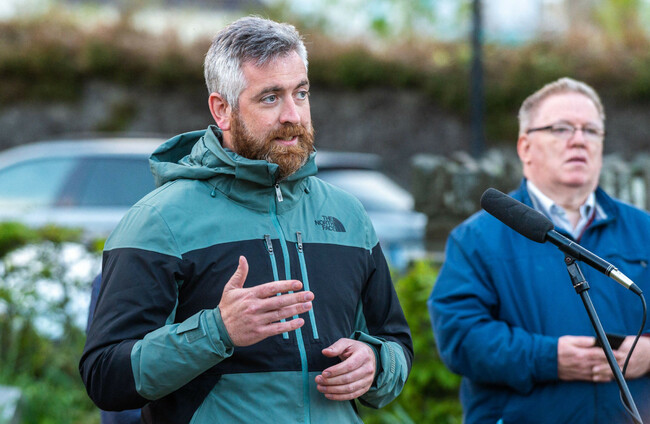
Minister of State Christopher O'Sullivan Alamy

Minister wants State to purchase land amounting to size of Killarney National Park every year

In an interview with The Journal, the Minister of State for Nature talks about how he plans to significantly grow Ireland’s nature reserves and pay farmers to be more sustainable.

NATURE AND BIODIVERSITY in Ireland are in crisis, but Christopher O’Sullivan has big ambitions for his time in office as the person with responsibility for making improvements in the area.

One of O’Sullivan’s big goals is to “significantly” expand the number of national parks and nature reserves owned by the State.

More generally, he wants to see the State take control of more private land as part of efforts to improve ecosystems and prevent further environmental degradation.

“The reason I say that is when the State owns land, like in the Killarney National Park or Connemara National Park, or Páirc Náisiúnta na Mara, we can control the activities within there. We can decide what measures we take without having to necessarily consult with private land owners,” the junior minister told The Journal.

“So we can make a real difference, like getting rid of invasive species like Rhododendron, managed grazing for breeding birds, growing nesting birds, predator control etc.”

Coillte, the semi-state forestry company, owns and manages 8% of Ireland’s land, while another 0.9% of the state’s land is protected through our national parks.

On the scale of purchases, O’Sullivan said: “I’d love to see us purchase in the region of 10,000 hectares a year.”

This would equate to growing State-managed land by one Killarney National Park every year. 

O’Sullivan was tight-lipped on what land the State is currently eyeing up to buy, but it is expected that it will build on recent high-profile purchases like the Conor Pass in County Kerry and the creation of Páirc Náisiúnta na Mara Ciarraí (Kerry Marine National Park).

Mission: Make people love nature

Given that O’Sullivan is known to be an avid bird watcher, nobody in Leinster House was surprised when Taoiseach Micheál Martin appointed the Fianna Fáil TD for Cork South–West as Minister of State with responsibility for Nature, Heritage and Biodiversity just over a year ago.

He entered the brief at a time when the public’s interest in nature and biodiversity was at a low ebb. The Greens had been given a hammering in the general election, losing 11 out of 12 Dáil seats, and internationally, climate change and biodiversity were low down the list of governmental priorities. 

A year on, little has changed. Polling continues to show that climate change does not feature high on the list of voter priorities, while nature and biodiversity don’t even get a mention.

During an interview with The Journal, O’Sullivan explains how he is trying to change that.

“One of the biggest challenges that I have as minister is to ensure that nature isn’t seen as an impediment to things. Whether it’s a flood scheme, whether it’s a much-needed piece of old infrastructure, unfortunately, the finger is often pointed at nature and biodiversity when it comes to this.

“People aren’t as inclined to care about nature, so we have to really be sensitive in how we do this.

“What I want to do is create an environment in Ireland where more people can get out into nature, so more people can appreciate nature.

“The more people who appreciate nature, the more people who love nature, and the more people who love nature, the more people who want to protect it. It’s very, very straightforward,” O’Sullivan said. 

He favours this approach over introducing a constitutional protection for nature, an idea that was proposed by the 2023 Citizens’ Assembly on biodiversity loss.

“What you don’t want to do is get people off side. Bring people with us. I think that’s the key challenge,” O’Sullivan said.

A report published by O’Sullivan’s department at the end of last year found that 90% of our habitats are in poor condition. It highlighted how over two-thirds are impacted by agricultural-related activities, particularly inappropriate grazing, drainage, and pollution.

It also pointed to water pollution as a result of agricultural activities. 

Asked how he marries this with the fact that his Cabinet colleague, Minister for Agriculture Martin Heydon, recently fought tooth and nail (and won) to keep Ireland’s nitrates derogation, O’Sullivan is loath to start a blame game.

“Well, from a European context, we still have among the best water quality in the world,” O’Sullivan said after it was put to him that water quality across Ireland is continuing to decline.

“I can see some bad results for biodiversity if we lose derogation, and that’s my personal view,” O’Sullivan said, arguing that losing the derogation would result in larger farms buying up land that may be suitable for biodiversity and habitats and turning it into grazing land for cattle. 

Bringing farmers on side

In a broad sense, O’Sullivan says his priority as junior minister is to make nature significantly better for species, including birds, mammals and insects, and to see habitats that have become degraded restored where possible, and to stop the further degradation of habitats.

On a more granular level, he wants to be the person responsible for delivering a national scheme that sees the Irish exchequer pay farmers and landowners to restore their land voluntarily. 

He envisions the scheme sitting on top of the one currently operated via the EU’s Common Agricultural Policy (CAP).

The sort of things farmers could be asked to do to receive payment from the scheme would be increasing woodlands, improving habitats for breeding birds, and even holding back water by not draining land in order to reduce pressure on rivers that may be overwhelmed by rainwater. 

O’Sullivan notes that the last point is all the more relevant given the recent flooding events parts of the country have experienced.

“With the Nature Restoration Plan being published in September and being developed at the moment, there could be an opportunity here to do that,” O’Sullivan said. 

Budget 2027

O’Sullivan is heading into the 2027 Budget negotiations with a significant list of asks for Minister for Public Expenditure Jack Chambers. 

First of all, he wants to scale up the Farm Plan Scheme that is operated by the National Parks and Wildlife Service and helps farmers with conservation and restoring habitats. 

Secondly, O’Sullivan wants to scale up staffing at the National Parks and Wildlife Service more generally. 

“The National Parks and Wildlife Service has been transformed by the previous minister, Malcolm Noonan. Its standing in Ireland has increased significantly because it has increased to about 550 staff in that time, from a very low base.

“But to deliver meaningful nature restoration in our national parks, to deliver amenities for people, to deliver trails, to administer plans like the one I’m talking about, we need extra staff,” the junior minister said. 

In an ideal world, he would like to see staffing at the agency grow to 1,000, although he acknowledges that this is a big ask for Budget 2027.

On how achievable his plans are, O’Sullivan is confident that he will get the support of the Government. 

“I would absolutely say that the greatest advocate we have for nature, from a political point of view in Ireland, isn’t me. It’s Micheál Martin. He’s unbelievably supportive of nature, unbelievably supportive,” O’Sullivan said. 

“I can tell you that certainly in terms of what I want to do and what I want to deliver, which is going to be ambitious, he is certainly the biggest advocate that I have, and that’s a fact like.

“Micheál would often send me pictures of species of insects and birds that he’s seen on his walks, because he does have a genuine interest,” O’Sullivan said. 

He added: “But it’s being pragmatic as well. It’s understanding that the country is striving to continue success from an economic point of view, but using the wealth that we’re generating to embark on proper nature restoration.

“And that’s what I want to do.” 

Readers like you are keeping these stories free for everyone...
A mix of advertising and supporting contributions helps keep paywalls away from valuable information like this article. Over 5,000 readers like you have already stepped up and support us with a monthly payment or a once-off donation.

Close
JournalTv
News in 60 seconds