We need your help now

Support from readers like you keeps The Journal open.

You are visiting us because we have something you value. Independent, unbiased news that tells the truth. Advertising revenue goes some way to support our mission, but this year it has not been enough.

If you've seen value in our reporting, please contribute what you can, so we can continue to produce accurate and meaningful journalism. For everyone who needs it.

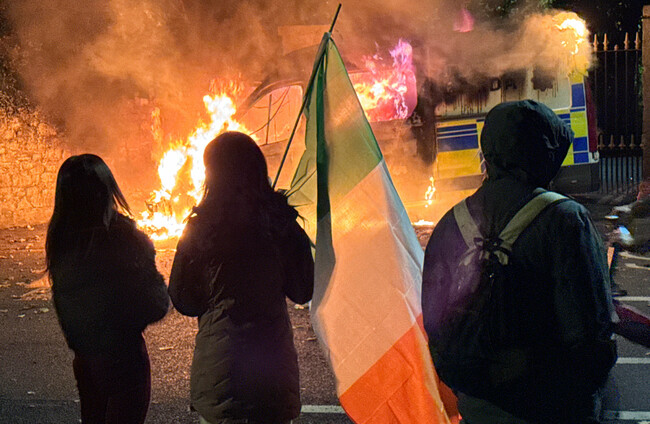
A Garda van burns outside the Citywest Hotel in west Dublin, after being set fire during a protest linked to the alleged sexual assault of a young girl in the area. Sasko Lazarov

How Citywest scenes are drawing the attention of far-right media and influencers

The hours-long standoff featured heavily in certain right-wing media from the UK and Canada.

THIS WEEK’S UNREST outside the Citywest hotel in Dublin which houses refugees and people seeking international protection has dominated domestic headlines – having resulted in 30 arrests and three injured gardaí – but it also drew attention from further afield.

The hours-long standoff on Tuesday night featured heavily across international media including on far-right platforms, where some of those taking part were described as “patriots” and the “fighting Irish” who were standing up against the “mass immigration cult”.

The unrest outside the west Dublin complex followed the alleged sexual assault of a young girl who was in state care by a 26-year-old man who has since been charged.

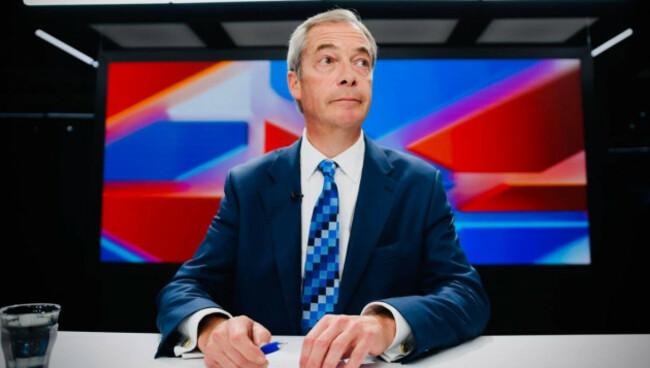
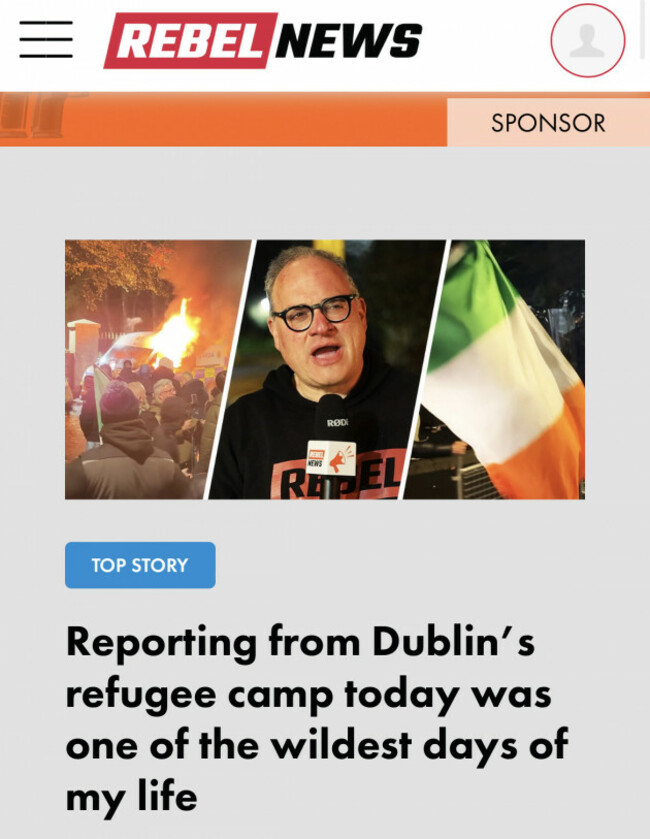
Reporters from the UK’s Nigel Farage-fronted GB News and Canadian outfit Rebel News were on the ground in Dublin to report on the demonstrations and how they would evolve over the course of Tuesday night, which appeared to have been considerably more organised when compared to Wednesday’s events.

Screenshot (332)

It should be noted that a number of the reports and dispatches carried on these outlets discussed elements of the background to the incident, which The Journal cannot repeat because of Irish laws. A criminal court process arising from the initial alleged incident is now under way, as a man has been charged.

While he did not attend, far-right activist Tommy Robinson also took an interest. He told his 1.7 million followers on X that reporters had arrived in Dublin from abroad to show “support” for the demonstration.

One video shared by a Canadian website, Rebel News, of the scenes showed an Irish-accented woman with a megaphone praising Robinson for his campaigning against migration. Robinson reshared this, adding that the site’s co-founder Ezra Levant had gone to Dublin “to show his support” for the protest.

It’s far from the first time Robinson has commented on Irish politics. He recently shared a news report about the controversy surrounding the staging of tricolours in Dublin, with a caption claiming that “for every flag taken down, 100 will go up, nobody can’t stop the patriotic wave”.

Another far-right figure who expressed support for the rioters on Tuesday was Austrian white nationalist Martin Sellner, who described the events as a “revolt”.

He reposted a video featuring Irish far-right activist and National Party member Keith Woods.

In that post, Sellner, who has been banned from entering a number of countries because of his extremism, wrote: “The Irish have had enough. This is what happens when states fail. Remigration now!” 

Remigration is a white nationalist policy that would see European countries ethnically cleansed of non-white people, regardless of their citizenship or legal status. 

Smaller livestreamers from the UK and Spain were also broadcasting from within the crowd on Tuesday night. One stream got approximately 90,000 views on YouTube.

According to Ciarán O’Connor of the Institute of Strategic Dialogue, these figures play a “key role in reinforcing that anti-migrant sentiment and using local events and transforming them into international events”.

“Ireland’s anti-migrant mobilisation is not only shaped by local figures on the ground but increasingly is amplified by networks in Britain and North America,” O’Connor told The Journal.

“We know that sensationalist content that is quite often created or intended to stir anger performs very well on social media.”

Rebel News’ Levant publicised his journey to Dublin, describing Citywest as “Ireland’s largest refugee camp”.

Posting to his 536,000 followers on X, Levant hailed the “fighting Irish” outside the hotel as an example of an “interesting and powerful people” who he hoped would turn back the tide on the “mass immigration cult”.

He added that he had previously visited other protests in Dublin and Co Tipperary, plus the UK and Netherlands, which he said had all brought him to view these countries as a “dystopian time machine” and what “life will be like in Canada in five years’ time if we don’t change course”.

IMG_0882 The riot in Citywest was the main story on the Rebel News website.

One subplot among the coverage from international figures is that Levant was apparently attacked by others involved in the demonstration.

Robinson said Levant had arrived to “show his support” only to become a “target himself and [get] knocked unconscious,” Robinson said.

There were posts on far-right social media channels, seen by The Journal, which celebrated the attack because Levant is Jewish.

GB News

Speaking to his studio from the scene on Tuesday night, GB News’s Northern Ireland correspondent Dougie Beattie told viewers that the issue of immigration had been “playing very, very heavily” ahead of this week’s presidential election in Ireland.

(It’s worth noting that recent polling from Ireland Thinks on the big issues for voters showed immigration (20%) as being significantly less important compared to housing (48%) and the cost of living (38%).)

Beattie’s colleague Nick Hadfield, who has covered similar protests in England, took to the scene last night, where he described those involved as “Irish patriots”.

Established four years ago, GB News counts Reform party leader Farage and former Tory Brexit minister Jacob Rees-Mogg among its presenter roster.

The free-to-air channel has a smaller audience compared to rivals but still records a share of the large UK market numbering 3.8 million.

In his broadcast, Beattie said there had been a “huge movement” in Ireland over the past three years against immigration, citing the housing of roughly 2,000 refugees and asylum seekers in the “beautiful” Citywest hotel as an example of a flashpoint.

There are around 1,200 Ukrainian refugees in the centre and approximately 460 international protection applicants.

On this, O’Connor from the Institute of Strategic Dialogue agreed that the anti-migrant movement had grown alongside the major increase in immigration to Ireland post-pandemic, coinciding with Russia’s invasion of Ukraine.

“While I don’t think that everyone at these widescale protests are far-right, I do think that the broader context is that those who went to protests were perhaps motivated or influenced by the kinds of content and narratives that have become so commonplace in social media over the last number of years.”

Response by gardaí to riot

Both Levant and Beattie alleged they had been pepper sprayed by gardaí amid the rioting.

In a broadcast shared on social media, Beattie – who pointed to his experience as a reporter covering similar scenes in Northern Ireland – questioned whether gardaí “do not want this story to get out”.

One Irish Times journalist who was at the scene said he had also been pepper sprayed but cited it as a “consequence” of covering an unfolding riot.

With reporting by Shane Raymond and David Mac Redmond

Readers like you are keeping these stories free for everyone...
A mix of advertising and supporting contributions helps keep paywalls away from valuable information like this article. Over 5,000 readers like you have already stepped up and support us with a monthly payment or a once-off donation.

Close
JournalTv
News in 60 seconds