Sign in. It’s quick, free and it’s up to you.
An account is an optional way to support the work we do. Find out more.
Sign in. It’s quick, free and it’s up to you.
An account is an optional way to support the work we do. Find out more.

In Calling 353, bestselling Motherfoclóir author and podcaster Darach Ó Séaghdha casts a linguistic eye on how we talk about what it means to be Irish, the signs we post to each other about Irishness – and what really lies beneath it all.
THE RECENTLY DECEASED author, criminal and politician Jeffrey Archer was a divil for a bit of shepherd’s pie. Like most authors, he was also a terrible pedant, and was very annoyed at the practice of making this dish with lamb.
Just as some people call hamburgers “beef burgers” because they don’t have ham in them, Archer felt the inclusion of mutton in a shepherd’s pie was based on a wilful misunderstanding; the pie was named after the restaurant in Westminster, not after actual shepherds.
There are mentions of “shepherd’s pie” in texts that predate the famous London eating-house, as well as the hotel of the same name in Cairo which is sometimes cited as the birthplace of this beloved pie. But that does not mean there is an unbroken continuity of pie-making and recipe-observing from the first pie called shepherd to the last one Archer scoffed before leaving us forever.
How could such a well-known and popular dish as shepherd’s pie maintain its credibility with such disagreement as to its main ingredient?
Well, it got me to thinking about another regional delicacy closer to home. As the nights get colder and the mornings greet us with frosty windows, the Dubliner’s mind naturally drifts to one thing. The simple stew that reminds them of their childhood, its distinctive smell as much a part of the city as the Poolbeg chimneys or the hawkers’ cries on Moore Street.
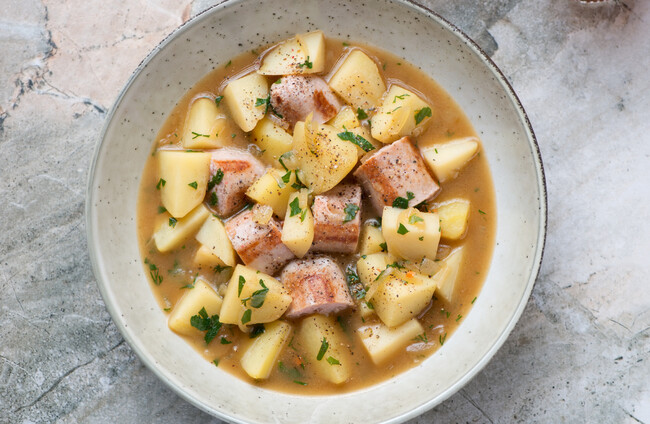
I am talking about coddle, Ireland’s answer to a cassoulet and Dublin’s signature dish.
The humble bowl of Liffey gumbo has enjoyed a certain notoriety over the past decade as its distinctive appearance has led to it becoming an internet personality in itself. Waterford may have its blaas and Clonakilty its black puddings, but it’s unlikely you know someone with those words muted on multiple social media apps. Furthermore, even if you had an impressively shaped blaa, the odds of it triggering an adult content warning on Instagram or Bluesky are low.
Not so the sausage soup that they sometimes call “the widow’s memory”.
With the same fast food franchises, culinary influencers and cookbooks available all over the world, and with supermarket supply chains making seasonality of fresh produce a moot point, the idea of a truly regional dish can feel like the stuff of history books sometimes. You can get a croissant in Carlow and miso soup in Monasterevin. But Dublin and coddle have stayed together like two sausages in a bowl.
The National Folklore Collection, digitalised at duchas.ie, features exhaustive records on Irish country life in its school’s collection. However, it contains no mention of coddle, supporting the view that this piece of Irish food heritage was hyper-localised in the capital.
How could an activity as basic as boiling sausages belong to any one place, especially a place as smug and annoying as Dublin? It’s an important question because looking into the cloudy liquid of a bowl of coddle can give us an insight into the very idea of food culture, the nature of community and the relationship between place and people.
What makes a dish national or regional – the recipe or the ingredients, or something else? Humour me while I put it to you that there are three ways to consider a piece of a community’s culture: Christmas trees, Christmas puddings and letters to Santa.
A Christmas tree is a part of a place’s culture and practice that is immediately recognisable even though the decorations on the branches can vary dramatically. Trad music can include a guitar or a tambourine and may not always include uileann pipes, but you can tell it’s trad straight away.
A Christmas pudding is a part of a culture with an exact recipe, prepared in a specific way: you wouldn’t stick chocolate or pomegranate in a plum pudding. But you can set it on fire and it is still a Christmas pudding; it endures. And maybe you want loads or maybe you only want a tiny bit but it’s still pudding. Things like set dancing and equestrian events fit the pudding model.
Finally, the “letter to Santa” cultural category is when a practice depends upon other people humouring you at their expense – like an Orange march or the Communion money shakedown.
Using this theory as a yardstick, coddle and the shepherd’s pie are both Christmas trees.
The culinary philosophy of coddle is best described with a phrase borrowed from Dublin’s greatest writer: scrupulous meanness. Using up any last scraps of food, wasting nothing: this is the guiding principle rather than a hundred grams of this and a cup of that. When times are good it might be made with a bottle of stout, in the day before payday the ratio of onion might be higher.
But the thing that defines it even more than the boiled sausages is the volume – you make coddle for a lot of people. There’s enough in the pot for an unexpected guest.
Maybe a person can make a small bowl of coddle just for themselves but they’d be like Kirsten Wiig in Bridesmaids making that very fancy cupcake just for herself. And she wasn’t in a great place when she did that.
I myself am a late convert to coddle – a few years ago I was flummoxed to find out that my daughter had been fed this in crèche one day and that she loved it. And while I still prefer my sausages in the air fryer, there is something to be said for a bowl of peppery comfort that seems to whisper, “come here to me”.
Darach will be back next Sunday with more thoughts on the words and Irish cultural phenomena that unite us.
To embed this post, copy the code below on your site













have your say