We need your help now

Support from readers like you keeps The Journal open.

You are visiting us because we have something you value. Independent, unbiased news that tells the truth. Advertising revenue goes some way to support our mission, but this year it has not been enough.

If you've seen value in our reporting, please contribute what you can, so we can continue to produce accurate and meaningful journalism. For everyone who needs it.

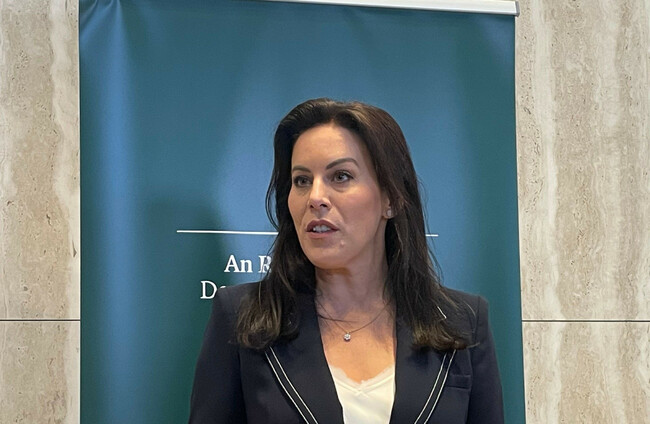
Health Minister Jennifer Carroll MacNeill said

Evacuation plans still unclear for Irish passengers aboard virus-stricken cruise ship, minister says

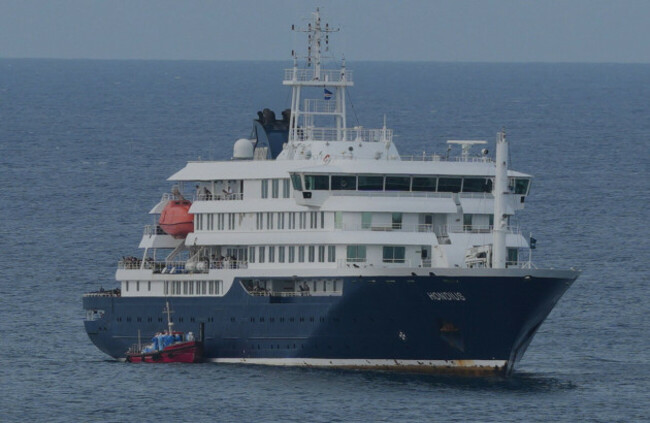
The fate of the MV Hondius has sparked international concern after three people travelling on the ship died after contracting the virus.

LAST UPDATE | 7 May

PLANS ARE STILL being worked out for two Irish passengers aboard the hantavirus-stricken MV Hondius, as international health authorities continue to monitor the outbreak linked to the cruise ship.

Three people travelling on the vessel have died after contracting the rare virus, prompting a major international public health response.

Speaking today, Health Minister Jennifer Carroll MacNeill said Irish authorities are still in the “gathering information stage” ahead of the ship’s expected arrival in Tenerife in the coming days.

“We’re working with the European Centre for Disease Control, there’s literally a meeting going on at the moment to think about how best we approach that clearly,” MacNeill told reporters.

“When the ship gets to Tenerife, passengers will be assessed as to what is their medical status. How are they? Are they symptomatic? Do they have any issues?”

“It is only then decisions will be made about where they would be transferred and what quarantine period would be necessary.”

Carroll MacNeill said the Irish passengers would undergo medical assessment once they arrive in Tenerife.

“The Irish people need to be assessed, medically assessed when they do get to Tenerife, and on foot of that, we’ll make the next set of decisions,” she added.

The ship has been at the centre of an international health scare since the World Health Organization (WHO) was informed on Saturday that three passengers had died and the suspected cause was hantavirus.

The version of the virus identified aboard the ship is understood to be the Andes strain, a rare variant capable of human-to-human transmission.

Despite concerns, health officials have stressed the outbreak is not expected to develop into a major epidemic.

Dr Abdirahman Mahamud, director at the alert and response coordination department of the WHO Emergencies Health Programme, said: “We don’t anticipate a large epidemic. With experience our member states have, and the actions they have taken, we believe that this will not lead to subsequent chain of transmission.”

It was revealed today that 30 passengers disembarked the ship on 24 April during a stopover on the remote island of St Helena in the Atlantic Ocean.

Emergency crews evacuated three people – two sick crew members and another person who had been in contact with one of the confirmed cases – from the ship yesterday.

hondius Alamy Stock Photo Alamy Stock Photo

It is now expected to arrive in the Canary Islands in the coming days, with the rest of the passengers to be evacuated from Monday, 11 May. 

The first confirmed case of hantavirus was not reported until 4 May.

The nationalities of two of the 30 are still unknown.

The Saint Helena government said there were currently “no suspected or confirmed cases of hantavirus on the island”, and the risk to the public remained low.

As a precautionary measure, the local health authorities are monitoring some individuals identified as higher-risk contacts – namely “those who had close, prolonged contact with the unwell passengers of the vessel”.

They have been advised to isolate at home, for a period of 45 days from the last known exposure to the virus. 

The British overseas territory of St Helena has a population of around 4,400 people. 

Former passengers isolating

Singapore’s Communicable Diseases Agency has said that two men aged 65 and 67 who had been on board the ship have been isolated as they await test results for hantavirus. Both arrived in Singapore in early May.

“One has a runny nose but is otherwise well, and the other is asymptomatic. The risk to the general public in Singapore is currently low,” the agency said.

Meanwhile, the Danish Patient Safety Authority also said a citizen who travelled on the ship is in self-quarantine. The person had returned to Denmark at the end of April.

The health authority said the person showed “no symptoms of illness” and the risk of them having contracted the virus was “low,” but it said it was in regular contact with the person and monitoring the situation.

Two people who returned to the UK from the ship have been advised to self-isolate, the UK Health Security Agency said, adding they were asymptomatic and the risk to the public was “very low”.

A plane believed to be carrying a sick passenger from the ship landed at Schiphol Airport in the Netherlands at 7.54am Irish time, according to an AFP reporter on the scene.

Officials in Spain, where the flight made an unexpected stop on Gran Canaria island, confirmed that the patient “had been transferred to Amsterdam on a different medicalised aircraft” than the one scheduled.

Low global risk: WHO

Experts confirmed the version of the virus detected aboard the Hondius was a rare strain known as the Andes virus, the only one that can be transmitted between humans.

The first person to have the virus on the ship could not have been infected during the cruise, given the one- to six-week incubation period, WHO expert Anais Legand told AFP.

The ship left Ushuaia, Argentina, on 1 April, and the first death occurred on 11 April. A Dutch man died on board and his wife, who left the ship to accompany his body to South Africa, died there 15 days later after also falling ill.

Argentine officials said the first couple who died had visited Chile, Uruguay and Argentina before the cruise.

They said experts would travel to Ushuaia to test rodents there for hantavirus.

The rare respiratory disease is usually spread from infected rodents, typically through urine, droppings and saliva.

With reporting from Eimer McAuley, Andrew Walsh and AFP.

Readers like you are keeping these stories free for everyone...
A mix of advertising and supporting contributions helps keep paywalls away from valuable information like this article. Over 5,000 readers like you have already stepped up and support us with a monthly payment or a once-off donation.

Close
78 Comments
This is YOUR comments community. Stay civil, stay constructive, stay on topic. Please familiarise yourself with our comments policy here before taking part.
Leave a Comment
    Submit a report
    Please help us understand how this comment violates our community guidelines.
    Thank you for the feedback
    Your feedback has been sent to our team for review.

    Leave a commentcancel

     
    JournalTv
    News in 60 seconds