Sign in. It’s quick, free and it’s up to you.
An account is an optional way to support the work we do. Find out more.
Sign in. It’s quick, free and it’s up to you.
An account is an optional way to support the work we do. Find out more.
BACK IN MAY, Twitter user @san_kaido posted this photo of daises, which according to Fukushima Diary was taken in Nasushiobara City.
Now the photo has gone viral around the world a few months later:
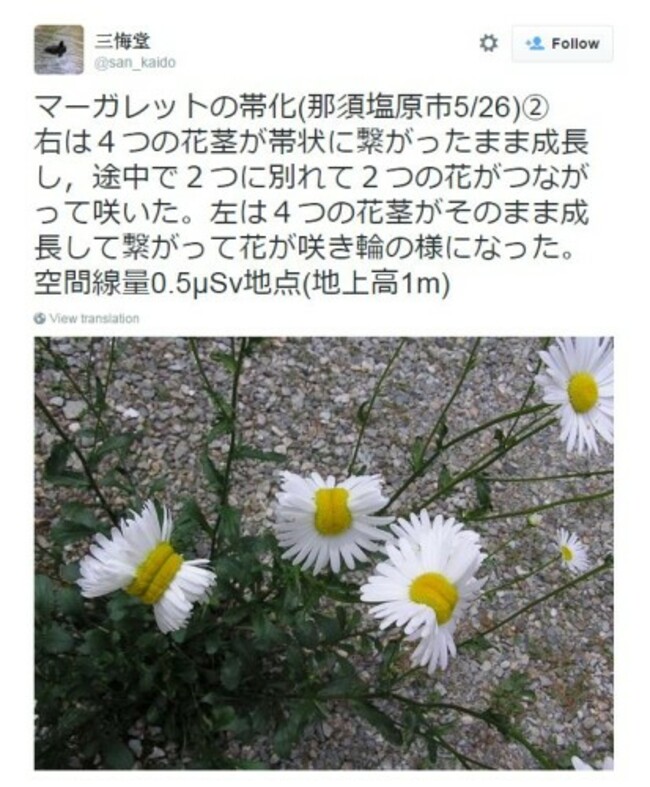
Nasushiobara City is in the Tochigi Prefecture, bordering Fukushima Prefecture.
In their tweet, San Kaido said “the atmospheric dose is 0.5 μSv/h at 1m above the ground”, referring to radiation in the area where the daisies were growing.
On 20 April 2011, an earthquake and tsunami that hit Japan damaged some of the reactors at the Fukushima Daiichi nuclear power station. Nasushiobara is about 110km away from the plant. The exclusion zone around the plant after the incident was 20km.
There is, of course, much speculation that the deformation in these daisies is due to the radiation from the Fukushima plant.
A robot sent into the nuclear plant earlier this year showed that radiation within the plant itself reached up to 10 sieverts an hour, which is a level fatal to humans.
Abormal growth in vascular plants (land plants that have vascular tissues which distribute water and minerals) is called fasciation, or cresting. It can be caused by a number of things, including hormonal, viral or environmental factors.
In September 2014, the World Nuclear Association said:
In September 2011, researchers at the Japan Atomic Energy Agency, Kyoto University and other institutes estimated that about 15 PBq of radioactivity (I-131 and Cs-137) had been released into the sea from late March through April, including substantial airborne fallout.
A leak was discovered in August 2013, and was rectified.

To embed this post, copy the code below on your site












have your say