Sign in. It’s quick, free and it’s up to you.
An account is an optional way to support the work we do. Find out more.
Sign in. It’s quick, free and it’s up to you.
An account is an optional way to support the work we do. Find out more.
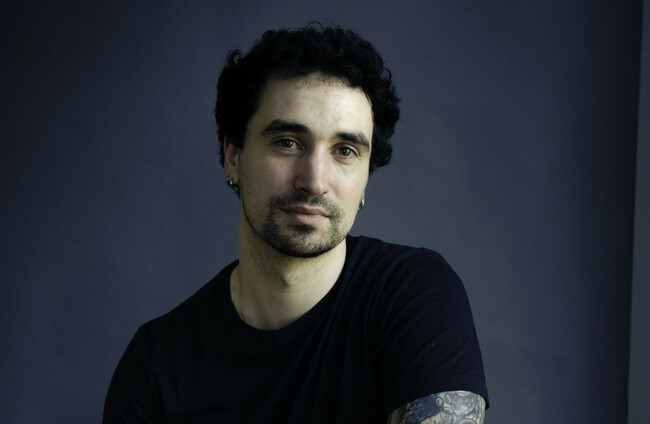
AT THE AGE of 28, Dublin author Djamel White is the youngest to make this year’s Booker Prize long list.
His debut novel All Them Dogs, published at the start of this year, earned one of the 13 spots on the long list for one of the world’s most prestigious literary awards.
It centres around the impulsive Tony Ward, who has returned to his home of Lucan in west Dublin after five years spent on the run from justice for his murder of a man in a gang feud.
Back home, Tony is taken under the wing of Darren ‘Flute’ Walsh, the right-hand man of major gang boss Aengus Lavelle. Together, the two act as enforcers, collecting drug debts and carrying out their boss’s wishes – all the while something brews between them.
But the gravity of their world of crime lands when Tony and Darren are tasked with killing a clumsy drug dealer.
The Booker panel described the novel as “a mouthy, ballsy and bracingly unsentimental portrait of West Dublin gangland, set well off the beaten track of the city’s usual literary landmarks”. White’s style of dialogue was labelled “racy and real”, and his use of description noted as “inventive and classically grounded”.
It’s high praise for any author, but as a debutant, it lends even more meaning.
The novel is set within White’s own locale. He spent his formative years in Co Cavan before he and his mother returned to live with his grandparents in his mother’s native Lucan when he was 17.
Reading and writing were always the things he was most drawn to, and All Them Dogs began its life as a short story written during the final year of his undergraduate degree.
As a short story, it wasn’t that short – it spanned 10,000 words, and “it was bursting at the seams already”, White told The Journal.
He entered into an MFA at University College Dublin with the story and spent the one-year programme developing it further, under the tutelage of his dissertation supervisor, the acclaimed author Anne Enright.
The submission of his dissertation left him with the first 50,000 words of a novel – “but it wasn’t the first 50,000 words of this novel”, he said. “I went back to square one and rewrote it over the course of six or seven months.”
When the novel was ready to be sent out to publishing houses, the first offer came within a week, and it ended up sparking a six-way auction. “It was a surprise,” White said. “That was an exciting time.”
Ultimately, the novel was acquired by John Murray Press, which published the work of literary greats Jane Austen, Arthur Conan Doyle and Lord Byron, among countless others.
Although the book was received well critically, White said it sold “modestly well in its first couple of weeks, and then like a lot of books, it sort of tapered off. It’s only now with the wind of the nomination – that’s a massive edge to have over the past few months.”
Submissions of novels to book awards is a formality, and White knew the book had been put forward for the Booker Prize, but he didn’t expect it to be handpicked by the panel as a contender for the best single work of sustained fiction written in English.
“I knew the book had been submitted to it, but that’s a meaningless thing to hang on to – that’s like buying a lottery ticket, essentially. It wasn’t something I expected.”
All Them Dogs is very much rooted in its west Dublin setting. The entirety of the novel plays out in the area’s housing estates, a boxing club, Tony’s Opel. There’s repeated trips on the M50 and visits to pubs and cafés in and around Lucan. A tattoo parlour and a chipper see schemes and fights.
“There was a particular kind of slice of the culture that I wanted to write about. I didn’t want to write about a deeply neglected or impoverished area. I was interested in it as this kind of urban area where there’s a lot of people from a lot of walks of life living in close proximity, because that experience growing up there and being from there,” White explained.
“Also, I thought it made things more interesting for Tony because circumstances aren’t as cut and dry as you might assume a character in the role he occupies would be. It doesn’t snap to the most immediate life victim of circumstances.
“There’s a little bit more nuance there, that yes, okay, he is of the environment and things that have happened to him throughout his life, but it becomes less of a social novel.”
There’s also the language keeping it in its setting: the dialogue is intensely colloquial without being incomprehensible. ‘Do you’ is written phonetically as ‘jih’, girlfriends are referred to as ‘mots’.
Did White fear that this would put off readers or publishers?
“Not at all,” he said. “I think you lose a lot if you try to take that out. There’s a balance: you don’t want it to come across as completely alien on the page.”
On whether there was any concern the intensity of the setting and language could perhaps make the novel less comprehensible for readers with no connection to Ireland, he exhaled.
“What can I do about that, you know? I knew there’d be people that would get it. It’s the book I wanted to write. If I was trying to write a book for everyone, frankly I would write a shit book.”
The vividness of setting is perhaps the most remarked upon element of the novel by critics, closely followed by characterisation. No single character is without duality; there are no ‘good’ and ‘bad’ people (although some are undeniably more sympathetic than others).
White said he doesn’t see himself as being confined by genre or setting. “At the moment I’m interested in relationships and families, and I think a good book in one way or another is about relationships – and the settings for that will be variable to change.”
On his future plans, he said he is now working on another novel, although he opted not to disclose any information on this. “I think so much of it is liable to change. We’re nearly at the moment to really see what it’s going to be.”
Would he ever revisit the world of All Them Dogs?
“I’ve certainly considered it. There’s a lot of characters in this book that I’d like to return to.”
The Booker Prize short list will be unveiled on 22 September, and the winner on 9 November.

To embed this post, copy the code below on your site















have your say