Sign in. It’s quick, free and it’s up to you.
An account is an optional way to support the work we do. Find out more.
Sign in. It’s quick, free and it’s up to you.
An account is an optional way to support the work we do. Find out more.
Updated, 14.50
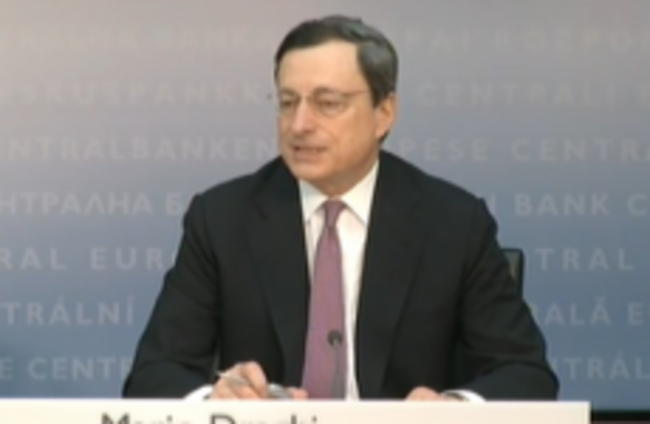
THE PROSPECT of a restructure of the promissory notes of Anglo Irish Bank was not discussed at this month’s meeting of the ECB governing council, the bank’s president Mario Draghi has said.
At a press conference in Frankfurt this afternoon, Draghi said the matter of the Anglo notes – which are owed by the bank to the Irish Central Bank – was “under study”, but was not part of discussions at the governing council.
It had been speculated that the governor of the Central Bank of Ireland, Patrick Honohan, would raise the issue at the monthly meeting.
“We are actually looking at this operation right now,” Draghi said. “The ECB staff is actually examining it.”
The news that the notes were not discussed means it is less likely that there will be a deal to restructure the notes before the end of the month, and that the State will have to proceed with the first €3.1 billion repayment before a deal could be struck.
Draghi also said he was “confident” that Ireland would vote Yes in the referendum on the European fiscal compact treaty.
The Italian said that the Irish government had made good progress under the terms of the EU-IMF bailout, and that the “government effort and performance in Ireland had been very very serious”.
Asked how he would react if Ireland voted ‘No’, Draghi said the compact was “a fundamental piece of our union now – it’s one of our pillars of trust”, and that he did not want to consider the possibility of Ireland rejecting it.
Although there were “certain fragilities that need to be taken care of, the vast experience in a sense is reassuring, in terms of delivery,” the Italian said.
The press conference came after the meeting decided to leave the main ECB interest rate unchanged at 1 per cent for the third month in succession.
Draghi had earlier told reporters that there were “signs of a stabilisation in economic activity” within the eurozone, “albeit still at a low level” – but reduced the ECB’s expectations of euro area growth in 2013.
The central bank now expects growth of between 0 and 2.2 per cent, rather than 0.3 to 2.3 per cent.
Draghi also described the issue of over €1 trillion in long-term loans to the eurozone banking sector, in an attempt to increase the flow of credit to the bloc’s businesses and consumers, as “an unquestionable success”.

To embed this post, copy the code below on your site












have your say