We need your help now

Support from readers like you keeps The Journal open.

You are visiting us because we have something you value. Independent, unbiased news that tells the truth. Advertising revenue goes some way to support our mission, but this year it has not been enough.

If you've seen value in our reporting, please contribute what you can, so we can continue to produce accurate and meaningful journalism. For everyone who needs it.

Beware talk of Dublin's office market recovery, multi-million price drops show it isn't here yet

With vacancy rates hitting 18.6%, the Central Bank warns the capital’s office market could face a “severe” slump until at least 2027.

DUBLIN’S OFFICE MARKET has been at a low ebb for years.

After Covid forced a major chunk of employees to work from home, vacancy rates for commercial real estate rose significantly, with a knock-on impact on valuations.

In 2019, just before the pandemic, the office vacancy rate in the capital was somewhere around 5%.

It is essentially impossible to be at 0%. There will always be some space with companies finishing up leases, businesses closing, and so on. This means that a rate of about 5% is essentially considered to be ‘full occupancy’.

This all means that, pre-Covid, the Dublin office market was going gangbusters. Prices for prime spaces surged, alongside valuations, amid strong demand. Grade-A office rents roughly doubled between 2013 and 2019.

But things are quite different now.

Figures recently published by the Central Bank found that the office vacancy rate in the capital stood at 18.6% as of the end of 2024.

It said this is “well above” the historic average of 13.7%, and also higher than in many European cities, such as Warsaw, Copenhagen and Stockholm.

The organisation predicts that the rate will likely rise “marginally” to just over 19% in 2026, before falling back below the end of 2024 levels by the end of 2027.

But even as the market still seems slow, there are plenty who have already said that a recovery has started.

See examples herehere and here

These tend to be mostly property agents, who have consistently said that the market has shown signs of green shoots.

The likes of Savills called it as soon as March 2025, predicting “sharp” drops in some city centre vacancy rates by the end of 2025 due to a “surge” in demand for premium commercial real estate.

However, the Central Bank figures indicate that this is yet to materialise. So what’s going on?

Estate agents

The first instinct might be to just dismiss entirely what estate agents are saying.

After all, they are trying to rent out offices. This means they have a vested interest in saying that demand is high and space is tight.

If the opposite is true – low demand and lots of available space – customers will want to pay less, therefore estate agents will get paid less.

However, things aren’t quite so simple, because estate agents are likely among the best sources of data we have.

The vacancy rate for residential property is tracked by the CSO. This has two clear benefits:

  1. The CSO is independent and does not have an incentive to under or overstate vacancy rate.
  2. The CSO is the state body when it comes to tracking figures, meaning it has much better resources and access to data than any one private company.

Unfortunately, the CSO only tracks the residential vacancy rate, not the commercial one.

This means that the information reported by real estate agents is often used as a guide to estimate what’s happening in the market.

This is best illustrated by the fact that the figures published by the Central Bank, which we talked about earlier, were not actually gathered by that organisation.

In fact, the estimate of the vacancy rate standing at 18.6% at the end of 2024 comes from CBRE, one of the country’s biggest real estate firms.

The same company recently said that the rate stood at “just below 16%” at the end of 2025. It also said that it has “fallen every quarter since Q1 2025” and made the same point as Savills about space being much tighter in prime city centre locations.

However, while the Central Bank used CBRE’s estimate for the vacancy rate at the end of 2024, that was just one of several sources it used.

The regulator did mention that in a “benign” scenario, the Dublin office market may have already hit a bottom and could drop to 14% by late 2027.

However, it also warned that in a more “severe” than expected situation, the office vacancy rate could rise above 22% in 2027 – almost the same level reached during the dark years of the financial crisis.

The Central Bank also pointed out that Dublin “has experienced one of the more significant slowdowns in Europe” for commercial real estate.

This has been driven by a few factors, including:

  • The growth of working from home. Ireland has one of the highest levels of remote working in Europe.
  • A slowdown in the tech sector, as these companies were the principal customers for high-end offices pre-2020
  • A large chunk of new supply coming onto the market in recent years. Real estate agents estimate that Dublin’s total office stock only rose by about 2% per year pre-Covid. Again, this comes from estate agents, so apply the usual scepticism. They also report that many new developments came through post-Covid, contributing more supply at a time when demand was softening due to remote work and the tech slowdown.

Rent prices

Many landlords have managed to avoid dropping headline rent prices by offering tenants rent-free periods, or covering fit out costs.

However, they are still taking a big hit on valuations, which are down by more than 30% from their pre-Covid peak.

This has been clear to see, with multiple dramatic individual examples.

These include the Beckett Building in the capital’s north docklands, which was bought for €101m in 2018. It was put up for sale with a price of €35m in 2024, a 65% price drop. But even this proved to be too much, as it was finally sold for €25m in April 2025 – around the time when some estate agents were pointing towards a recovery.

There are multiple other buildings which have traded hands at steep discounts, such as another docklands development which was bought for €106m in 2018, sold for €50m in November 2025.

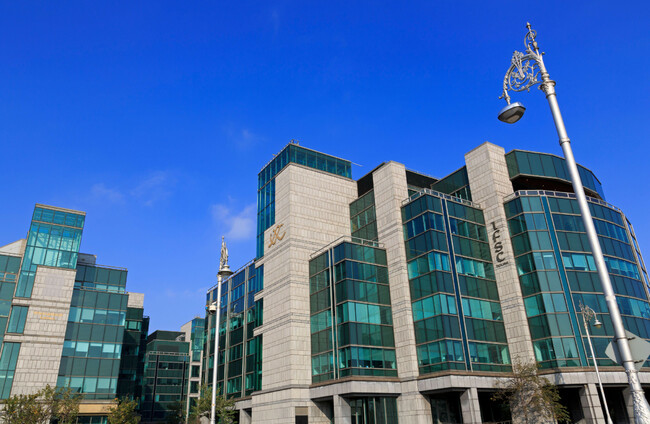
Or a building in the IFSC once valued at over €100m put up for sale for half of that.

The scale of the price drops, and the relative recentness of many of these deals, points to a market which is still facing problems.

There is a debate to be had about which way things will go, and it is possible that we’re in the very early stages of a comeback.

But landlords still face structural problems, such as a sizeable chunk of the population working remotely on a long-term basis.

While valuations remain soft and there is uncertainty whether vacancies have yet peaked, it seems a bit early to be calling a recovery.

Readers like you are keeping these stories free for everyone...
A mix of advertising and supporting contributions helps keep paywalls away from valuable information like this article. Over 5,000 readers like you have already stepped up and support us with a monthly payment or a once-off donation.

Close
16 Comments
This is YOUR comments community. Stay civil, stay constructive, stay on topic. Please familiarise yourself with our comments policy here before taking part.
Leave a Comment
    Submit a report
    Please help us understand how this comment violates our community guidelines.
    Thank you for the feedback
    Your feedback has been sent to our team for review.

    Leave a commentcancel

     
    JournalTv
    News in 60 seconds