Sign in. It’s quick, free and it’s up to you.
An account is an optional way to support the work we do. Find out more.
Sign in. It’s quick, free and it’s up to you.
An account is an optional way to support the work we do. Find out more.
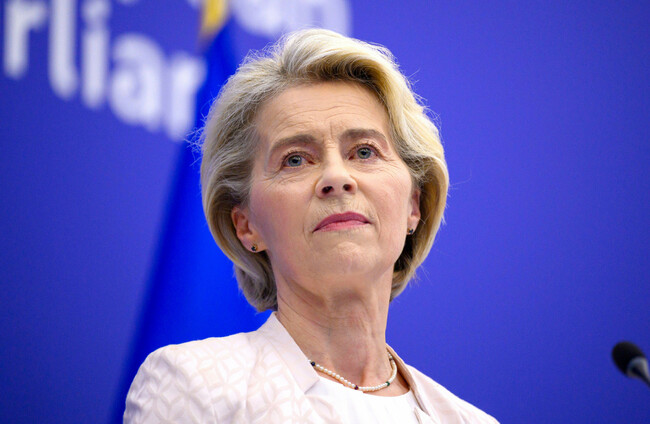
THE EUROPEAN UNION will have soon have a Commissioner with a direct responsibility for the defence of its member states in the new legislative term, the Commission President Ursula von der Leyen has confirmed.
In her first speech since successfully securing a second term at the highest position in the EU, the German politician outlined the many lessons Europe has learnt since the Russian invasion of Ukraine in 2022.
Adapting to those lessons was at the forefront of von der Leyen’s 20-minute speech this afternoon at the GlobSec Security Conference in Prague, where the former defence minister laid out that EU member states needed to do more to defend themselves.
“Protecting Europe is, first and foremost, Europe’s duty. And while Nato must remain the centre of our defence, we need a much-stronger European pillar,” the Commission President said.
The move has been a point of contention between EU member states and neutral Ireland in the past, with half of voters previously indicating to The Journal that they would not be in favour of increased militarisation in the bloc.
No such plans exist to create a so-called ‘EU army’, but a dedicated Commissioner would be in charge of developing directives and regulations which would seek to increase the security of the Union’s external boundaries.
Von der Leyen said that while European countries have increased defence spending and weapons manufacturing, and cut “red tape” around such activities in the wake of the war in Ukraine, it has not been enough, in her view.
“We must have in mind a systemic overhaul of Europe’s defence. And this is why I will appoint a full-fledged Defence Commissioner in the next Commission. This is Europe’s strategic responsibility,” she added.
The second half of the decade will be high-risk.
— Ursula von der Leyen (@vonderleyen) August 30, 2024
We Europeans must be on guard.
We must think about our Union as, intrinsically, a security project.
Where Central Europe has a crucial role to play ↓ https://t.co/m3LndLHjkN
Speaking in Strasbourg last month, the Commission President also vowed to create a “Union of defence”.
This scheme would include strategic plans to defend European air space and also would promise to double the staff in Europol, triple European border security teams and enlarge their mandates.
Defending EU member states has been on the Commission’s agenda for over two years, since Russia invaded the sovereign territory of Ukraine and the introduction of a Defence Commissioner during this legislative term has long been rumoured in Brussels.
Today, von der Leyen argued the EU needed to adapt to the times and re-think the ways it conducts itself and thinks of defence.
She said that the rest of Europe “should’ve listened” to eastern member states’ warnings over Russian aggression before the 2022 invasion in Ukraine, indicating more should’ve been done in the aftermath of the 2014 Russian annexation of Crimea.
Many peace advocacy groups, such as Amnesty International, have argued this very point over the last decade. Amnesty has since said that any justice for Ukraine after the invasion is defeated should also hold Russia accountable for their actions in 2014.
Von der Leyen suggested that the muted response at the time was because western European countries relied on Russian gas and other foreign resources, which has since changed after the full-scale invasion of Ukraine.
“For decades, many said that economic interdependence was the ultimate source of security. And we all know that Europe was buying Russian gas and this was supposed to be the ‘guarantee’ that Moscow would never start a new war on the old continent.
“This was an illusion. Putin has traded his country’s prosperity for his own imperial ambitions. And our own dependency on Russia, has become an asset in Putin’s hands. What was believed to be a source of security, was in fact a source of vulnerability.”
This has since changed, she said, and appointing a European Defence Commissioner, who could assess such ‘illusions’ in the future, is key to ensure that the security of the EU remains the top priority for member states.

To embed this post, copy the code below on your site









have your say