We need your help now

Support from readers like you keeps The Journal open.

You are visiting us because we have something you value. Independent, unbiased news that tells the truth. Advertising revenue goes some way to support our mission, but this year it has not been enough.

If you've seen value in our reporting, please contribute what you can, so we can continue to produce accurate and meaningful journalism. For everyone who needs it.

'Security not war': How quickly can Europe move on its ambitious new defence plan?

Movement has been swift so far by EU standards but it’s likely any plan will be slow to put into progress.

‘SWIFT DELIVERIES’ and multiple mentions of ‘speed’ and moving quickly.

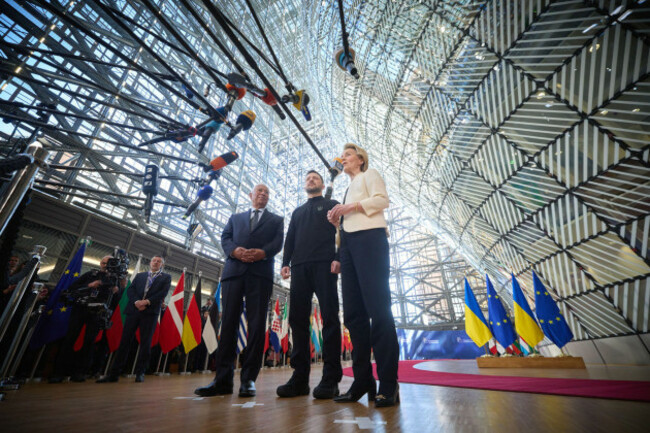
Europe means business when it comes to its shift on defence spending – and with their urgent language, that was the message EU chiefs Ursula von der Leyen and Antonio Costa wanted to make clear as they spoke to reporters late on Thursday.

The leaders of the EU’s 27 member states had given their green light to the plan hours earlier, as they met for their summit at the Europa Building in Brussels.

Von der Leyen had announced plans to unlock €800 billion for defence spending in advance of Thursday’s gathering in response to the growing threat from Russia, as the US under Donald Trump steps away from its traditional role as Europe’s security backup plan.

The summit itself was organised late last month after those initial Trump-Putin talks on the Ukraine War, but everything – the defence plan, the summit, the planned sideline meetings with Volodymyr Zelenskyy – took on a greater urgency in the wake of last week’s Oval Office blowup between Trump and Zelenskyy and the US decisions to end military and intelligence support for Ukraine.

As tends to happen at times of crisis, there was an intense media spotlight on this week’s meeting of EU leaders.

But what happens next? Does this really represent a ‘turning of a page’ on defence, as one senior official put it ahead of the summit. Or was it just an expensive photo-op – a chance to issue strong statements and pose for the cameras alongside Ukraine’s popular wartime leader?

european-council-president-antonio-costa-ukraines-president-volodymyr-zelenskyy-and-european-commission-president-ursula-von-der-leyen-speak-to-press-at-european-union-headquarters-in-brussels-belg Volodymyr Zelenskyy flanked by EU chiefs Antonio Costa and Ursula von der Leyen at this week's summit. Alamy Stock Photo Alamy Stock Photo

The leaders

We’ll get to the next steps in a second – but first, maybe it would be helpful to take a step back and remind ourselves which ‘bits’ of the EU have been involved in this week’s drama and how they interact.

First of all – the summit itself.

What happened on Thursday was a meeting of the European Council – the leaders of the 27 member states (Macron, Meloni, Scholz, Martin and co) along with Costa, who’s President of the European Council.

Scheduled meetings of this group typically happen four times a year, but special meetings can also be called in response to particular crises (Brexit, Covid etc).

This week’s summit was called to specifically address the issues of Ukraine and European defence.

As an institution, the group of leaders on the European Council set the general direction of the EU – so statements like the one issued on Thursday night act as a guide on what to prioritise, and how to progress big ideas.

Von der Leyen is the President of the European Commission, which drafts laws, directives and regulations on the back of the agenda set at these European Council meetings.

The heads of the two arms of the EU – Costa and von der Leyen – remarked in their late night press conference that they were reassured at how swiftly the defence plan was being progressed.

“A month ago, we had a strategic brainstorming session,” Costa told reporters. “Today, we are delivering.”

The EU, he said, was ready to put its money where its mouth was.

Covid-style plan

In terms of the money being put up – while €800 billion is the headline figure of cash that could be made available, there are multiple different facets to the plan, including loans worth €150 billion specifically to be spent on defence.

Comparisons have been made to the multi-billion euro “once in a generation” fund the EU launched as part of its Covid recovery plan.

John O’Brennan, a lecturer in European politics at NUI Maynooth, described the urgent progress on defence as a hugely important move for the EU – one, he said, of “genuine epochal significance”.

“In historical terms the reason this really matters is that the EU is now about to pivot, I think, from being a so-called soft power to a hard power. In other words, von der Leyen and European leaders are convinced that they need to develop a European army and all the attendant architecture to support that.”

Movement, he reckons, will be very quick. 

“Remember that the model here is more or less a coalition of the willing, and that means that member states can opt in according to their needs.”

Neutral states like Ireland won’t be press-ganged into taking part, he said – but bigger countries and those at most threat from Russia, including Nordic and eastern states, are likely to jump at the chance to invest this cash in their militaries.

“We could end up with a completely independent European force – and that will mean a European army in the years to come, of up to 300,000 troops stationed largely in central and Eastern Europe.”

Europe’s leaders may have moved quickly by EU standards in recent weeks – but Donnacha Ó Beacháin, a professor of politics at Dublin City University, warned that it will take “many years to reverse decades of neglect in the spheres of defence and security” by EU countries. 

“The Russians know that any plan will be slow to put into practice and is therefore unlikely to shape the direction of its war in Ukraine in the immediate future.”

He added: “A Ukrainian friend of mine wrote yesterday that when they hear again and again that Ukraine is a wake-up call for Europe the only picture they see is of a sleeping person who has already five times postponed the alarm and keeps pressing the dismiss button.”

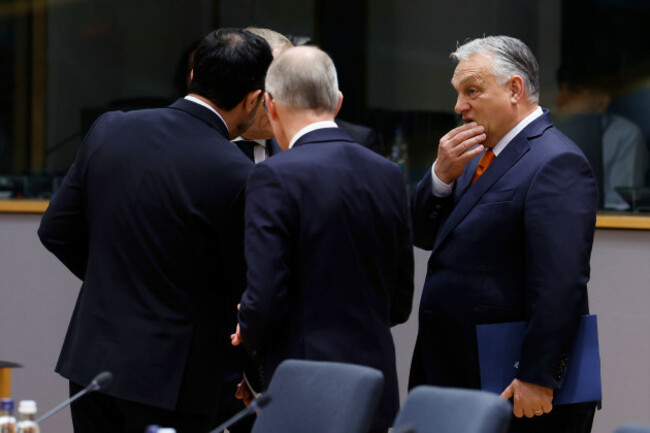
hungarys-prime-minister-viktor-orban-right-during-a-round-table-meeting-at-an-eu-summit-in-brussels-thursday-march-6-2025-ap-photogeert-vanden-wijngaert Hungary's Prime Minister Viktor Orban (right) with Portugal's Prime Minister Luis Montenegro and Poland's Donald Tusk. Orban refused to sign a separate EU statement on support for Ukraine, but was part of the 27 backing the plan to boost defence spending. Alamy Stock Photo Alamy Stock Photo

Nuclear umbrella

As the EU moves ahead with its plans, individual leaders have been taking their own decisive steps in the past week. 

French President Emmanuel Macron said ahead of the summit that he’d discuss extending France’s nuclear deterrent to other European nations.

In Brussels, that move was welcomed by a number of leaders, with Denmark’s Prime Minister Mette Frederiksen insisting “everything must be on the table now” and Poland’s Donald Tusk describing it as “very promising”.

Europe had no choice but to begin a new arms race, Tusk wrote on social media on Thursday as the summit began.

“Europe must be ready for this race, and Russia will lose it like the Soviet Union 40 years ago. From today, Europe will arm itself more wisely and faster than Russia.”

He went even further yesterday, telling Poland’s parliament the country “must pursue the most advanced capabilities, including nuclear and modern unconventional weapons”. The arms race, Tusk said, was about security, not war.

Amid all those stormclouds gathering more positive news for Zelenskyy and Ukraine emerged on Thursday night, just as the leaders at the summit were breaking for dinner, with the announcement that US and Ukrainian teams were to restart direct talks in Saudi Arabia next week.

It’s been a very long week in global politics.

We’ll know a lot more about the state of the world – and Europe’s place in it – by the time the 27 leaders meet again, in just 12 days’ time.

Readers like you are keeping these stories free for everyone...
A mix of advertising and supporting contributions helps keep paywalls away from valuable information like this article. Over 5,000 readers like you have already stepped up and support us with a monthly payment or a once-off donation.

Close
86 Comments
This is YOUR comments community. Stay civil, stay constructive, stay on topic. Please familiarise yourself with our comments policy here before taking part.
Leave a Comment
    Submit a report
    Please help us understand how this comment violates our community guidelines.
    Thank you for the feedback
    Your feedback has been sent to our team for review.

    Leave a commentcancel

     
    JournalTv
    News in 60 seconds