Sign in. It’s quick, free and it’s up to you.
An account is an optional way to support the work we do. Find out more.
Sign in. It’s quick, free and it’s up to you.
An account is an optional way to support the work we do. Find out more.
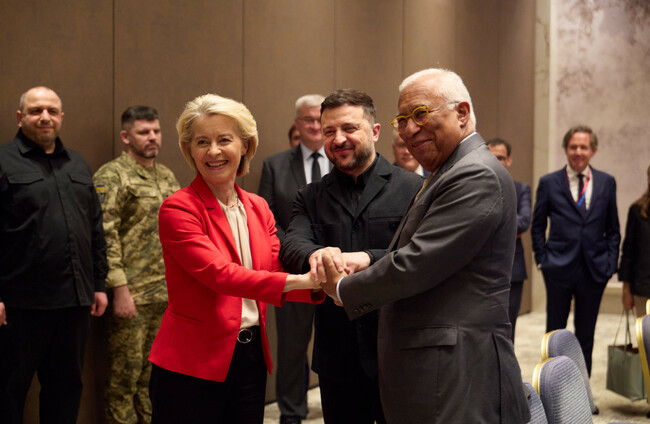
UKRAINIAN PRESIDENT VOLODYMYR Zelenskyy has landed to Ukraine as European leaders are to celebrate the long-awated green light given today for a 90-billion-euro loan for Kyiv.
After months of wrangling with Hungary, the final sign-off for the loan and a new package of EU sanctions on Russia boosted Zelenskyy as he touched down for talks with the bloc’s leaders in resort town Ayia Napa.
EU chief Ursula von der Leyen today welcomed the “good news”.
We have secured Ukraine’s financial resilience for two years. Together, we are doing everything to ensure that our state has sufficient funds for both defense and social needs. We discussed this today with Ursula von der Leyen @vonderleyen and António Costa @eucopresident. It is… pic.twitter.com/Dsi7XMbeKZ
— Volodymyr Zelenskyy / Володимир Зеленський (@ZelenskyyUa) April 23, 2026
“While Russia doubles down on its aggression, we are doubling down on our support to the brave Ukrainian nation enabling Ukraine to defend itself and putting pressure on Russia’s war economy,” she said on X.
Taoiseach Micheál Martin also “warmly” welcomed the unblocking of the loan, and said that it is “vital for Ukraine’s defence”.
“This sends a very serious signal; Europe is behind Ukraine for the long haul,” he added, speaking from Cyprus this evening.
Much to discuss in Cyprus.
— Micheál Martin (@MichealMartinTD) April 23, 2026
We warmly welcome the unblocking of the €90m EU loan for Ukraine.
It’s vital for Ukraine’s defence, and its energy infrastructure.
This sends a very serious signal; Europe is behind Ukraine for the long haul. pic.twitter.com/Jkl40vMbWJ
Zelenskyy hailed the move and urged the first tranche to be disbursed by May or June. He has previously said Ukraine wants to use the money to strengthen the country’s army and support “the domestic production of Ukrainian weapons”.
But he immediately put pressure on EU leaders to give Ukraine full, not “symbolic” membership of the European Union.
“We are defending common European values. I believe that we deserve full-fledged EU membership,” he told journalists, including from AFP, in a recorded voice message.
The 90-billion euros were blocked after a bitter row broke out between Hungary’s nationalist premier Viktor Orban and Zelenskyy.
Orban warned he would only lift his veto on the funds after Ukraine fixed a pipeline damaged by a Russian strike. Following its repair this week, oil flowed once more via the pipeline to Hungary and Slovakia.
Moscow ally Orban has frequently been a thorn in the EU’s side and officials hope decisions on Ukraine will now be made faster without his opposition, after a crushing election defeat to pro-EU opposition figure Peter Magyar this month.
Orban, who will only step down next month but will not attend meetings in Cyprus today and tomorrow – which will be informal – had been blocking Ukraine’s next step towards EU accession.
But even with him gone, there is reluctance among EU members to fast track Kyiv’s bid to join – prompting some to float the possibility of granting Ukraine a lesser status without full membership rights.
“There will be no enlargement for Ukraine in the foreseeable future,” a European diplomat told AFP.
A senior Ukrainian official said Zelenskyy would discuss with leaders “joint weapons production and security capabilities, the challenges posed by the war in Iran” and air defence for Ukraine.
The new round of economic punishment for the Kremlin the 20th by the EU since the war started – targets Russia’s energy, banking and trade sectors.
The measures included clamping down further on the so-called “shadow fleet” of ageing tankers that Moscow uses to dodge oil export restrictions, and curbs on Russian cryptocurrency traders.
During the two days of talks in Cyprus, which holds the rotating EU presidency, leaders will also discuss the Middle East war and its fallout, including skyrocketing energy prices.
Cyprus was sucked into the conflict in March after a drone strike on a British base on the Mediterranean island.
European leaders will be joined on Friday by their regional counterparts for what a senior EU official described as “intensive dialogue”.
Expected to join them are Lebanese President Joseph Aoun, Egyptian President Abdel Fattah al-Sisi, Syrian President Ahmed al-Sharaa, and Jordanian Crown Prince Hussein bin Abdullah.
During a working lunch, they will discuss the situation in Lebanon.
A key issue for Europe is the Strait of Hormuz whose effective closure has sent oil prices soaring and crimped supply of jet fuel in Europe.
The European Union’s 2028-2034 budget will also be discussed for the first time, with hopes of securing a final agreement by the end of 2026.
The EU executive wants a bigger budget worth around two trillion euros ($2.3 trillion) though national governments are reluctant to pay more.
That’s why despite the energy shocks, the EU has little wiggle room to spend more as it pays off Covid-era loans.
But as with anything related to money in the EU, France and Germany are diametrically opposed, with Paris calling for more European investment and Berlin arguing for fiscal restraint.
European officials fear that without a deal before France’s presidential election next year, there is a risk that a far-right leader could cut contributions to the EU by France, the bloc’s second-biggest economy.

To embed this post, copy the code below on your site







have your say