Sign in. It’s quick, free and it’s up to you.
An account is an optional way to support the work we do. Find out more.
Sign in. It’s quick, free and it’s up to you.
An account is an optional way to support the work we do. Find out more.

THE VOTING RULES for the Eurovision will be “majorly overhauled” after controversy regarding the public vote for Israel at this year’s Song Contest.
Among the changes is a limit to the number of times people can vote and the discouragement of “disproportionate promotion campaigns” by “governments or governmental agencies”.
The changes come after an Israeli government agency paid for adverts targeting this year’s Eurovision public vote.
Eurovision organisers hope these changes will be enough to persuade national broadcasters to participate in next year’s event in Austria and not go ahead with a planned vote on Israel’s participation.
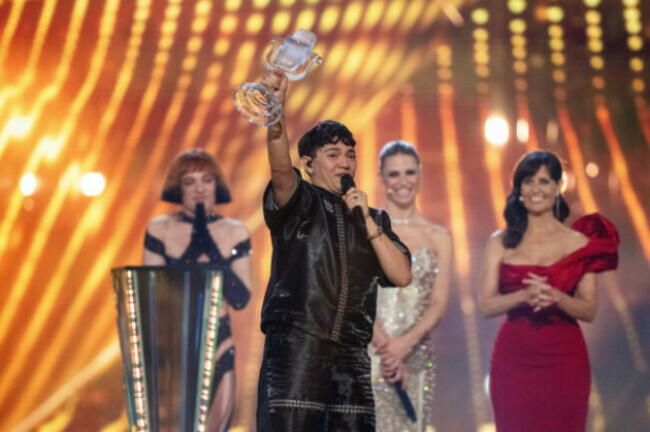
The Eurovision is organised by the European Broadcasting Union (EBU), which is essentially an alliance of public service broadcasters whose countries are within the European Broadcasting Area.
However, a number of national broadcasters, including RTÉ, said in September that it would not take part in next year’s competition if Israel was allowed to participate.
A vote is due to take place at the EBU’s General Assembly at the beginning of December around Israel’s participation in next year’s competition.
However, the EBU today said that members will be “asked to consider this package of measures and decide if they are sufficient to meet their concerns without having a vote on participation”.
After the General Assembly, the EBU will work to confirm participation in next year’s contest and reveal this list before Christmas.
In a statement to The Journal this morning, an RTÉ spokesperson remarked that “events in the Middle East are unfolding day by day”.
“As previously confirmed by the EBU, the issue of participation in the 2026 Eurovision Song Contest has been included on the agenda of the EBU General Assembly.”
In May, the director of the Eurovision said it would “look at the promotion of acts by their delegations” to ensure “such promotion is not disproportionately affecting” the audience voting.
It came after Eurovision News Spotlight, an independent news branch of the EBU, published a report which found that an Israeli government agency paid for adverts targeting the Eurovision public vote.
The agency placed advertisements across Google products, such as YouTube, and provided instructions on how to vote up to 20 times for the country’s representative.
While such promotion was permitted, concern was raised that this runs against the spirit of the contest.
Israel’s entrant, Yuval Raphael, received 297 public votes—the highest number of public votes for any act in the Grand Final.
However, Israel had ranked 14th after the jury vote and ended up coming second to Austria due to the public votes.
National broadcasters across Europe, including RTÉ, requested a breakdown in voting numbers as a result.
In a statement today, the EBU announced changes to the voting framework “to strengthen trust, transparency and audience engagement”.
Martin Green, Director of the Eurovision, remarked that “neutrality and integrity is of paramount importance” and that the updated rules aim to “protect the contest from attempts to unfairly influence the vote”.
While the new rules will allow for the “appropriate promotion of artists and their songs” it will “discourage disproportionate promotion campaigns… particularly when undertaken or supported by third parties, including governments or governmental agencies”.
Participating broadcasters and artists are not permitted to actively engage in, facilitate or contribute to promotional campaigns by third parties that could influence the voting outcome.
Meanwhile, the maximum number of votes per payment method (online, SMS and phone call) will be reduced from 20 to 10 and fans will be “actively encouraged to share their support across multiple entries”.
Elsewhere, the qualification system has been changed for the semi-final.
Last year, the public vote decided who would go on to compete in the final but the upcoming Song Contest will see the return of juries of music experts.
This will create a roughly 50/50 split between jury and audience votes in the semi-final, as is the case in the Grand Final.
It’s hoped this will ensure “musical balance and diversity in songs that qualify for the Grand Final”.
The number of jurors will also increase from five to seven.
The EBU has also committed to strengthening the monitoring of suspicious voting patterns to maintain trust in the results of the audience vote.
“While we are confident the 2025 Contest delivered a valid and robust result, these changes will help provide stronger safeguards and increase engagement so fans can be sure that every vote counts and every voice is heard,” said Green.
The 70th Eurovision Song Contest will be hosted at the Wiener Stadthalle, in Vienna, Austria, on Tuesday 12, Thursday 14 and Saturday 16 May.

To embed this post, copy the code below on your site














have your say