Sign in. It’s quick, free and it’s up to you.
An account is an optional way to support the work we do. Find out more.
Sign in. It’s quick, free and it’s up to you.
An account is an optional way to support the work we do. Find out more.
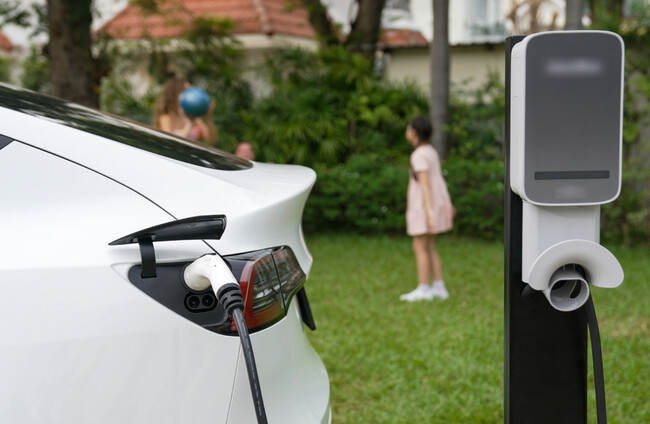
OFF THE BACK of a recent article we did about a shortage of parking in new housing estates, a reader got in touch with us to flag a similar problem.
Asel, a resident in Dublin 15, emailed us about the difficulties she was having trying to get an electric car charger installed.
Asel lives in an older estate in west Dublin, built in the early noughties.
Many of the homes, including hers, do not have driveways or designated parking spots.
Asel made the decision to switch to an electric car and assumed that the parking situation wouldn’t be that much of an impediment to charging her car.
She was wrong.
By the time she had reached out to us, she had already had numerous interactions with her estate’s management company; her landlord, the Approved Housing Body, Tuath; Fingal County Council; and a handful of her local TDs and councillors.
No one she contacted seemed to be able to give her a straight answer on whether it was legal for her to get a car charger installed for one of the communal parking spaces or not.
Having a charger in a communal space is no one’s favourite idea, but it is the reality for the many people who want to switch to an EV but live in housing estates or apartments with no designated parking.
Part of the problem is that no one has figured out how to navigate this.
In her initial email to us, Asel said that dealing with the local authority alone has been a “nightmare”.
In one response from Fingal County Council to a local councillor who enquired on Asel’s behalf, the Council’s planning unit said that, as things stand, only statutory bodies can lay cables under footpaths and that EV parking would need planning permission to ensure it does not introduce a “road safety hazard”.
They added that while building regulations cover the need for EV charging where parking is in-curtilage, there is “no provision or policy at this given time for EV parking on the roadside”.
A response given by Fingal Council to a different local politician who also put a query in on Asel’s behalf was that planning permission would be required to install a charger.
In this response, the Council said Asel would need to look into getting a Road Opening Licence and public liability insurance, as it would be a “private installation in a public parking space”.
Even if Asel were to be granted the planning permission, because it’s a communal space it’s not guaranteed that she would have access to the charger, but this is a risk she is willing to take to be able to avail of the reduced overnight charging rates.
She hit a further roadblock – one that seems to be the ultimate one – when the estate’s third-party management company agent told her she is not allowed to install a charger because the parking spots are not assigned to individual households.
Asel said the whole process has put her off switching to an electric vehicle.
“With the current price of fuel, switching to an EV [electric vehicle] would be an ideal scenario, but it is only an option for the rich,” she concluded her email.
Asel’s situation is a complicated one, but it isn’t unique.
Government policy is currently encouraging people to switch to EVs, with the latest Climate Action Plan setting a target of having 845,000 EVs on Irish roads by 2030 (30% of the private national fleet).
But for many people, even those who want to make the switch on environmental and/or economic grounds, doing so can be a painful process.
Brian Caulfield, professor of transportation at Trinity College Dublin’s School of Engineering, told The Journal that this is going to be a big problem unless the government takes action to simplify the process.
“It’s going to be a very big issue. Like when you look at the economics of owning an electric car, they really only stack up right now – even with the increased cost of petrol – if you have a driveway,” he said.
Caulfield said this is one of the biggest barriers to people making the switch.
“Many other countries are able to get around this; they do more innovative things in terms of on-kerb charging, where they use existing lamp posts that have an electricity supply, and there’s a couple of examples of those across [Dublin] city, but nowhere near enough,” he said.
Caulfield explained that two of the key motivations for people being able to charge at home are that it is a lot cheaper than public charging because people can avail of the reduced overnight rates, and that it is much more convenient for people.
“Even if you take cost out of it, overnight is when it’s the most efficient for the grid, and it’s most efficient in terms of our renewable energy systems.
“That’s when we tend to have a lot of wind energy that needs to be used, and if it’s not used, it’s wasted.”
In terms of how we remove this barrier for people like Asel, who want to make the switch but don’t have a private driveway, Caulfield said it comes down to better planning with far more communal charging spots.
He pointed to Center Parcs, the family holiday destination in Longford, as an unexpected example of somewhere that is doing things well.
“I was blown away by the volume of the electric car chargers that they have down there. But then, equally, if you want to charge overnight, you book a spot and you’re able to charge your car overnight. That’s the type of thing that we need in our communities,” Caulfield said.
In February, the Government published its draft National EV Charging Strategy for 2026-28.
In it, it recognises that as EV uptake grows in Ireland, home charging will remain the most common and convenient form of charging for most drivers and that special provisions will be needed for people with shared parking facilities.
The Department of Climate is working on the introduction of a solution for people with shared parking, using “private wires”, but that’s not currently up and running to help people like Asel who want to make the switch now.
It also recognises that alternatives are needed for people like Asel who cannot charge at home, but again, these are not yet a reality.
On how these issues can be resolved for people who are ready to make the switch now, Dublin West TD and Green Party leader Roderic O’Gorman said the Department of Transport and the Department of Housing need to issue clear guidance for local authorities.
“A large number of people are now accommodated through AHBs like Tuath, and they should get guidance in terms of what they should do and encouragement to say, ‘Yes, getting EVs on the road is a key part of meeting our climate targets, and we need to make it as easy as possible for people’.
“And people who are housed by the State in an AHB shouldn’t be denied the ability to benefit now from the increasingly cheap EVs, but also the much cheaper fuel rates than petrol or diesel,” O’Gorman said.
When we contacted Asel’s landlord, the AHB, Tuath, they told us that it was the housing estate’s owners’ management company that would be responsible for deciding whether a charger could be installed or not.
When we contacted the agent of the owners’ management company, Fischer Property, they told us that because the roads and footpaths in the estate have been taken in charge by the local authority, it would have to be involved in any decision-making regarding the installation of charging infrastructure.
However, when we contacted the local authority (Fingal County Council) they said:
“Permission would be required from the management company/owner, so assuming that the specific development is under Tuath and that would be the tenants first approach.”
Asel told us she has not been put off switching to an EV, but charging the car is going to be “a major headache”, with the nearest public charger 3km away.
She made the point that she is willing to pay for the charger with her own money and questioned how the Government expects to get to net zero carbon emissions when people who are trying to make sustainable choices are met with these kinds of stumbling blocks.
“It’s impossible,” Asel said.

To embed this post, copy the code below on your site













have your say